
Vandaag of morgen in huis

Kwaliteit gegarandeerd

Welkomstaanbiedingen ontgrendelen: GRATIS bezorging | Tot 80% korting | Gratis 30 dagen JoyPlus-proefperiode
Download de app
A steamer can do more than cook vegetables. With the right model, you can prepare rice, soup, baby food or a complete meal in several tiers. However, choosing one isn’t always straightforward. Products are often advertised as multifunctional, large or suitable for all hobs, while important details are left out.
So, look out for these three common pitfalls:
A stainless steel steamer is generally a practical choice for everyday use. Several models list 304 stainless steel, also known as food-grade stainless steel, in their product information. This material resists corrosion and is suitable for contact with food. However, this does not automatically prove that every product meets all the quality standards you may be looking for. Always check the full product information and safety details.
A stainless steel steamer without an interior coating has the advantage that you don’t need to maintain a non-stick layer. It’s best to use a soft sponge and avoid metal scouring pads. White marks or a rainbow-coloured film can appear due to minerals or overheating; these can often be removed with diluted vinegar.
A pan with a non-stick coating can be useful for porridge, rice or light dishes. Use wooden or plastic utensils. Never immerse the base of an electric model with a power connection in water.
For one or two people, a compact pan with a steamer insert of around 1.6 to 2.5 litres is often enough. A model with a steaming rack is useful if you want to heat soup, milk or porridge in the pan below while steaming vegetables, eggs or small rolls above.
For families, a steamer pan measuring 24 to 28 cm, a three-tier steamer or a multi-tier electric food steamer is a more practical choice. Don’t just consider the capacity in litres; check the diameter of the steaming tiers too. A wide tray is needed for dishes such as a whole fish or larger portions of vegetables.
Also check that the parts stack securely. A transparent lid lets you keep an eye on the cooking without letting steam escape every time you lift it.
A standard steamer only works on hobs that the manufacturer lists as compatible. A steamer for induction hobs will usually need a suitable layered base. Check that induction is specifically mentioned; don’t rely solely on the phrase ‘all hobs’.
For an electric food steamer, power, a timer, the water reservoir and automatic shut-off are all important considerations. A power rating of 800 watts is common for compact models. Larger appliances may use more power and produce steam more quickly, but they also need a stable position and a suitable socket.
Follow these basic safety rules with every model:
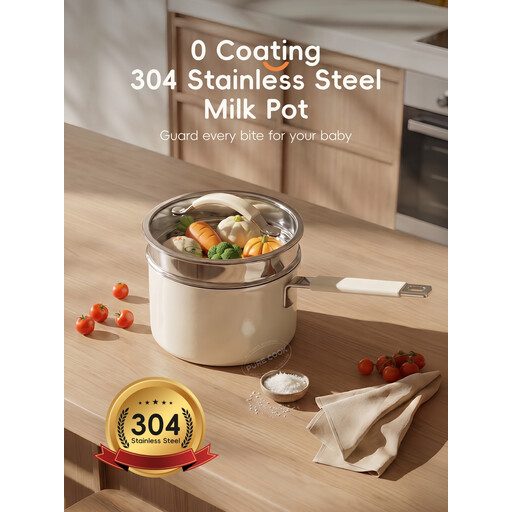
Why it suits this profile: With an 18 cm diameter and a capacity of 2,5 quart, it’s a good fit for small households, students and parents preparing milk, porridge or small portions of baby food.
The product description specifies 304 stainless steel, a steamer insert, a glass lid and compatibility with all hobs. This makes the material and intended uses clearer.
304 stainless steel interior with no chemical coating; according to the description, steaming and simmering can be done at the same time.

Why it suits this profile: This set combines a small milk pan with several saucepans. It’s a good choice for households that want to use one steamer insert for a variety of everyday dishes.
The set contents are clearly specified: 1,5, 2, 2,5 and 5 litres, with an 18 cm pan that includes a steamer insert. This lets you choose the right capacity for each dish.
Several sizes; according to the product information, suitable for gas, electric and induction hobs.
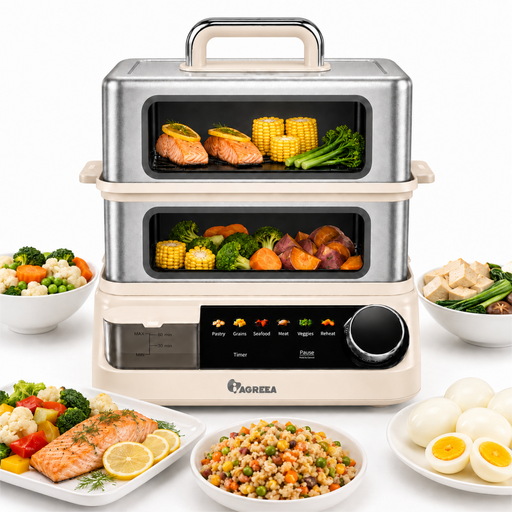
Why it suits this profile: Its two tiers and total capacity of 14 litres are designed for family meals and larger quantities of vegetables, fish, meat or side dishes.
The 2,5-litre external water tank and visible water level make it easier to top up and check than a reservoir that’s difficult to see.
Two stainless steel trays measuring 300 × 230 mm; six presets and a timer, according to the product description.
We’ve put together a complete, up-to-date list of products that meet these strict selection criteria and the applicable European safety regulations.
Even steam distribution is important when cooking vegetables. Put ingredients that need longer to cook at the bottom, and softer ingredients at the top. Cut them into roughly equal-sized pieces so they cook at a similar rate.
When steaming vegetables and preparing baby food, a well-fitting lid and easy-to-clean parts are useful. Use separate, clean utensils for baby food and follow the storage instructions for the ingredients. A steamer makes food easier to prepare, but it doesn’t replace general food safety guidance.
It depends on the model. Only choose a steamer that explicitly states it’s compatible with induction. A layered or reinforced base may be needed for effective heat transfer.
Let the pan cool first, then use warm water, mild washing-up liquid and a soft sponge. If needed, remove limescale or white marks with diluted vinegar, then rinse thoroughly. Check the product information before putting any parts in the dishwasher.
It depends on the power rating, cooking time and your energy tariff. An 800-watt appliance running for 30 minutes theoretically uses 0,4 kWh. Actual consumption may be lower or higher depending on the thermostat, amount of water and cooking time. Also bear in mind the difference between an electric food steamer and a pan used on an induction or gas hob.
