
Vandaag of morgen in huis

Kwaliteit gegarandeerd

Welkomstaanbiedingen ontgrendelen: GRATIS bezorging | Tot 80% korting | Gratis 30 dagen JoyPlus-proefperiode
Download de app
A steamer seems simple: water at the bottom, ingredients above it and a lid on top. Yet many households buy a model that is barely used after a few weeks. The problem is often not the steaming itself, but an incorrect assessment of capacity, hob compatibility, cleaning requirements or storage space.
A multi-tier steamer can be useful for a family, but it takes up considerable space both during use and in storage. For one or two people, a compact steamer or small electric cooking pot is often more practical. Do not look only at the stated capacity; also consider the diameter, height and cupboard space required.
Not every traditional pan works on induction. Check that it explicitly states that the pan is suitable for induction, gas, electric hobs and ceramic hobs. With an electric steamer, you should also check the mains voltage. Products offered for the European market generally specify a suitable connection, but always verify this on the product page.
A stainless steel steamer is generally fairly easy to clean by hand, but discolouration or white marks can occur due to heat, minerals or starch. With models featuring a non-stick coating, avoid metal utensils and abrasive sponges. Also check whether the components are dishwasher-safe. An electrical base must never be immersed in water.
Some new stainless steel pans may have residual polishing wax. According to Maxcook’s product information, it is recommended to boil the pan in hot water for a few minutes before first use and then wipe it down carefully.
For a household of one or two people, a capacity of approximately 1.6 to 2.5 litres may be sufficient. A family is more likely to benefit from 6 to 14 litres or several spacious tiers. A multi-tier steamer allows you to prepare vegetables, fish and rice at the same time, for example. Place ingredients with the longest cooking time at the bottom, where the steam enters first.
Bear in mind that the stated capacity sometimes refers to the total capacity rather than the usable space in each basket. With a rice cooker with a steaming basket, the steaming space is also often smaller than that of a freestanding food steamer.
304 stainless steel is often used for cookware because of its corrosion resistance and robust construction. The product description should clearly state which component is made from this material. Handles, for example, may be made from silicone or wood and will therefore require a different care routine.
For a steamer for induction hobs, a suitable magnetic base is required. According to the product description, a thickened composite base may be suitable for several types of hob. When using stainless steel, preferably use medium to low heat to help prevent overheating and discolouration.
An electric steamer is useful when you do not want to use a hob. Look out for:
According to Tefal’s product information, certain models have a timer of up to 60 minutes, automatic shut-off and a refill system. These are verifiable features; on their own, they say nothing about the taste or nutritional value of a meal.
Steaming can be a practical way to prepare healthy steamed meals, as little or no oil is required. According to information provided by some brands, steaming can help retain colour, texture and flavour. Treat this as a manufacturer’s description, not as a medical or nutritional guarantee.
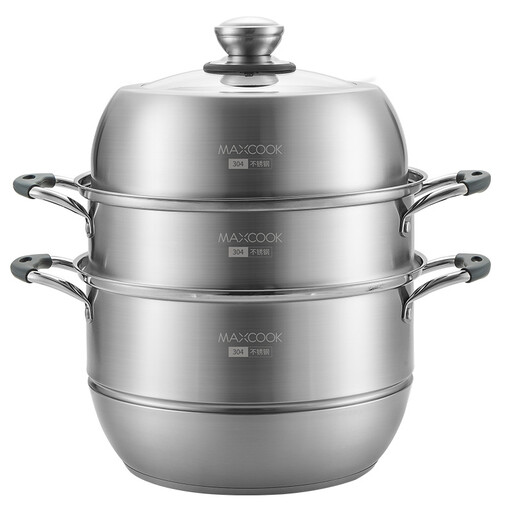
Why it suits this profile: A traditional solution without electric controls, suitable for households that already have a hob and want to steam several ingredients at once.
The product information states 304 stainless steel, three tiers and compatibility with induction, gas, electric and ceramic glass hobs. Hand washing is recommended.
28 cm diameter, three tiers and a thickened composite base for different types of hob.
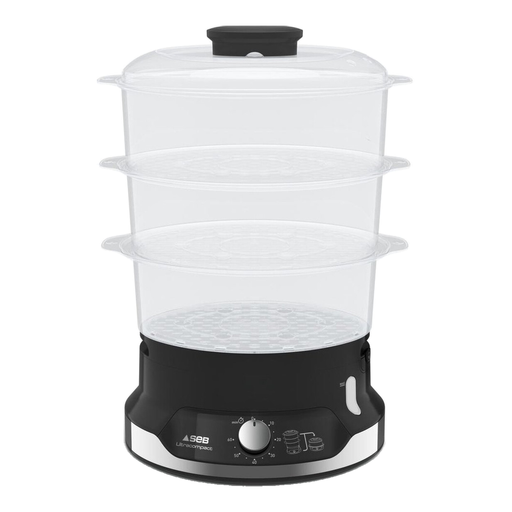
Why it suits this profile: Suitable for anyone looking for an electric food steamer with straightforward controls and enough room for several portions.
The three stackable baskets make use of vertical space rather than requiring a wide pan. The product information states that it has a 60-minute timer, automatic shut-off and the option to top up the water during use.
800 watts, 9-litre total capacity and stackable components for compact storage.
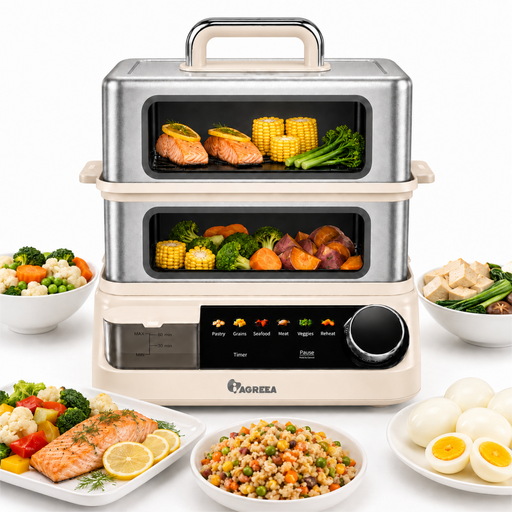
Why it suits this profile: For families who want to prepare large portions of fish, meat and vegetables in a single cooking cycle.
The two stainless steel baskets and external water reservoir help reduce interruptions when preparing larger meals. The basket dimensions are listed in the product information.
14-litre capacity, 2,000 watts, two tiers and six pre-programmed settings.
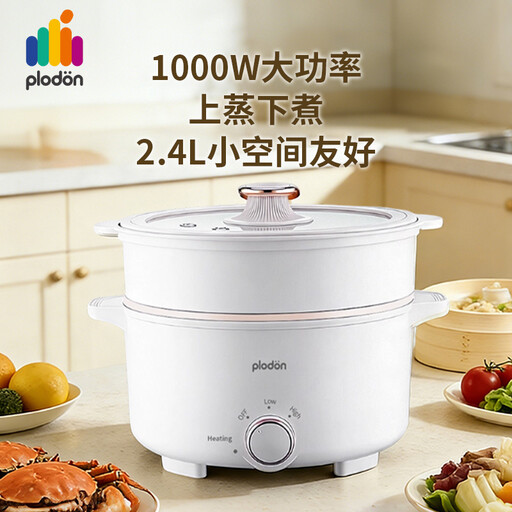
Why it suits this profile: A compact multifunctional electric cooking pot for ramen, soup, pasta, eggs and smaller portions of steamed dishes.
The 2.4-litre capacity prevents a small kitchen from losing unnecessary space. The removable steamer can be stored separately.
1,000 watts, two heat settings, non-stick interior and a removable steaming insert.
We have put together a complete, up-to-date list of products that fully meet these strict selection criteria and the applicable European safety regulations.
That depends on the base. Only choose a model that explicitly states that it is suitable for induction. A product described merely as “stainless steel” is not automatically suitable for an induction hob.
Compact models commonly use between 715 and 800 watts. Larger electric food steamers can use 2,000 watts. More power may build up steam faster, but it also increases electricity consumption per hour. The actual cost depends on the power rating, cooking time and your energy tariff.
The lifespan depends on the material, use and care. A stainless steel pan does not have a non-stick coating that can wear out, but it can discolour if overheated. With electric models, the cable, controls, water reservoir and coating are the main areas to check. Always follow the manufacturer’s care instructions and inspect the product for damage before use.
