
Short ironing sessions
You iron linen napkins along with a few other items and want to put your appliance away easily after a short session.


For short, varied ironing sessions where storage space is limited, a steam iron is usually enough. If you regularly tackle large piles and stubborn creases, a steam generator may be worth considering, provided you have room for the base unit. The Consumers’ Association makes a similar distinction based on how much you iron in one go. Also compare tank capacity, adjustable steam and maintenance. A high steam output specification alone doesn’t prove you’ll get better results on linen napkins.
You iron linen napkins along with a few other items and want to put your appliance away easily after a short session.
You regularly iron a sizeable pile and want to refill the water less often during longer sessions, including when tackling creases in linen.
You iron linen and other textiles one after another and want to adjust the temperature and steam for each item.
Choose this if: you usually do short, varied ironing sessions and want to store your appliance compactly.
The trade-off: the smaller tank may need refilling more often when you have a large pile to iron.
Choose this if: you often iron for a long time in one go and have room for a base unit.
The trade-off: the base unit takes up more storage space, and the purchase price is usually higher.
| What to consider | What to check before buying | Who is this important for? |
|---|---|---|
| Ease of handling and storage | Compare the type of appliance and its dimensions, and check how easy it is to see the water level. | For short sessions, I want something that’s easy to handle and store. Around 36% of consumers prioritise ease of handling when doing varied, often short ironing sessions. |
| Steam for large loads | Compare continuous steam output in g/min separately from the steam boost, and check the tank capacity and the space needed for the base unit. | If I often iron a sizeable pile, I want to refill less often and tackle creases effectively. Around 29% of consumers give top priority to large loads and creases in linen. |
| Switching between fabrics | Check the temperature control, adjustable steam and the care labels on the fabrics. | If you alternate between linen and other ironable fabrics in one session, you’ll want to adjust the settings for each item. Around 21% of consumers prioritise having control when ironing different fabrics. |
| Maintenance | Check the descaling instructions for the exact model and whether suitable parts are available. | I want to know in advance what maintenance my appliance needs and how to look after it. Around 14% of consumers put maintenance and long-term usability first. |
A steam boost is not the same as the continuous steam output during a longer ironing session.
Compare continuous steam output in g/min, tank capacity and adjustability separately. Manufacturers’ figures are not an independent test of how well an appliance irons linen napkins.
The larger tank is most useful when you iron for a long time in one go. For short sessions, the separate base unit may simply take up extra space.
Before choosing a generator, consider the size of your usual weekly wash and how often you actually iron a large pile.
A commercial guarantee does not replace your statutory rights under Dutch law. ACM ConsuWijzer describes these as separate rights.
Keep your proof of purchase and model details. If your product is faulty, contact the seller.
Philips describes the DST3041/80 from the 3000 Series as a steam iron with a 300 ml tank and a ceramic soleplate, designed for smaller loads.
Tefal specifies adjustable steam output of up to 60 g/min, a steam boost of 250 g/min and a Micro-Calc filter for the Ultimate Pure FV9844.
Braun specifies a continuous steam output of 190 g/min for the CareStyle 7 Pro IS7286BK.
These Joybuy products are steam generators for anyone who regularly has larger ironing loads. Check that the exact appliance has a CE mark and that the manufacturer has drawn up an EU Declaration of Conformity. According to the NVWA and Ondernemersplein, these are required for electrical products placed on the market in the Netherlands.
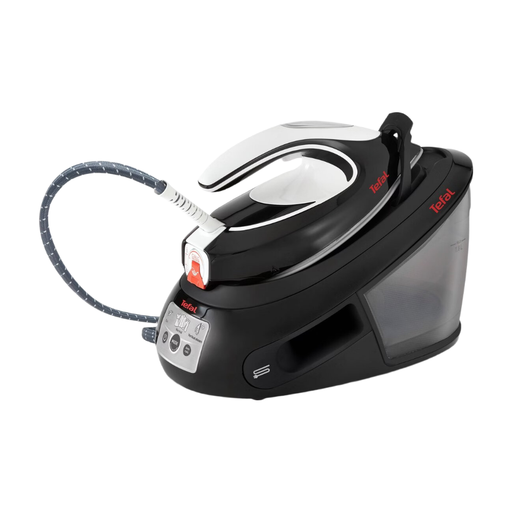 No image available
A steam generator to consider if you regularly have larger ironing loads and want to take limescale maintenance into account.
The product description lists continuous steam output of 120 g/min, a steam boost of 450 g/min and a removable limescale collector. The name specifies 6,5 bar.
 No image available
The features listed may be useful if you iron for longer sessions and switch between different ironable fabrics.
The product description lists continuous steam output of 120 g/min, a 1,4 L tank, temperature selection for each fabric and vertical steaming. The product name specifies 2400 W and a steam boost of 350 g.
 No image available
An option for longer ironing sessions if you’re considering an automatic setting for different fabrics.
The product description lists a 1,3 L tank, continuous steam output of 120 g/min and OptimalTEMP. According to the description, the temperature cannot be set manually.
 No image available
The stated continuous steam output may be worth considering for longer ironing sessions. Bear in mind that a steam generator has a base unit.
The product description lists continuous steam output of 120 g/min, a steam boost of 380 g/min, Calc Clear maintenance and a Durilium AirGlide soleplate.
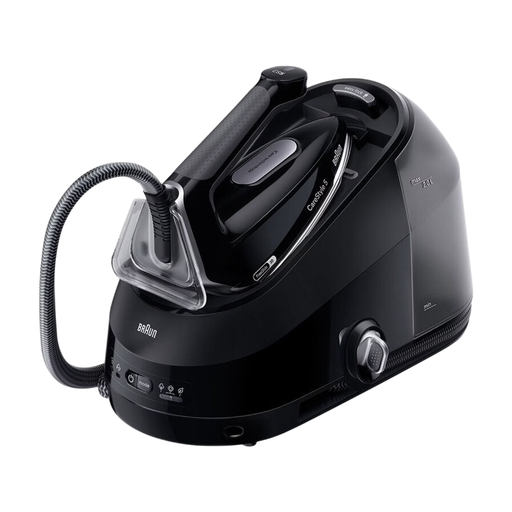 No image available
A model to compare if you often iron for longer sessions and want an automatic programme for different fabrics.
The product description lists a removable 2 L tank and steam output of up to 150 g/min. The automatic programme adapts to the fabric, but the steam output cannot be adjusted.
A linen retailer recommends ironing linen, including napkins, while it’s still slightly damp. Check the care label on your napkins too; this advice may not apply to every linen blend.
Follow the descaling procedure for the exact model. Philips describes different systems for different ranges, so don’t assume the cooling and descaling instructions apply to another brand or model.
No. According to ACM ConsuWijzer, your statutory rights depend on what you could reasonably expect from the product with normal use. A manufacturer’s or seller’s guarantee is separate; if your product is faulty, contact the seller.
The NVWA states that electrical products placed on the market in the Netherlands must have a CE mark. Ondernemersplein, a Dutch government information service for businesses, also states that the manufacturer must draw up an EU Declaration of Conformity. Check these requirements for the exact appliance.
According to ACM ConsuWijzer, a standard online product purchase usually comes with a statutory cooling-off period of up to 14 days after delivery. Exceptions apply to certain products and situations.