
If you want to iron a skirt quickly
You iron one or a few cotton skirts at a time and want an appliance that’s easy to get out and put away.


If you only iron one or a few cotton skirts and have little storage space, a standard steam iron is likely to be the more practical choice. For larger, regular ironing sessions, a steam generator may be worth considering, provided you have enough room for it. The Dutch Consumers’ Association describes standard steam irons as more compact and suitable for smaller loads, while steam generators are larger and may need refilling less often. Whichever you choose, follow the care label for the temperature and agree with your housemates on where it can cool down and how it will be maintained.
You iron one or a few cotton skirts at a time and want an appliance that’s easy to get out and put away.
You all use the same appliance, so clear controls, a safe place for it to cool down and agreed maintenance arrangements are important.
You regularly iron other or thicker garments too, and want to refill less often, provided you have room for the appliance at home.
Best for: short ironing sessions, cotton skirts and limited storage space.
The trade-off: the Dutch Consumers’ Association describes this type as more compact, with a smaller water tank than a steam generator.
Best for: larger, regular ironing sessions when you want to refill less often.
The trade-off: the Dutch Consumers’ Association describes steam generators as larger and harder to store, so check that you have room for both the appliance and the ironing board.
These points will help you choose a model that suits both your ironing needs and the shared space at home.
| What to consider | What to check before buying | Who should pay particular attention? |
|---|---|---|
| Results on cotton | Check the results on cotton for each model, where available. Compare continuous steam and steam boost separately, and follow the care label for the temperature. | If I’m ironing one or a few cotton skirts, I want to know how the appliance performs on cotton, not just how much steam it produces. This is the top priority for around 31% of consumers. |
| Storage and accessibility | Measure the space available for the appliance and ironing board. Also check the tank and make sure there’s room for the appliance to cool down safely. | If I have little cupboard space, I want an iron that’s easy to get out and put away. Storage space is the top priority for around 25% of consumers. |
| Shared use | Check whether the exact model has automatic shut-off, and agree on a stable place for it to cool down and when to switch it off. | When housemates share an appliance, I want to know how we can use it and leave it safely. This is a top priority for around 25% of consumers. |
| Maintenance | Check the manual for the descaling method and agree on who will carry out the maintenance. | When an appliance is shared, I want to make sure maintenance doesn’t get overlooked. Maintenance is the top priority for around 19% of consumers. |
A steam boost figure doesn’t necessarily tell you how well an iron smooths cotton or how it performs during a longer ironing session.
Compare continuous steam and steam boost as separate specifications. Also check which setting the stated figure applies to, and look at independent test results for cotton where available.
A steam generator takes up more room and may not suit a small, shared ironing area.
Before buying, check where the appliance, tank and ironing board will fit, and where it can cool down safely. A larger tank isn’t necessarily needed for short sessions.
Limescale can reduce steam performance and cause leaks or marks on clothes.
Keep the manual with the appliance and agree on who will carry out the recommended maintenance. The right descaling method varies by model.
The 3000 Series DST3041/80 is a standard steam iron with a ceramic soleplate and a 300 ml tank.
The FreeStyle 5 SI 5037 Violet is a standard steam iron with manual temperature control.
The Easygliss Plus FV5770E0 is a standard steam iron, while the Express Airglide SV8026E0 is a larger steam generator.
According to Rowenta, the Autosteam DW4020D1 is a standard steam iron with automatic steam control and a precision tip.
These Joybuy products are standard steam irons. Compare their specifications with your ironing needs, the storage space available and your arrangements for sharing the appliance.
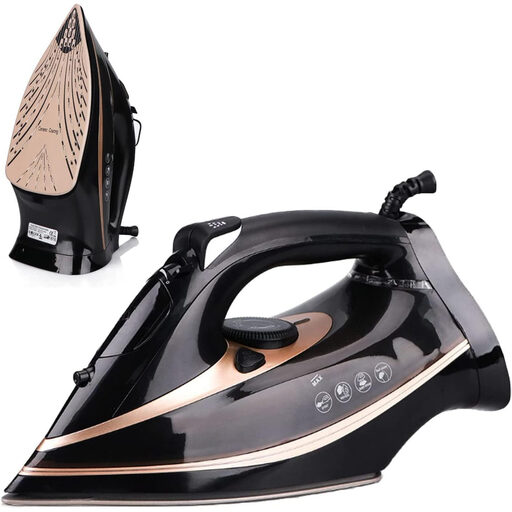 No image available
A standard steam iron for ironing skirts with steam.
Ceramic soleplate; steam output up to 70 g/min; 120 g steam boost; 300 ml water tank; self-cleaning function.
 No image available
A handheld steam iron for those who want to choose between different temperature settings.
Five temperature settings; continuous steam up to 50 g/min; 180 g steam boost; 350 ml water tank; 1.95 m cord; anti-drip system and self-cleaning.
 No image available
A handheld steam iron for a small ironing session, with the option of dry ironing too.
Steam output up to 22 g/min; 0.15 l tank; weight 0.77 kg; manual temperature and steam control; automatic shut-off.
 No image available
A standard steam iron for those comparing automatic shut-off when sharing an appliance.
SuperCeramic soleplate with precision tip; continuous steam up to 50 g/min; automatic shut-off after 8 minutes upright or 30 seconds horizontally; anti-drip system and self-cleaning.
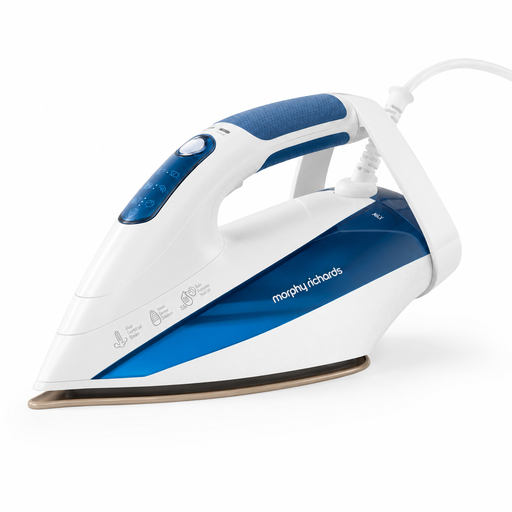 No image available
A standard steam iron for those comparing a 350 ml tank and a precision tip.
2400–2800 W power; ceramic soleplate with precision tip; steam output of 50 g/min; 350 ml tank; anti-drip system and self-cleaning.
No. Set the maximum temperature according to the care label for the whole skirt, not just the word ‘cotton’. A lining or blended fabric may need different treatment.
Make sure there’s a stable place where the appliance can cool down safely, and agree on who will switch it off after use. The Netherlands Fire Service advises fully unwinding cable reels and, where possible, plugging high-power appliances directly into a wall socket. Always follow the appliance manual too.
Follow the manual for the exact model, as the method varies by appliance. For example, Tefal advises against using vinegar or descaling products for a steam generator and describes separate methods for items such as anti-scale rods and scale collectors.
Yes. According to Business.gov.nl, businesses placing electrical appliances on the market must comply with the relevant European rules. For an appliance that meets the requirements, the manufacturer must apply a CE mark and draw up an EU declaration of conformity. A model listing alone doesn’t confirm that an individual item has been checked.
No. The Dutch Government says there’s no fixed period for the statutory guarantee in the Netherlands, and that you should contact the seller if a product is faulty. For online purchases from a business, you’re also often entitled to a 14-day cooling-off period; check whether it applies to your purchase.