
Occasional ironer
You want to smooth a few ironable cotton pillowcases without having to store a bulky appliance. The Consumers' Association of the Netherlands explains the difference between a steam iron and a steam generator.


For a few pillowcases and limited storage space, a standard steam iron is the more practical choice. If you regularly tackle larger piles, a steam generator is worth comparing. Let the care label guide the temperature and amount of steam you use, and, if you share the appliance, consider its automatic shut-off, maintenance and storage requirements too. Before buying, check that the specific appliance meets the applicable product safety requirements.
You want to smooth a few ironable cotton pillowcases without having to store a bulky appliance. The Consumers' Association of the Netherlands explains the difference between a steam iron and a steam generator.
Several people in your household use and put away the same appliance. Clear temperature controls and agreed safe-use practices are important.
You regularly iron lots of pillowcases or other laundry in one go and want to compare a standard iron with a steam generator. The Consumers' Association of the Netherlands lists a generator as an option for people who do a lot of ironing.
Best for: ironing a few pillowcases and putting the appliance away neatly after use.
Things to consider: you may need to refill it during longer ironing sessions.
Best for: regularly ironing larger loads in one go, with enough space for the base unit.
Things to consider: the separate tank and base take up extra working and storage space; manufacturer figures don’t automatically predict the results on every pillowcase.
| What to consider | What to look for | Who should consider this? |
|---|---|---|
| Care label and ironing setting | Check the ironing symbol on each pillowcase and adjust the temperature and steam accordingly. | If I want to smooth my cotton pillowcases, I need to know what their care labels allow; around 40% of consumers prioritise smoothing their pillowcases. |
| Shared use | Check the temperature controls and any automatic shut-off feature on the specific model. | If people in my household share the same appliance, I want everyone to understand the settings and leave it in a safe state; around 30% of consumers give shared use top priority. |
| Storage space | Compare the space needed for the entire appliance, including any separate base unit. | If I need to put everything away after a short ironing session, I want to know how much space the complete setup takes up; around 20% of consumers say storage space is the deciding factor. |
| Long sessions and maintenance | Compare tank capacity and continuous steam output using the same units; check the descaling instructions for the exact model. | If I iron a lot of laundry in one go, I want to know how the tank and maintenance requirements fit my sessions; around 10% of consumers prioritise long sessions and maintenance. |
The fibre name alone doesn’t tell you how a particular pillowcase should be treated. The ironing symbol on the care label shows which treatment is permitted.
Check the care label on each pillowcase before setting the temperature and steam.
The feature varies by model, and it doesn’t remove the need for household members to agree how to leave a hot appliance safely.
Check the feature on the exact model and agree who will put the iron away safely after use.
A generator has a separate tank and base, whereas a standard steam iron doesn’t need this setup.
First work out how often and how much you iron in one go, then measure the space available for the complete appliance.
Descaling instructions can vary between a steam iron and a steam generator.
Make a note of the model number of the shared appliance and follow the instructions for that model.
Philips offers both steam irons and steam generators in its 3000 Series, making it easy to compare a compact appliance with one that has a separate base unit.
The Easygliss Plus FV5736E3 is a steam iron worth comparing if temperature settings and shared use matter to you.
There are several models in the TexStyle 3 range, so check the features of the exact model.
The Steamforce DW9240D1 is a steam iron worth comparing if you want to stick with a standard iron for more challenging ironing jobs.
This selection includes standard steam irons for smaller jobs and steam generators for those who iron larger loads in one go. If you share the appliance, compare storage space and the model-specific safety and maintenance information too.
 Image unavailable
Suited to those who iron larger loads in one go and have space for a separate base unit.
1.4-litre water tank; continuous steam output of 120 g/min; 2400 W; automatic shut-off.
Don’t leave the appliance unattended, and make sure you have enough space to store it.
 Image unavailable
Suited to smaller ironing jobs where you want to put a standard steam iron away after use.
300 ml water tank; continuous steam output of 40 g/min; ceramic soleplate; automatic shut-off.
For each pillowcase, follow the ironing symbol for the permitted temperature and steam settings.
 Image unavailable
Suited to those comparing generators for longer ironing sessions and who have room for a separate base unit.
The product information lists a 1.8-litre water tank.
The description warns that the soleplate and steam get hot, and that the appliance shouldn’t be left unattended.
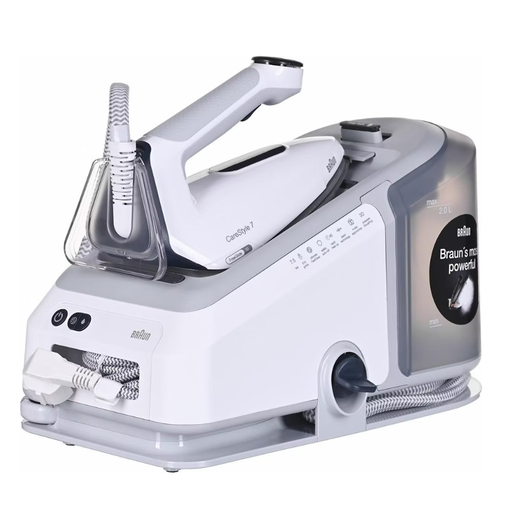 Image unavailable
Suited to those comparing an ironing system for longer sessions and who have room for the water tank and base unit.
2-litre water tank; the product information lists a FastClean descaling system.
Follow the maintenance instructions for the exact model and don’t leave the appliance unattended.
 Image unavailable
Suited to those considering a generator for longer ironing sessions and comparing models with a removable tank.
Removable 1.8-litre water tank; 2400 W; automatic shut-off and anti-scale function.
The product information warns that the soleplate and steam get hot, and says not to leave the appliance unattended.
Don’t assume so just because it’s cotton. Follow the ironing symbol on the pillowcase: GINETEX lists maximum soleplate temperatures of 200 °C, 150 °C and 110 °C for the relevant symbols. The symbol for 110 °C means you should iron without steam.
Follow the descaling instructions for the exact model and make sure everyone in your household knows which procedure to use. Philips has separate maintenance instructions for steam irons and steam generators.
No. According to the Dutch government, consumer purchases are covered by a legal guarantee, and the retailer is your point of contact if a product is faulty. The Netherlands has no fixed statutory guarantee period that applies to every product; a manufacturer's guarantee is an additional benefit.
Yes. The Dutch government lists electrical appliances among the products covered by European safety requirements and CE marking. A brand or model name on its own doesn’t prove that a specific appliance meets all the applicable requirements.