
If you iron cotton dresses
You want to remove creases from cotton dresses and judge the results dress by dress. The Consumers’ Association notes that cotton can be harder to smooth than lightweight synthetic fabrics.


If you have a few cotton dresses and limited storage space, a steam iron is the obvious choice. A steam generator is better suited to longer ironing sessions or stubborn creases, provided you have room for the whole appliance. Choose the maximum temperature for each dress according to its care label, as GINETEX advises. The Consumers’ Association reports that some garment steamers smooth lightweight fabrics, but not always cotton.
You want to remove creases from cotton dresses and judge the results dress by dress. The Consumers’ Association notes that cotton can be harder to smooth than lightweight synthetic fabrics.
You iron a small amount of clothing and want to be able to store the appliance easily before and after moving. The Consumers’ Association cites limited storage space as a reason to consider a steam iron.
You want to set the temperature for each garment according to its ironing symbol. GINETEX advises choosing the maximum temperature solely on the basis of the care label.
Best suited to: ironing a small number of dresses and having limited space around your move.
The trade-off: the built-in tank is smaller, so you may need to refill it more often during longer sessions.
Best suited to: ironing lots of clothes in one go or regularly dealing with stubborn creases, if you have room for the whole appliance.
The trade-off: the larger tank and the appliance as a whole take up more space; check that your ironing board is suitable too.
Best suited to: refreshing lightly creased clothes when a less crisp finish is acceptable.
The trade-off: according to the Consumers’ Association, some steamers smoothed lightweight fabrics, but not cotton or heavier fabrics.
The Consumers’ Association describes cotton as harder to smooth than lightweight synthetic fabrics. GINETEX advises choosing the maximum temperature solely on the basis of the care label.
| What to consider | What should you check? | Who is this important for? |
|---|---|---|
| Removing creases from cotton | Compare adjustable continuous steam with a steam boost; look at how it performs on cotton, not just its wattage. | If I want to smooth cotton dresses, I prioritise the results on that fabric; around 36% of consumers give this need priority. |
| Size and storage | Check the dimensions of the complete appliance and the space available, including around your ironing board. | Around a move, I want to know where the appliance and ironing set-up will fit; around 29% of consumers choose based on storage space. |
| Looking after each dress | Follow the care label for each garment and adjust the temperature and steam accordingly. | If my dresses have different care labels, I want to adjust the settings for each fabric; around 21% of consumers prioritise fabric care. |
| Maintenance | Check how to descale the specific model and how easy it is to fill and empty the water tank. Philips describes descaling methods for each model. | If I use my iron often, I want to know what maintenance the model requires; around 14% of consumers prioritise maintenance. |
The Consumers’ Association found that some garment steamers smoothed lightweight fabrics, but not cotton or heavier fabrics.
If you want your cotton dresses to look crisply ironed, don’t choose solely for the convenience of vertical steaming; first decide what kind of finish you need.
A short burst of steam is not the same as continuous steam. Tank capacity and steam settings can also matter during longer sessions and when ironing different dresses.
Compare continuous steam, settings, tank capacity and the care label together.
A steam generator takes up more space as a whole and may not suit every ironing board, even if its hand unit is lighter.
Check your storage space and ironing set-up in advance.
A different model number may mean you’re looking at a different version.
Compare the full model number and version on the product and manufacturer pages before assuming two models are identical.
The Easygliss Plus FV5736E0 is a specific steam iron with published details on continuous steam, tank capacity and automatic shut-off.
The TexStyle 3 SI 3054 GY has a thermostat dial, anti-drip system and self-cleaning function.
Steam Iron 80080009 is a separate model with an adjustable thermostat.
Philips describes descaling methods that can vary from model to model.
This selection of Joybuy products includes steam irons for shorter ironing sessions and steam generators for longer sessions. For each model, check that the version and features suit your dresses and available storage space.
 Image unavailable
Ideal if you want to adjust the steam and temperature to suit the care label.
Continuous steam: 45 g/min; steam boost: 220 g/min; water tank: 200 ml.
 Image unavailable
Ideal if you’re looking for a portable model with manual settings for different dresses.
The product is described as compact, lightweight and dual voltage; its stated weight is 0.77 kg. The description mentions temperature and steam settings, as well as dry and steam ironing.
 Image unavailable
Ideal if you want to weigh up variable steam and a separate steam boost against the care labels on your dresses.
2000 W; continuous steam: 20 g/min; steam boost: 90 g/min. The product information mentions Calc-Clean maintenance.
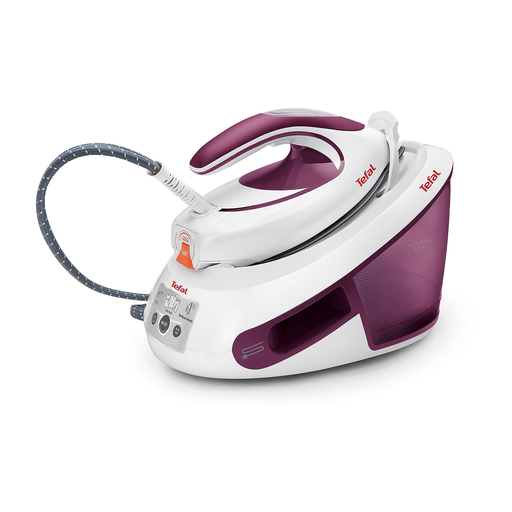 Image unavailable
Ideal if longer sessions and fewer refills matter to you; check you have room for a steam generator first.
2800 W; water tank: 1.8 l; steam output up to 50 g/min. The product information mentions variable steam settings and temperature selection based on the fabric.
 Image unavailable
Ideal if you have longer ironing sessions and can make room for the complete appliance. The Consumers’ Association points out that a steam generator takes up more space overall than a standard steam iron.
2400 W; water tank: 1.4 l; continuous steam: 120 g/min; steam boost: 350 g. The product information mentions a ceramic soleplate.
No. Set the maximum temperature according to the care label on that dress. The Consumers’ Association advises following the label; too much heat can damage or make the fabric shiny.
Only use steam once the iron is hot enough and if the care label allows it. The Consumers’ Association advises against using a steam boost too often in succession, and recommends dry ironing without steam after steaming.
Follow the descaling procedure for the exact model. Philips describes different methods for different model ranges; don’t automatically use the method for another model.
If a product is faulty, the seller may have to provide a solution, such as a repair or replacement, under the applicable terms, according to ACM ConsuWijzer. Online purchases also generally come with a statutory 14-day cooling-off period after delivery, with some exceptions.
For electrical appliances covered by the relevant EU rules, the manufacturer must affix a CE marking after a conformity assessment and draw up an EU Declaration of Conformity, according to Ondernemersplein. This general requirement doesn’t confirm that a particular item complies.