
If you usually iron just a few napkins
If you iron in short sessions and want to store your appliance away neatly afterwards, a standard steam iron is worth considering. The Consumers’ Association describes this type as compact and quick to heat up.


For just a few linen napkins at a time, a standard steam iron is usually the more practical choice. The Consumers’ Association describes this type as compact and quick to heat up, while a steam generator takes up more space. A generator may suit you if short ironing sessions often turn into longer ones and you’d rather refill less often. Iron linen while it’s slightly damp and always follow the care label. The Irish Linen Guild recommends ironing the reverse first, then the right side.
If you iron in short sessions and want to store your appliance away neatly afterwards, a standard steam iron is worth considering. The Consumers’ Association describes this type as compact and quick to heat up.
If your priority is a smooth finish and you want to pay attention to corners and hems, look for a good soleplate, adjustable steam and a spray function. The Irish Linen Guild recommends ironing linen while it’s slightly damp.
If you regularly tackle longer ironing sessions as well as small piles, you could weigh up the benefit of a larger tank against the extra space a steam generator takes up. Tefal lists a removable 1.8-litre tank for the SV8026.
Best for: ironing a few napkins at a time, getting started quickly and storing your appliance away neatly.
Trade-off: the tank is smaller, so check how often you’ll need to refill it during an ironing session.
Best for: small piles that often turn into longer sessions, or lots of stubborn creases.
Trade-off: the larger tank and generator take up more storage space. The Consumers’ Association describes a standard steam iron as more compact.
Best for: easing light creases when sharply pressed napkin edges aren’t the goal.
Trade-off: Tefal describes a clothes steamer as a vertical appliance without a soleplate. The manufacturer says an iron is a better choice for sharp creases.
| What to consider | What should you check? | Who is this important for? |
|---|---|---|
| Getting started quickly and storage | Check the heat-up time for the setting you use, and think about where the appliance can cool down safely and be stored. | For short sessions, I don’t want to wait long and would like to put the iron away easily. Around 36% of consumers in this ironing scenario prioritise getting started quickly and compact storage. |
| Smooth linen and neat edges | Check the steam and temperature settings, whether there’s a spray function, and the shape of the soleplate tip. Follow the care label. | If I want flat napkins with neat corners, I look for a soleplate and a suitable level of moisture. For around 29% of consumers, a smooth finish with neat edges is the top priority. |
| Maintenance with regular use | Check the model’s manual for descaling instructions and approved water types, and see how easy it is to clean and empty. | If you use the appliance often, it’s worth knowing in advance what maintenance involves. Around 21% of consumers give ease of maintenance top priority. |
| Ironing for longer sessions now and then | Weigh the tank capacity against the space available for storage, and check whether your ironing board is stable enough for a generator. | If an ironing session sometimes takes longer, I’d like to refill less often without the appliance taking up too much space. Around 14% of consumers prioritise longer sessions and fewer interruptions. |
Ironing often doesn’t necessarily mean ironing for long stretches. For short sessions, the Consumers’ Association describes a standard steam iron as compact and quick to heat up.
Think about how long a typical ironing session lasts and how stubborn the creases are, not just how often you iron.
A generator needs more storage space. Also check that your ironing board is stable enough to support the whole unit.
A clothes steamer doesn’t apply the horizontal pressure of a soleplate. Tefal says an iron is a better choice if you want to press sharp creases.
Choose an iron if neat, sharply pressed edges matter. A clothes steamer is more suitable if a softer finish is all you need.
Tefal lists a 270 ml tank for the FV5736, while the Joybuy product page states 200 ml. The same page also gives a notably high steam pressure figure.
Check the full model code and compare the product details with the manual before taking a differing specification into account.
The Dutch government states that the Netherlands has no fixed statutory guarantee period, and that a manufacturer’s guarantee is in addition to your legal rights to a product that works properly.
When comparing extra cover, check what terms and benefits it adds. If there’s a fault, contact the seller.
The TexStyle 3 SI 3030 is an example of a standard steam iron for short sessions, designed with quick start-up and edges in mind.
The Easygliss Plus FV5736 and Express Airglide SV8026 illustrate the difference between a standard steam iron and a steam generator.
The 3000 Series DST3031/20 is an example of a standard steam iron that Philips describes as suitable for smaller loads of ironing.
These Joybuy products are standard steam irons with a soleplate, suited to short ironing sessions and neatly pressed napkins.
 Image unavailable
A standard steam iron with a precision tip and spray function may suit pressing napkins flat and dampening linen.
The product description lists an anti-drip function and automatic shut-off. Check the tank capacity for the exact variant.
 Image unavailable
The soleplate makes this a suitable option if you want to press napkins flat and use a spray function to lightly dampen dry linen.
The product description lists a 2000 W power rating, a spray function and temperature and steam settings, including cotton and linen.
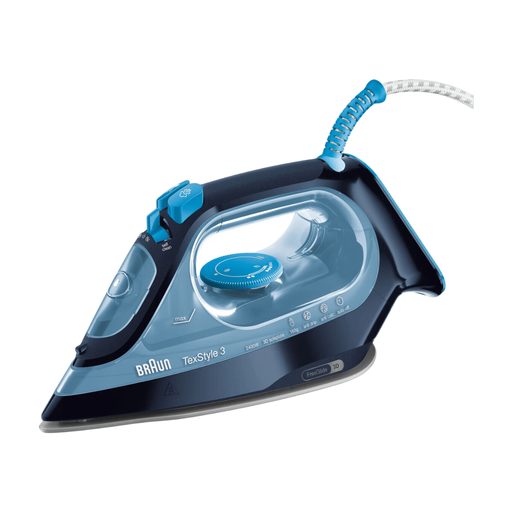 Image unavailable
A standard steam iron with a precision tip may suit short sessions when you also need to reach corners and seams.
The product description lists a steam shot, anti-scale system, anti-drip function, precision tip and quick heat-up.
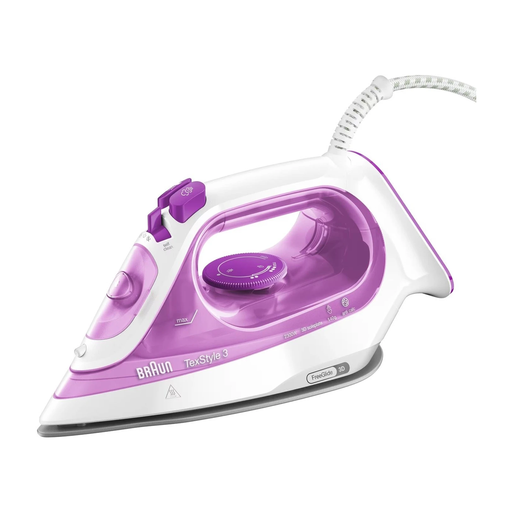 Image unavailable
This model may suit short sessions when you want to get started quickly and use a precision tip for edges.
Braun lists a 35-second heat-up time on the Max setting, a 270 ml tank, self-cleaning and a precision tip. Check whether the Max setting is suitable for the care label.
 Image unavailable
The soleplate and precision tip may suit anyone who wants to press napkins flat and reach smaller areas.
The product description lists continuous steam, self-cleaning and an anti-drip function.
No. According to the Irish Linen Guild, linen can be ironed while slightly damp. If it has dried out, spray it with water again if needed. Check the care label first, as blends, colours and finishes can affect how it should be treated.
For sharply pressed napkin edges, an iron with a soleplate is usually the more practical choice. Tefal describes clothes steamers as vertical appliances used without an ironing board, and says irons are better suited to sharp creases.
Follow the descaling procedure and water instructions for the exact model. Philips warns that limescale can build up over time; maintenance steps may vary from one appliance to another.
No. According to the Dutch government, a manufacturer’s guarantee is in addition to your legal rights to a product that works properly. The Netherlands has no fixed statutory guarantee period. If there’s a fault, contact the seller.
A mains-powered iron that falls within the voltage range of the EU Low Voltage Directive must carry the CE mark to be placed on the EU market. Check the marking and product information for the exact model; a brand name or product listing alone does not prove compliance.