
Occasional ironers
If you only iron a few linen tea towels and have limited storage space, you may find a steam iron more practical. The Dutch Consumers' Association lists limited storage space as a reason to choose a steam iron.


For a few linen tea towels and limited storage space, a steam iron is the more practical choice. If you regularly iron large piles, a steam generator can mean fewer top-ups. Check the care label on each towel, and make sure you have room for the base and a suitable ironing board if you choose a generator.
If you only iron a few linen tea towels and have limited storage space, you may find a steam iron more practical. The Dutch Consumers' Association lists limited storage space as a reason to choose a steam iron.
If you regularly iron lots of tea towels in one go, you may appreciate the larger tank on a steam generator, but you’ll also need room for its separate base. The Dutch Consumers' Association identifies the larger tank as one of the differences between these types of appliance.
If you often use steam and want to plan ahead for limescale maintenance, it’s worth checking the care routine for the exact model. The Dutch Consumers' Association notes that an anti-scale system can slow limescale build-up, but doesn’t remove the need for maintenance.
Best for: small loads, limited storage space or an appliance you can get ready quickly.
Bear in mind: the water tank is inside the iron, so you may need to refill it sooner during longer ironing sessions. The Dutch Consumers' Association says this type is suitable if you don’t do much ironing.
Best for: regularly tackling large piles of ironing, with enough room for a separate base.
Bear in mind: the complete set takes up more space, and your ironing board needs to be suitable for the base. The Dutch Consumers' Association highlights the larger tank as an advantage for longer ironing sessions.
| What to consider | What should you check? | Who should give this more consideration? |
|---|---|---|
| Temperature and steam | Check the care label and temperature control; compare adjustable continuous steam separately from a steam boost. | I want to smooth out linen tea towels without damaging the fabric, so I’ll set the temperature according to the care label. Around 36% of consumers say their main concern is getting smooth results without damaging the fabric. |
| Space and ease of handling | Compare the appliance type and dimensions, the weight of the iron and the space available on your ironing board and in your cupboard. | If there’s little storage space in the utility room, I want an appliance that’s easy to set up and put away. Around 29% of consumers prioritise compact storage and ease of handling. |
| Refilling during long sessions | Check the tank capacity of the exact model and whether you can refill it while in use. | When I have a large pile to iron, I’d rather not keep stopping to refill the water tank. Around 21% of consumers prioritise fewer refills over compact storage. |
| Limescale maintenance | Find out what descaling steps are needed and whether the model uses reusable parts or replaceable cartridges. | If you iron with steam regularly, you’ll want to know what maintenance is involved. Around 14% of consumers say limescale maintenance is their main buying concern. |
A steam boost and continuous steam output are different functions. If you’re ironing a whole pile, it’s important to check the continuous steam output separately.
Start by comparing continuous steam output and tank capacity; then look at the steam boost separately for stubborn creases.
The separate base takes up space and, according to the Dutch Consumers' Association, may not be suitable for a standard ironing board.
Measure the space available on your worktop and ironing board, as well as in your storage area.
A generator may require a different storage space or a suitable ironing board.
An anti-scale feature doesn’t replace regular maintenance. The Dutch Consumers' Association explains that these systems slow limescale build-up, but maintenance is still needed.
Check the manual for the exact model to see whether it has reusable parts or replaceable cartridges.
Models with replaceable cartridges may involve ongoing costs.
Tefal’s range includes both steam irons and steam generators. Compare how much space each model needs and how it is refilled.
Philips offers both conventional steam irons and steam generators. Check model numbers and versions carefully, as they aren’t automatically interchangeable.
The TexStyle 9 SI9682DB is a steam iron. You can compare its settings and descaling method for each version.
This selection includes compact steam irons and steam generators for smaller or larger ironing sessions. Compare the steam settings, tank and maintenance requirements of each model. For electrical appliances covered by the relevant EU requirements, Business.gov.nl and the Netherlands Food and Consumer Product Safety Authority list CE marking and an EU declaration of conformity as requirements. Check the documentation for the specific version.
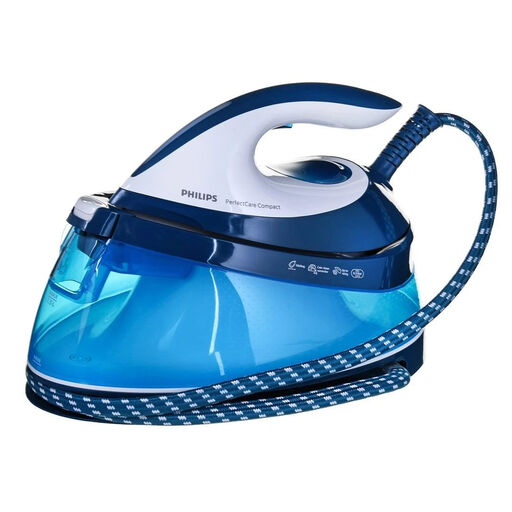 No image available
A steam generator may suit you if you have a large pile to iron and want to follow a descaling routine; make sure you have room for the separate base.
The product description lists 120 g/min continuous steam, OptimalTEMP and Smart Calc-Clean. The product title lists 2400 W, a 400 g steam boost and a 1,5 l water tank.
 No image available
This compact handheld iron may suit smaller ironing sessions and limited storage space.
The product description lists a 0,15 l tank, manual temperature and steam controls, and continuous steam. The product title lists dual voltage.
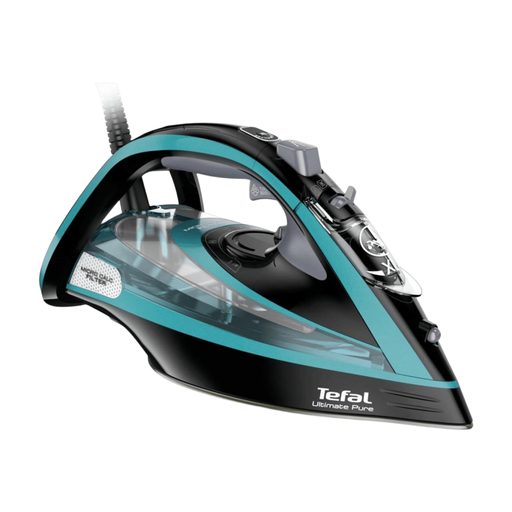 No image available
A conventional steam iron may suit smaller loads and doesn’t need a separate generator base. Set the temperature for each tea towel according to its care label.
For the FV9844, Tefal lists 3200 W of power, adjustable steam output of up to 60 g/min and a 250 g/min steam boost. The product description mentions a Micro-Calc filter and a cleaning reminder.
 No image available
This steam iron may suit smaller loads when you don’t want a separate generator base.
The product description lists a 300 ml tank, continuous steam output of 50 g/min, a precision tip and a self-cleaning system.
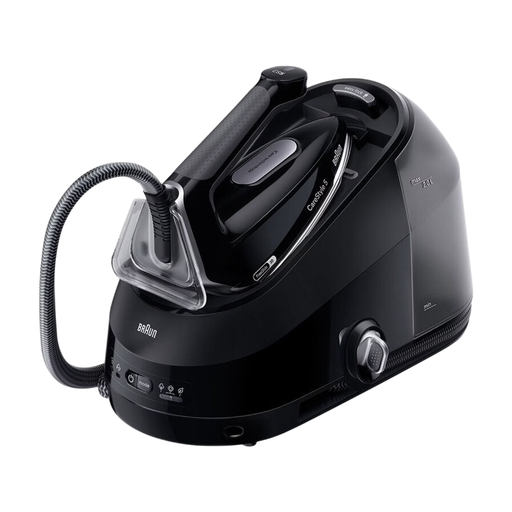 No image available
The larger tank may suit big piles if you’d rather refill less often; just make sure you have room for the separate base.
The product description lists a removable 2 l tank, continuous steam output of up to 150 g/min and iCare temperature control. According to the product specifications, the steam output settings aren’t adjustable.
No. Use the care label on that tea towel to determine the maximum temperature, rather than relying on the fibre type alone. GINETEX distinguishes between ironing symbols for a maximum of 200 °C, 150 °C and 110 °C; the label may also say not to iron the item.
Follow your model’s manual for water use and descaling. The Dutch Consumers' Association recommends continuing with maintenance even if your iron has an anti-scale system. It also advises against using scented ironing water or other additives.
For a consumer purchase in the Netherlands, the seller is responsible for providing an appropriate solution at no extra cost if the product doesn’t meet what you could reasonably expect. ACM ConsuWijzer explains that there isn’t one fixed time limit for every appliance; any manufacturer’s warranty is in addition to your statutory rights.
Check the product documentation for the specific version. Business.gov.nl and the Netherlands Food and Consumer Product Safety Authority state that electrical appliances covered by the relevant EU requirements must have CE marking and an EU declaration of conformity. A CE mark on a general sales page doesn’t, by itself, prove that a specific product has been independently tested.