
Occasional ironers
You only iron a few placemats at a time and want to store your appliance easily in the utility room.


For a few placemats at a time, a compact steam iron is often the practical choice. If you regularly iron large piles, a steam generator with a separate tank can mean less frequent refilling, but it takes up more space. The Consumers’ Association recommends choosing according to how much you iron and how much storage space you have. Always check the care label on your placemat before setting the temperature or steam.
You only iron a few placemats at a time and want to store your appliance easily in the utility room.
You regularly iron large piles of placemats and other thick fabrics, and want to refill the water less often.
Your placemats may contain different fibres or have delicate finishes. You want to adjust the temperature and steam to suit the care instructions for each item.
Best for: ironing a small pile now and then and storing your appliance away neatly.
Trade-off: the water tank is built into the iron you hold, so you may need to refill it sooner during a longer session than you would with a generator.
Best for: ironing larger piles or thicker fabrics in one go, provided you have space for the appliance and a suitable place to iron.
Trade-off: the separate tank and base unit take up more space. Also consider the overall weight, noise and whether your ironing board can support it.
| What to consider | What to look for | Who is this important for? |
|---|---|---|
| Compact storage | Compare the size of the appliance with your available storage space and the size of your usual pile of ironing. | I usually only iron a few placemats and want an appliance that’s easy to put away; around 40% of consumers prioritise a compact option for shorter sessions. |
| Longer ironing sessions | Compare the tank capacity and continuous steam separately from the steam boost, and allow for the space needed for a base unit. | If I often iron a large pile in one go, I want fewer interruptions to refill the tank; around 30% of consumers prioritise large or frequent piles. |
| Fabric care instructions | Check the ironing symbol and make sure the temperature and steam can be set appropriately. | For placemats made from different fabrics or with different finishes, I want to tailor the treatment to each item; around 20% of consumers prioritise fabric choice. |
| Descaling | Check the model’s care instructions and see whether it needs any replaceable consumables. | I want to know in advance what maintenance the appliance requires and whether I’ll need to buy anything regularly; around 10% of consumers make maintenance their top priority. |
If you’re only ironing a few placemats, the larger tank of a generator may offer little benefit, while taking up more space.
Start by considering how large and frequent your ironing sessions are. Then compare tank capacity and steam output.
Also check that you have enough storage space and that your ironing board can support the base unit.
A steam boost and a continuous steam figure describe different functions. A higher steam boost figure doesn’t, on its own, tell you how much steam an appliance produces during normal use.
Compare the figures separately and check which setting is being used, such as turbo mode.
The care instructions for the specific placemat determine the right temperature and treatment. Ironing at too high a temperature can damage the fabric.
Check the ironing symbol before you start and adjust the temperature and steam accordingly. The GINETEX symbol for a maximum of 110 °C means you should iron without steam.
Maintenance methods vary by appliance; some systems use replaceable anti-scale cartridges.
Before choosing, read the manual or model-specific instructions and check whether you’ll need any consumables.
Systems with replaceable anti-scale cartridges may involve ongoing costs.
Philips offers both steam irons and steam generators to suit shorter or longer ironing sessions.
The Easygliss Plus FV5736 is a steam iron that lets you control the steam manually.
The TexStyle 3 SI 3041 is a steam iron with a thermostat dial and self-cleaning function.
The Steamforce DW9240D1 is a steam iron worth comparing if adjustable steam is an important factor in your choice.
This selection includes steam irons for shorter sessions and steam generators for those who iron for longer stretches. According to the Netherlands Food and Consumer Product Safety Authority, electrical ironing appliances sold in the Netherlands must carry a CE marking. Check the marking on the actual product.
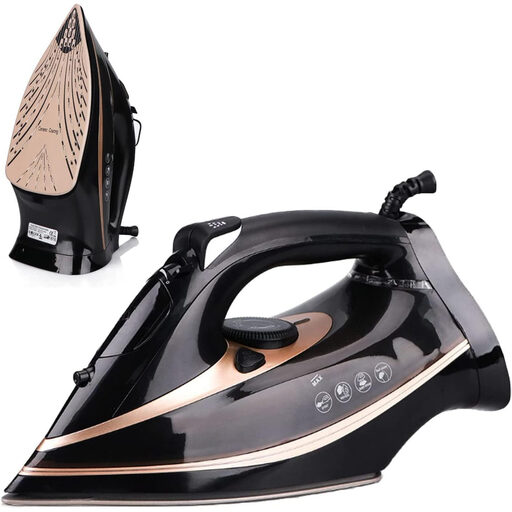 Image unavailable
A handheld iron to compare if you want to use steam on smaller piles of placemats.
The product name lists 2600 W, a ceramic soleplate, 70 g/min steam, a 120 g steam boost, a 300 ml tank and a self-cleaning function.
 Image unavailable
A handheld model to compare if you’re looking for a compact appliance for ironing placemats.
The product name lists 2400 W, a non-stick soleplate, automatic cleaning and an anti-drip system.
 Image unavailable
A steam generator to consider if you regularly have longer ironing sessions and have room for a separate base unit.
The product name lists 2400 W, a 350 g steam boost and a 1.4 l tank. Philips also specifies continuous steam of 120 g/min for model PSG3000/20.
 Image unavailable
A compact steam generator to compare if you’re considering a separate base unit for ironing several placemats at a time.
 Image unavailable
A handheld iron to compare if you want to iron placemats directly and store the appliance away neatly afterwards.
The product name lists 40 g/min steam, a 180 g steam boost and a 300 ml tank.
Follow the care label on the specific placemat, not just the name of the fibre. GINETEX states that the ironing symbol for a maximum of 110 °C means you should iron without steam.
Only use steam if the care instructions allow it and the iron is hot enough. The Consumers’ Association recommends continuing to iron without steam after steaming, if you prefer. Then leave the placemat to cool and dry.
Follow the instructions for your model when it comes to water and descaling. The Consumers’ Association recommends checking whether softened water is suitable and advises against using ironing water.
No. The Dutch Government states that there is no fixed statutory guarantee period in the Netherlands; what matters is what you can reasonably expect from the product. If a product is faulty, contact the seller. Any manufacturer’s guarantee is separate.
The Netherlands Food and Consumer Product Safety Authority states that CE marking is compulsory for electrical products covered by this requirement. Check the marking on the item you buy; a product listing alone doesn’t confirm that the appliance being sold carries it.