
If you iron small piles
You occasionally iron a few cotton handkerchiefs and don’t want to store a large appliance. The Dutch Consumers’ Association says a standard steam iron is a good fit if you don’t do much ironing or have limited storage space.


For a few cotton handkerchiefs at a time, a standard steam iron is usually the more practical choice. A steam generator is better suited to housemates who often iron larger piles and have space for the separate tank. If you’ll be sharing the appliance, check the controls, maintenance requirements and automatic shut-off on the exact model, and follow the handkerchief’s care label for the right temperature.
You occasionally iron a few cotton handkerchiefs and don’t want to store a large appliance. The Dutch Consumers’ Association says a standard steam iron is a good fit if you don’t do much ironing or have limited storage space.
You share the appliance and want everyone to be able to set the temperature and controls easily. Check whether the exact model has automatic shut-off and how the feature works.
You regularly use the appliance for larger piles and weigh up the larger tank against the extra space a steam generator needs. The Dutch Consumers’ Association says a standard steam iron is an option if you don’t do much ironing or have limited storage space.
A good fit if: you usually iron a few handkerchiefs or want to store the appliance neatly; the Dutch Consumers’ Association recommends this type for people who don’t do much ironing.
Trade-off: the tank is smaller, so you may need to refill it sooner during longer ironing sessions.
A good fit if: housemates often iron larger loads, tackle stubborn creases and have room for the separate tank and a suitable ironing board.
Trade-off: the Dutch Consumers’ Association says a steam generator is larger, harder to store, more expensive and noisier than a standard steam iron.
| What to consider | What to look for | Who is this important for? |
|---|---|---|
| Smoothing out creases | Follow the maximum temperature on the care label; check whether the temperature and steam settings are adjustable. | If I mainly iron handkerchiefs, I want to be able to match the temperature to the care label. Around 40% of consumers prioritise smoothing out creases in their handkerchiefs. |
| Shared use | Check the controls and automatic shut-off on the exact model; agree who will switch the appliance off after use and let it cool down. | When several housemates use the iron, I want clear settings and a consistent routine for finishing up. Around 30% of consumers prioritise safe, straightforward shared use. |
| Storage space and load size | Weigh the amount of laundry per session against the tank capacity and the space available for the appliance and ironing board. | If I have limited storage space but sometimes iron larger piles, I want to weigh up these two factors. Around 20% of consumers prioritise storage space and load size. |
| Maintenance | Read the model-specific instructions for water and descaling, and check whether any parts need replacing. | If the appliance is shared, I want to know what maintenance it needs and who will take care of it. Around 10% of consumers prioritise easy maintenance. |
Continuous steam is specified in g/min; a steam boost is designed for localised, stubborn creases and doesn’t tell you the same thing about everyday ironing.
Compare the two figures separately, and for a few handkerchiefs, also consider how comfortable the appliance is to handle.
A generator takes up more space than a standard steam iron and may be awkward to use on a regular ironing board.
Measure your storage space and check that your ironing board is suitable before factoring in the larger tank.
According to the Dutch Consumers’ Association, an anti-scale system slows the build-up of limescale, but doesn’t replace maintenance.
Follow the instructions and, if you share the appliance, agree who will maintain it.
Models with replaceable cartridges may involve recurring purchases.
The Dutch product information for the Philips 3000 Series DST3041/30 lists a ceramic soleplate and a 300 ml tank, making it a suitable option for smaller loads.
The Braun TexStyle 3 SI3055BK is a standard steam iron with manual temperature control.
The Express Steam FV2838E0 is a standard steam iron, while the Express Power SV8110 is a separate steam generator designed for a different pattern of use.
For the Autosteam DW4020D1, Rowenta describes automatic steam settings and a precision tip.
These products are standard steam irons for small ironing jobs and shared use. Check the temperature controls, maintenance requirements and automatic shut-off for each model.
 Image unavailable
A standard steam iron for anyone who wants to iron small items; check that the settings are suitable for the handkerchief’s care label.
The product name lists a non-stick soleplate, self-cleaning and an anti-drip function.
 Image unavailable
A standard steam iron to consider for small ironing jobs; check this model’s temperature and steam settings.
 Image unavailable
A handheld steam iron for anyone looking for a compact model for small items; check the settings for the fabrics you want to iron.
The product name lists dual voltage; check that the mains voltage is suitable before using the appliance.
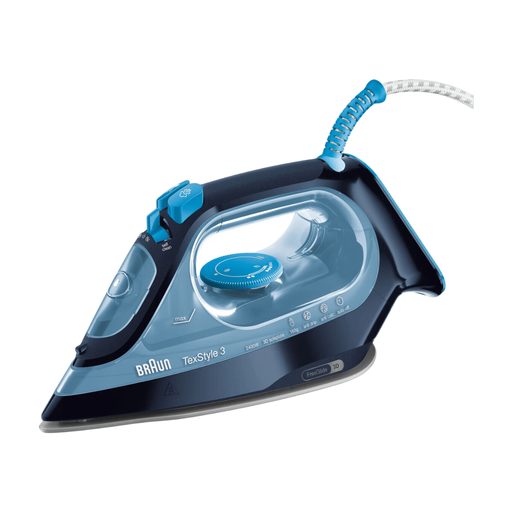 Image unavailable
A standard steam iron for anyone considering a model from the Braun TexStyle 3 range; for shared use, check the settings and shut-off function on the exact SI3050 model.
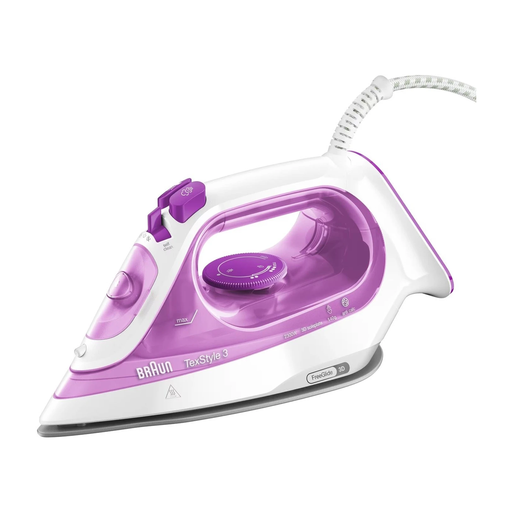 Image unavailable
A standard steam iron for anyone who irons small items and seams; check the temperature setting and maintenance requirements for this exact model.
No. Follow the handkerchief’s care label, even if it is made of cotton or contains a blended fabric. GINETEX ironing symbols indicate the maximum soleplate temperature; the fabric name alone doesn’t determine the correct setting.
Agree who will check the reservoir and soleplate, and who will descale the appliance according to the manual. The Dutch Consumers’ Association notes that limescale build-up means maintenance is needed; follow the instructions for water for your specific model.
No. Treat the feature as an extra safety measure. Its availability and shut-off time vary by model; switch the appliance off, unplug it and let it cool down safely.
No. According to the Dutch government, consumers are entitled to a product that works properly, but there is no fixed statutory guarantee period in the Netherlands. If a product is faulty, contact the seller; a manufacturer’s guarantee is an additional benefit.
Electrical equipment within the applicable voltage range must meet the safety requirements of the Low Voltage Directive. The Netherlands Food and Consumer Product Safety Authority outlines manufacturers’ and importers’ responsibilities; EU information includes requirements such as conformity assessment, CE marking and clear safety information. A listing in an online shop is not, by itself, proof that an individual item complies.