
Shared utility room user
You iron a few covers and then clear the workspace. Compare how easy the appliance is to store and what safety features it offers.


For a few covers in a shared utility room, a standard steam iron is the obvious choice if you want to put it away easily after use. For a pile of covers, a steam generator with a separate water tank may be worth considering if you have room for the base. The Consumentenbond points to a generator’s larger water tank, as well as the extra cost and space it may involve. Always follow the care label on each cover: GINETEX explains that the label applies to the whole textile item, not just the fibre type.
You iron a few covers and then clear the workspace. Compare how easy the appliance is to store and what safety features it offers.
Your cotton covers may have a print, finish or zip. GINETEX emphasises that the care label applies to the whole textile item, including these details.
You regularly iron a pile of covers and weigh up refilling less often against the space needed for an appliance with a separate base. The Consumentenbond describes the larger water tank as a feature of steam generators.
Best for: short ironing sessions with a few covers, when you want to clear the shared workspace quickly.
Things to consider: the built-in water tank may need refilling more often when ironing larger quantities. Automatic shut-off does not replace taking care when putting the iron away and switching it off.
Best for: ironing several covers in a row, if you have enough space to use and store it.
Things to consider: the separate base takes up space, and the Consumentenbond notes that steam generators cost more.
| Consideration | What to look for | Which consumers? |
|---|---|---|
| Workspace and storage | Compare the appliance and any separate base; also consider how you can position it securely. | If I need to clear the shared utility room quickly after a short session, I want an appliance that is practical to store. Consumers who prioritise space and easy tidying account for about 33% of consumers in this use situation. |
| Fabric and finish | Check the label on the whole cover before setting the temperature or steam; also check the instructions for any print, finish or accessories. | If a cover has a print, finish or zip, for example, I want to follow the care label for the whole item. Consumers who prioritise fabric protection above all else when buying account for about 27% of consumers in this use situation. |
| Several covers per session | Compare tank capacity and refilling; keep the stated continuous steam output separate from a short burst of steam. | If I iron several covers in a row, I want to know how often I may need to stop to refill the tank. Consumers who prioritise long ironing sessions account for about 20% of consumers in this use situation. |
| Descaling and ongoing costs | Check the care instructions and whether the model needs consumables; anti-scale features do not eliminate the need for maintenance. | I want to understand in advance how to descale the appliance and whether this involves buying supplies regularly. Consumers who prioritise maintenance and running costs when buying account for about 20% of consumers in this use situation. |
The label applies to the whole cover. A print, finish or accessory may also affect how the item can be treated.
Check the label on the specific cover before choosing the temperature and steam setting.
A steam boost and continuous steam output describe different functions. One figure alone does not tell you how a whole pile of covers will iron.
Compare the stated figures separately, and take tank capacity, refilling and available space into account.
According to the Consumentenbond, an anti-scale system slows the build-up of limescale, but maintenance is still needed. Systems with cartridges may involve recurring costs, depending on the system and how it is used.
Check the descaling instructions for the exact model and whether it requires replacement cartridges.
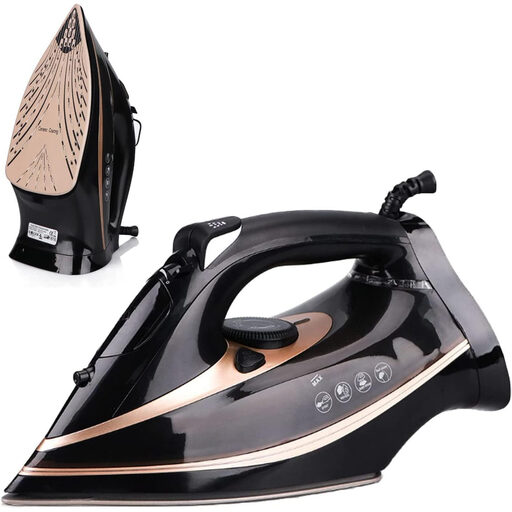
The Azur 8000 DST8050/20 is an example of a standard steam iron.
The TexStyle 5 SI5256BL is an example of a steam iron with manual temperature selection.
The brand offers both the standard Ultimate Power Pro FV9E50 steam iron and the Express Easy SV6131 steam generator.
This selection includes standard steam irons and steam generators to compare for ironing cushion covers. For electrical appliances covered by the Commodities Act Decree on Electrical Equipment, check the CE marking and safety information for the exact version; the NVWA says that products of this kind must carry a CE marking.
 No image available
A standard steam iron to compare if you do not want a separate generator base.
The product name lists a continuous steam output of 70 g/min, a 120 g steam boost and a 300 ml water tank.
The product name also lists a self-cleaning function.
 No image available
A standard steam iron to compare for ironing covers without a separate generator base.
The product name lists a non-stick soleplate, automatic cleaning and an anti-drip system.
 No image available
A steam generator to compare if you iron several covers in a row and have room for a separate base.
The product name lists 2400 W, a 350 g steam boost and a 1,4 L water tank.
 No image available
A steam generator to compare if you are considering a model with a separate base for ironing cushion covers.
The product name identifies this as a Philips steam generator, model GC6842/30.
 No image available
A steam generator to compare if you have room to store a separate base in the shared utility room.
The product name identifies the model as Tefal SV8026 Express Power.
No. Use the care label on the whole cover to determine the maximum temperature and treatment, not just the fibre type. GINETEX explains that the finish, applications and accessories may also affect this.
Follow the instructions for your appliance on switching it off, letting it cool, emptying it and putting it away. Automatic shut-off is an additional feature, not a reason to leave a hot appliance in the shared workspace.
The Consumentenbond says that steam irons and steam generators are generally designed for tap water, but guidance on softened water and descaling varies between models. Follow the instructions for the exact version; an anti-scale feature does not eliminate the need for maintenance.
No. A manufacturer’s warranty is in addition to your statutory rights. According to ACM ConsuWijzer, the seller is responsible for offering an appropriate solution if a product breaks during normal use sooner than you could reasonably expect.
The NVWA says that electrical products covered by the Commodities Act Decree on Electrical Equipment must carry a CE marking. This is the manufacturer’s declaration that the product meets European requirements; check the marking and safety information for the exact version.