
Anyone who wears a waistcoat every day
You want to freshen up your waistcoat after a wet journey without treating the fabric or finish incorrectly. GINETEX advises following the care label rather than relying on the fibre name alone.


A steam generator is worth considering if you regularly iron other cotton items or thicker cotton garments as well as your waistcoat. For a quick touch-up, though, the larger unit may be more awkward to use. First check the ironing symbol, lining and finish: the fact that a garment is made of cotton does not determine how much heat or steam the whole waistcoat can take. Extra steam will not dry a soaking-wet waistcoat straight away.
You want to freshen up your waistcoat after a wet journey without treating the fabric or finish incorrectly. GINETEX advises following the care label rather than relying on the fibre name alone.
You also iron other sturdy cotton items and could benefit from a steam generator’s separate water tank and continuous steam. The Consumers' Association describes the larger tank as a feature of steam generators.
Your waistcoats may contain different materials or finishes, so you want to tailor how you treat each part that the care label says can be ironed.
A good fit if: you regularly iron several garments or sturdy cotton items and can make use of a separate water tank and continuous steam.
The trade-off: the Consumers' Association describes a steam generator as larger and heavier to store than a standard steam iron.
A good fit if: you usually just touch up a waistcoat and have limited storage space.
The trade-off: the Consumers' Association highlights the larger tank and benefits for heavier ironing loads as advantages of a steam generator. Decide whether they outweigh the extra space it takes up for your quick touch-up.
| What to consider | What to look for when buying | Who is this important to? |
|---|---|---|
| Protecting the fabric and finish | Check the ironing symbol and whether steam is allowed; also check the lining, buttons and seams. | If my waistcoat is still damp after being caught in the rain, I want to know which parts can take heat and steam first. Around 36% of consumers put protecting the fabric and finish first. |
| Regular cotton ironing | Compare continuous steam output in g/min separately from the steam boost, and check whether you have room for the unit. | I also regularly iron other sturdy cotton items and want to use a generator mainly for those. Around 29% of consumers prioritise regular ironing. |
| Different parts that can be ironed | Check which steam settings the model offers and match them to the instructions for each part. | If my waistcoat has different materials or finishes, I want to tailor how I treat each part that can be ironed. Around 21% of consumers focus on this flexibility. |
| Maintenance and storage | Read the model-specific descaling instructions and think about where you could keep the unit. | If I have limited storage space, I want to know in advance where a larger unit will fit and what maintenance it needs. Around 14% of consumers prioritise maintenance and storage. |
According to GINETEX, the care label determines how a garment can be treated, not the fibre name alone. The lining and finish may have different instructions.
Check the labels for the relevant parts and make sure steam ironing is allowed before applying heat or pressure.
Manufacturers list continuous steam output and steam boost separately; a peak figure does not describe the whole ironing session.
Compare the stated continuous output in g/min separately from the steam boost, and consider whether you regularly iron several garments.
The Consumers' Association describes a steam generator as larger to store than a standard steam iron. Maintenance instructions vary by model.
Check the space you have available beforehand, and follow the chosen model’s manual for descaling and cleaning.
The CareStyle 5 IS5249BK is a model to consider if you want to compare different steam settings.
The Express Power SV8110 is a model to consider if you want to compare continuous steam output and anti-scale maintenance.
The PerfectCare 8000 PSG8300/80 is a model to consider if you want automatic steam output for fabrics that can be ironed.
These product suggestions are for ironing and steam-ironing clothes. The list includes both steam generators and a standard steam iron; the latter is not a substitute if you specifically want a generator.
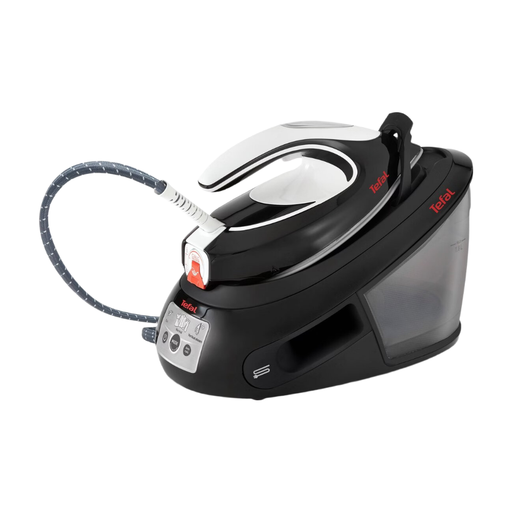 No image available
A model to consider if you’re specifically looking for a steam generator.
The product name states 6,5 bar.
 No image available
An option to compare if you’re looking for a steam generator for ironing clothes.
2400 W; 350 g steam boost; 1,4 l water tank; vertical ironing; blue.
 No image available
A model to compare if you’re looking for a steam generator for your ironing.
 No image available
An option to compare if you’re looking for a steam generator with specified tank and steam details.
70 g steam output; 120 g steam boost; 6 bar; removable 1,8 l tank; ECO setting; anti-scale function; automatic switch-off.
 No image available
This is a standard steam iron, not a steam generator. Consider it only if you’re not specifically looking for a generator.
2000 W; blue and white.
Don’t rely on the word cotton alone: check the ironing symbol, and consider the lining and finish too. GINETEX includes a symbol for ironing without steam. Extra steam is no guarantee that a soaking-wet waistcoat made from several components will dry straight away.
Follow the manual for the specific model. For the maintenance procedure described, Tefal advises unplugging the appliance and letting it cool down; Tefal also warns against putting descaling products in the tank. Don’t assume these instructions apply to another brand or model.
An additional package is not the same as your statutory rights. ACM ConsuWijzer explains that in the Netherlands, statutory guarantees apply if a product does not do what you could reasonably expect under normal use, alongside any manufacturer’s or retailer’s guarantee. The retailer is your point of contact for an appropriate solution.
Appliances within the scope of the EU Low Voltage Directive must meet the relevant safety requirements and CE rules when placed on the market. For alternating current, the scope covers 50–1000 V. The manufacturer is responsible for compliance; CE marking is not an independent test of ironing performance.
For online purchases from a business, you generally have 14 days to change your mind, although there are exceptions. Check the retailer’s information for the terms that apply to your purchase.