If you iron several shirts in a row after a busy school week, a steam generator is worth considering: its larger water tank can mean fewer pauses to refill it. For the occasional single collar, a standard steam iron may be more practical, as there’s no separate base unit to store. Consumentenbond also recommends considering how much space the base unit takes up. Check the soleplate, maintenance requirements and care label on your clothes, too.
Who is a steam generator suitable for?
The time-poor collar ironer
You mainly want to smooth out collars and areas around buttons before the school week begins again. Braun describes the CareStyle 3 IS3255BL as having a curved soleplate for working around buttons and seams. Always follow the shirt’s care label, too.
The weekly shirt ironer
You iron several shirts in a row and don’t want to keep stopping to refill the water tank. Consumentenbond cites the larger tank as one reason to consider a steam generator. Also check that the base unit fits on your ironing board and in your storage space.
The space-conscious ironer
You only iron occasionally and need to be able to store your appliance easily. Consumentenbond recommends comparing it with a standard steam iron, as a steam generator comes with a separate base unit.
What should you look for when ironing shirt collars?
Steam generator
Choose this if: you iron several shirts in a row after the school week or often have to deal with stubborn creases.
The trade-off: the larger water tank can mean fewer refills, but the base unit takes up space. Consumentenbond also recommends checking that it fits your ironing board.
Standard steam iron
Choose this if: you mainly iron one collar now and then or have limited storage space.
The trade-off: there’s no separate base unit, but the iron carries its own water, and its smaller tank may need refilling sooner during a long ironing session.
| What to consider |
What to look for |
Who is this most relevant to? |
| Collars and buttons |
Compare the soleplate shape and steam settings. Braun describes the curved soleplate on the IS3255BL as designed for working around buttons and seams. |
If you mainly want to iron collars and areas around buttons precisely, you’ll need good control of the soleplate and should follow the garment’s care label. Around 33% of consumers prioritise this level of precision. |
| Several shirts |
Compare tank capacity and continuous steam output in g/min. Treat the steam boost as a separate specification from continuous output. |
When you have a pile of shirts to iron, you’ll want to stop less often to refill the water tank. Around 27% of consumers prioritise a long ironing session with few interruptions. |
| Maintenance and limescale |
Check how to descale the model and follow its specific instructions. Consumentenbond notes that the method varies from one appliance to another. |
If you want to keep maintenance simple, find out in advance what tasks and parts are required for your chosen model. Around 20% of consumers prioritise maintenance. |
| Space and cost |
Measure your storage space and compare the appliance with a standard steam iron, too. Consumentenbond notes that room for the base unit is one factor to consider. |
If you only iron a collar now and then, you won’t want an appliance that’s awkward to store or offers more than you need. Around 20% of consumers prioritise space or keeping costs down. |
Common mistakes when buying a steam generator
-
Comparing a steam boost as if it were available continuously
Manufacturers list continuous steam output and steam boost as separate specifications. One figure doesn’t mean the same thing as the other.
When comparing models for several shirts, start with the continuous output in g/min, then look at the steam boost separately.
-
Buying a steam generator just for the occasional collar
A steam generator has a separate base unit and may take up more storage space than you need for occasional ironing. Consumentenbond suggests a standard steam iron as an alternative for people who iron less often.
Measure the space where you plan to store the appliance and check that the base unit fits on your ironing board.
-
Assuming anti-limescale features mean no maintenance is needed
Limescale can affect steam performance, and the cleaning method varies from one model to another.
Before you buy, check how to empty and descale the appliance, then follow the instructions for your chosen model.
Brands to consider when choosing
Philips
The Philips PSG3000/20 is worth comparing for regular shirt ironing. Consider its continuous steam, steam boost and soleplate.
- Philips Netherlands lists 120 g/min continuous steam, a 350 g steam boost and a ceramic soleplate for the PSG3000/20.
- These are Philips specifications, not results from independent tests of collar ironing. Check the base unit and maintenance instructions, too.
Braun
The CareStyle 3 IS3255BL is worth a look if you often iron around buttons and seams.
- Braun lists 130 g/min continuous steam, a 480 g steam boost and a curved FreeGlide 3D soleplate for this model.
- Braun’s claim that the soleplate glides more easily around obstacles isn’t an independently verified ironing result.
Tefal
The Pro Express Ultimate II GV9710E0 combines stated continuous steam output with a removable limescale collector.
- Tefal lists 155 g/min continuous steam, a 580 g steam boost and a removable limescale collector.
- Steam boost is a different specification from continuous output. Tefal’s performance and suitability claims aren’t comparative test results.
Tristar
The ST-8930 offers a different combination of tank and steam settings to compare.
- Tristar lists a fixed 1,2 l tank, 100 g/min continuous steam and an adjustable thermostat for the ST-8930.
- According to Tristar, the tank can’t be refilled continuously and the steam output isn’t adjustable. These specifications don’t prove an independently verified ironing result.
Steam generators for this ironing task
This selection features steam generators to compare if you iron several shirts in a row after the school week. For collar work, consider the soleplate, too, and check that the base unit fits in your storage space.
 No image available
Philips 3000 Series steam generator PSG3000/20
Worth comparing if you iron several shirts in a row. Check that the soleplate suits your collar-ironing needs, too.
- 2.400 W
- Steam boost: 350 g
- Water tank: 1,4 l
View at Joybuy
 No image available
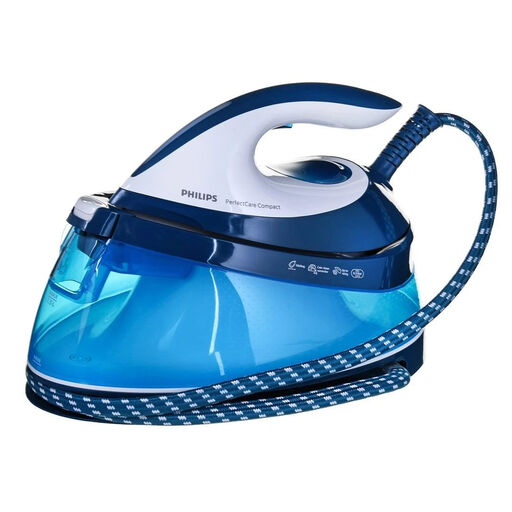
Philips PerfectCare Compact Essential GC6842/30
A steam generator to compare for ironing several shirts in one session. Before buying, check the tank details and that the base unit will fit in your available storage space.
View at Joybuy
 No image available
Tefal SV8026 steam generator
A model to compare for ironing several items in a row. Check the tank and maintenance details for this version before deciding.
View at Joybuy
 No image available
Philips PerfectCare GC7840/20 steam generator
An option to compare for ironing several shirts in a row. Consider whether the specifications suit your collar-ironing needs and maintenance preferences, too.
- 2.400 W
- Steam boost: 400 g
- Water tank: 1,5 l
View at Joybuy
 No image available
Morphy Richards EasySteam+ MUH-ISE4B
A model to compare for ironing several shirts in one session. Check that the stated tank capacity and steam settings suit the way you plan to use it.
- 2.400 W
- Steam boost: 120 g
- Steam output: 70 g
- Pressure: 6 bar
- Removable tank: 1,8 l
View at Joybuy
Frequently asked questions
How should you start ironing a shirt collar?
First, check the care label and don’t use steam if the label says not to. Philips recommends laying the collar flat, ironing the underside first and then the outside, and guiding the iron tip around the buttons.
How often should you descale a steam generator?
Follow the instructions and any maintenance alerts for your chosen model. Consumentenbond notes that descaling methods vary between appliances. An anti-limescale system doesn’t necessarily mean you can skip maintenance.
Does the manufacturer’s guarantee provide the full guarantee in the Netherlands?
No. According to the Dutch government, statutory consumer rights are separate from any manufacturer’s guarantee. If an issue is covered by your statutory rights, the retailer must offer a solution. Consider what an extended guarantee actually adds before paying for one.
Which product safety rules apply when buying in the Netherlands?
EUR-Lex explains that the EU Low Voltage Directive applies to electrical equipment with a rated voltage of 50–1.000 V AC. Equipment within this range must meet requirements including CE marking, clear instructions and safety information. Check this information for the specific product: a model name alone doesn’t prove that it meets the requirements.


