
Anyone ironing several cotton skirts
You want to tackle stubborn creases in a dedicated ironing session before the working week. Look at continuous steam output and how well it irons cotton, not just the steam boost.


If you iron several cotton skirts in a row before the working week, or are dealing with stubborn creases, a steam generator could be a good choice. Compare continuous steam output, tank capacity and ease of handling, and don’t mistake a steam boost for continuous performance. According to the Consumentenbond, a standard steam iron may be more practical if you iron infrequently or have limited storage space. Always check the care label for the whole skirt, including its lining and any embellishments.
You want to tackle stubborn creases in a dedicated ironing session before the working week. Look at continuous steam output and how well it irons cotton, not just the steam boost.
You iron several items of clothing in a row and want to minimise interruptions to refill the tank. The Consumentenbond cites the larger water tank as one reason to consider a steam generator for larger ironing loads; tank capacity, controls and maintenance are still worth checking for each model.
You want your skirts looking neat without leaving a large appliance on the ironing board all the time. Weigh the size of the generator against its tank capacity and the space you have available.
A good fit if: you iron skirts regularly but want to put the appliance away between uses.
The trade-off: a compact generator still has a separate tank; check its dimensions and how much room it takes up on your ironing board.
A good fit if: you iron several skirts and other laundry in one session and want to refill less often.
The trade-off: the larger tank needs storage space and room on your ironing board; compare the descaling method for each model too.
A good fit if: you usually iron just one skirt, have limited space or are prioritising the initial purchase cost.
The trade-off: according to the Consumentenbond, a standard steam iron generally has a smaller tank and produces less steam than a steam generator.
| What to consider | What should you check? | Who should give this more weight? |
|---|---|---|
| Creases in cotton | Compare continuous steam output in g/min separately from the steam boost; if possible, look for an independent assessment of how well it smooths cotton. | If I iron several cotton skirts before the working week, I want to know whether the continuous steam output is suitable for the creases. Around 36% of consumers prioritise ironing results on cotton. |
| Getting through an ironing session | Check the tank capacity and whether you can refill it during use; also consider how easy the iron is to handle. | When I iron several items of clothing in a row, I don’t want to stop often to refill the tank. Around 29% of consumers prioritise ironing without interruptions. |
| Lining and finish | Read the care symbol and instructions for the whole garment, then check whether the controls are suitable. | For a skirt with a lining or embellishments, I want to avoid treating a delicate part incorrectly. Fabric care is the main priority for around 21% of consumers. |
| Space and maintenance | Measure the space available for the appliance and ironing board; check the descaling method for the specific model. | If I have limited storage space, I also want to know how much room the tank needs and what maintenance is required. Around 14% of consumers put space and maintenance ahead of other buying factors. |
A steam boost and continuous steam output are different specifications. The Consumentenbond assesses crease removal separately, so a peak figure alone doesn’t tell you how well a model performs on cotton.
Compare figures using the same units and measurement basis. If available, check a test of how well the exact model smooths cotton.
The care label sets the maximum temperature; knowing the fibre is cotton alone doesn’t tell you what the lining, appliqués or finish can withstand.
Read the instructions for the whole skirt before ironing. GINETEX advises basing the maximum temperature on the care label, not just on the fibre composition.
A separate tank takes up space, and limescale can affect how a steam iron works.
Check the dimensions and whether your ironing board is suitable. Follow the instructions for the exact model when descaling.
The PerfectCare Compact GC7840/20 is a compact steam generator worth comparing if easy storage and operation without manual temperature settings are important to you.
The Express Essential SV6115E0 and Express Airglide SV8026E0 have different tank and maintenance features to suit your ironing session.
The CareStyle 3 IS3255BL is worth considering if manoeuvrability around seams and pockets matters to you.
Laurastar describes Lift Plus as a portable steam station for use on the ironing board and on clothes on a hanger.
These steam generators are worth comparing for ironing skirts and other laundry in one session.
 Image unavailable
A compact model worth comparing if you want to put the generator away between uses.
Joybuy lists 2400 W, a 1,4-litre tank and a 350 g steam boost. The product name also mentions vertical ironing and a lightweight, compact design. A steam boost isn’t a measure of continuous steam output.
 Image unavailable
A compact model worth considering if you iron regularly and want to factor in storage space.
The product name includes Compact Essential and model GC6842/30. Compare its dimensions with the space where you plan to store it.
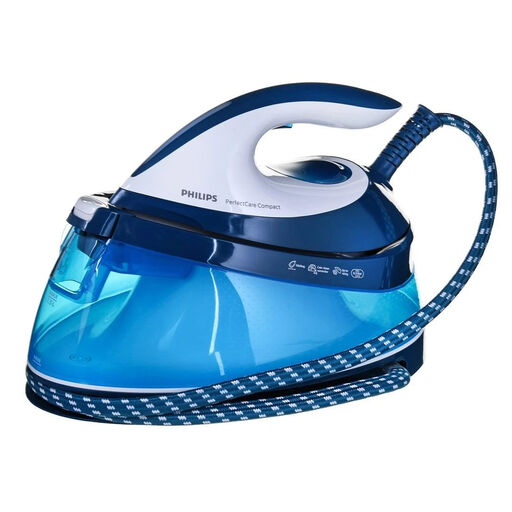 Image unavailable
A compact model worth comparing if you iron several skirts and have limited storage space.
Joybuy lists 2400 W, a 1,5-litre tank and a 400 g steam boost. The product name also mentions vertical steaming and quick heat-up. The steam boost is separate from continuous steam output.
 Image unavailable
A model worth comparing if a removable tank and maintenance features matter during a longer ironing session.
Joybuy lists a removable 1,8-litre tank, 6 bar pressure, a 120 g steam boost and a steam output of 70 g. No time unit is given for the output, so don’t compare this figure as if it were g/min. The product name also mentions an anti-scale function.
No. Follow the skirt’s care label and don’t base the temperature solely on the fact that the fabric is cotton. Also take any delicate parts of the garment into account.
Not necessarily. According to the Consumentenbond, a standard steam iron may be a better fit if you do little ironing, have limited storage space or are prioritising the initial purchase cost. A steam generator is mainly worth considering for larger ironing loads or stubborn creases.
Follow the descaling instructions for the exact model. Philips explains that harder water can cause limescale to build up more quickly, and that regular descaling helps prevent problems such as brown stains, leaks and reduced steam output. Don’t assume that a Philips maintenance interval also applies to other brands.
In the Netherlands, the retailer is responsible for the statutory guarantee. According to ACM ConsuWijzer, the retailer must offer a suitable solution if the product doesn’t meet what you could reasonably expect; a manufacturer’s guarantee doesn’t replace this right.
Yes, for electrical products covered by the Dutch requirements for electrical equipment. According to the Netherlands Food and Consumer Product Safety Authority, the manufacturer uses the CE mark to declare that the product meets the applicable European requirements. CE marking isn’t an independent product assessment.