
Anyone who irons a shirt occasionally
You mainly want to get one cuff and the rest of a single shirt looking smart before a visit. Limited preparation time, little storage space and precise ironing around buttons all matter.


For one shirt before a visit, a standard steam iron is often more practical. A steam generator is more suited to anyone who also regularly irons larger loads of laundry or stubborn creases, according to the Consumers' Association. When ironing cuffs, look for precise control around buttons and adjustable steam, and factor in the extra space needed for the base unit and maintenance.
You mainly want to get one cuff and the rest of a single shirt looking smart before a visit. Limited preparation time, little storage space and precise ironing around buttons all matter.
You often iron laundry as well as shirts, or tackle stubborn creases, so a separate water tank could be useful. The Consumers' Association says a steam generator is particularly suited to regular, prolonged ironing.
You want to match the temperature and steam to the garment care label, and take the maintenance instructions for your chosen model into account too. Philips recommends checking the care label before ironing a garment.
| What to consider | What should you check? | Who should pay particular attention to this? |
|---|---|---|
| Precise ironing around buttons | Look at the shape of the tip and soleplate, and check whether the steam can be adjusted. Philips recommends unbuttoning the cuff and ironing the inside first, followed by the outside, using the tip to work around the buttons. | If I mainly want to work neatly around buttons, I look for control over the tip and steam output. Around 42% of consumers put precision when ironing cuffs first. |
| Getting started quickly | Check the warm-up time for the exact model and allow for setting up and storing the base unit. A short warm-up time alone does not prove that ironing a single cuff will be quicker. | Before heading out, I want to get one shirt ready in time, without unnecessary preparation. Around 25% of consumers place the greatest importance on getting started quickly. |
| Longer ironing sessions | Compare continuous steam output in g/min separately from the steam boost, and check the tank capacity and how it is refilled. | If I regularly iron more than just shirts, I look at the continuous steam output and the tank. Around 17% of consumers give longer sessions top priority. |
| Space and maintenance | Check how much room you need on the ironing board and for storage, and read the descaling instructions for the exact model. | At home, I want to be able to store and maintain an appliance without it becoming impractical. This is the top priority for around 16% of consumers. |
A steam boost and continuous steam output are different measurements. A high steam boost does not tell you how easy it is to work around buttons. Too much steam can also leave the fabric and ironing board damp.
For cuffs, also consider the shape of the soleplate and whether the steam can be adjusted. The Consumers' Association distinguishes between continuous steam and a steam boost; always follow the garment care label too.
For a short ironing session, the separate tank and larger overall size may not be worth the benefits for longer sessions.
Compare a standard steam iron with a generator in terms of preparation, storage and how often you iron larger loads.
An anti-scale system slows the build-up of limescale, but maintenance is still needed; the steps required vary by model.
Check the manual for your chosen appliance. Tefal advises against using vinegar or descaling products in the tank of its steam generators; don't apply this instruction to another brand without checking first.
The CareStyle 5 IS5249BK is worth comparing if you need to manoeuvre around buttons and also have longer ironing sessions.
The Express Essential SV6115E0 is a compact steam generator worth considering if getting started quickly is important to you.
The 3000 Series PSG3000/20 is another steam generator to compare for steam output and soleplate, based on how you plan to use it.
These models are steam generators for anyone who has longer ironing sessions as well as ironing cuffs. For one occasional shirt, a standard steam iron may be more practical. The Netherlands Food and Consumer Product Safety Authority states that CE marking is mandatory for electrical products. Check the marking on the specific item: the general requirement does not confirm that every product on offer complies.
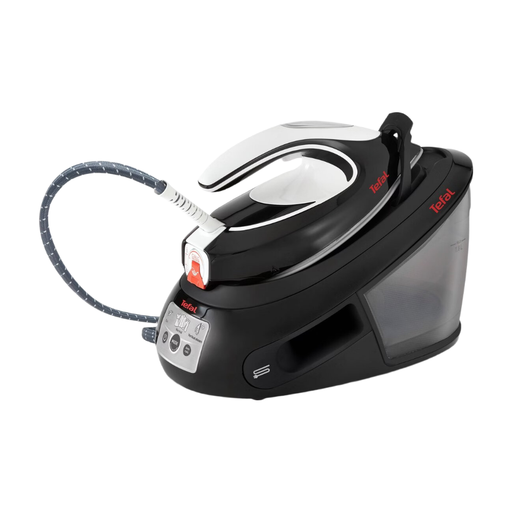 No image available
The separate base makes this an option to compare if you have longer ironing sessions as well as ironing cuffs.
The product information specifies a pressure of 6,5 bar, a removable limescale collector and a Durilium AirGlide soleplate. Automatic temperature and steam settings are also mentioned.
 No image available
The tank capacity may be useful if you regularly iron larger loads as well as shirts.
The product information specifies a removable 1,4-litre tank, a warm-up time of around 2 minutes and 2400 W. Philips specifies continuous steam output of 120 g/min, a steam boost of 350 g and a ceramic soleplate for this model.
 No image available
The separate base makes this model particularly relevant if you also have longer ironing sessions.
The product information specifies a removable 1,8-litre tank and Calc Clear. Continuous steam output and a steam boost are separate measurements; don't compare them as if they were the same.
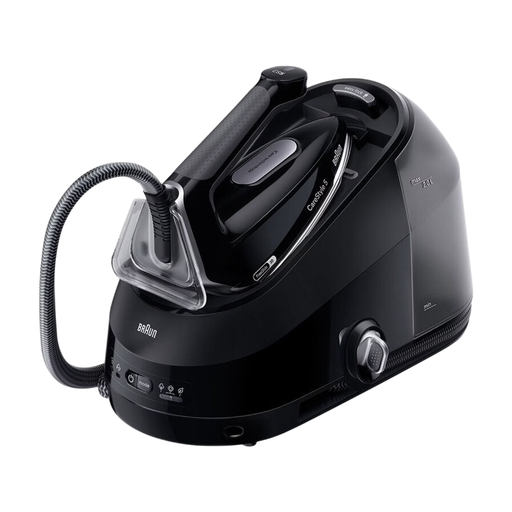 No image available
The manufacturer describes how the soleplate moves over obstacles, including buttons. This may be useful for cuffs, but it is not an independent test of ironing results.
The product information specifies a removable 2-litre tank. Braun gives continuous steam output of 150 g/min for this model.
 No image available
The product information mentions vertical steam for hanging clothes and curtains, as well as use on an ironing board.
Specifications include steam output of 70 g/min, a steam boost of 120 g, 6 bar and a removable 1,8-litre tank. The product information also mentions self-cleaning and anti-scale technology.
Unbutton the cuff, iron the inside first and then the outside, and use the tip to work around the buttons. Check the ironing symbol beforehand; not every fabric can be ironed or steamed.
Not necessarily, but check that your board has a suitable place for the base unit and can support the whole appliance. A generator may be too large or heavy for some standard ironing boards.
Follow the manual for the exact model and let the appliance cool down safely before maintenance. Tefal advises against using vinegar or descaling products in the tank of its steam generators; check the instructions for another brand separately.
No. According to the Dutch Government, there is no fixed statutory guarantee period in the Netherlands: you are entitled to expect a product to meet reasonable expectations. If a product is faulty, contact the seller; any additional guarantee is on top of your statutory rights.
Yes. The Netherlands Food and Consumer Product Safety Authority states that CE marking is mandatory for electrical products. This general requirement does not confirm that a specific item on offer actually carries the marking, so check the product itself.