
Occasional collar ironer
You mainly want a neat-looking collar, but wonder whether you need a steam generator for just one garment.


If you only iron one shirt collar now and then, consider a regular steam iron too. According to the Consumers’ Association, the separate water tank of a steam generator is most useful if you iron more often or need to tackle stubborn creases. If you do choose a steam generator, check that you can position and store the base safely, and find out how easy the specific model is to guide around collar points and buttons.
You mainly want a neat-looking collar, but wonder whether you need a steam generator for just one garment.
You iron shirts regularly, but need to find room for the appliance and ironing board in shared accommodation.
You iron several garments in one session with your housemates, so you pay attention to refilling and maintenance.
Best for: If you usually iron one collar or shirt and have little need for a separate water tank.
Consider: Compare how easy each option is to use for your ironing needs. According to the Consumers’ Association, a steam generator is most useful for large loads and stubborn creases.
Best for: If you regularly iron several shirts but have limited space to store the appliance.
Consider: ‘Compact’ doesn’t automatically mean the base will fit on your ironing board or in your cupboard. Check the dimensions and positioning requirements of the exact model.
Best for: If you iron several garments one after another with your housemates, or want straightforward limescale maintenance.
Consider: A tank that makes refilling easier or a specific limescale feature won’t solve the need for a suitable place to iron and store the appliance.
| What to consider | What to look for | Who is this important for? |
|---|---|---|
| Collars and buttons | Look at the shape and manoeuvrability of the soleplate tip. Assess the appliance for your fabric and follow the care label. | If I want to iron precisely around collar points and buttons, I look for good control of the soleplate; around 40% of consumers put precision around collars first. |
| Storage and positioning | Measure the available space and check the dimensions and positioning requirements of the model and ironing board. | If I share limited space with housemates, both the appliance and its base need a safe place during use; around 30% of consumers prioritise storage space. |
| Several garments | Check the tank and how it is refilled. Don’t compare continuous steam output with a short burst of steam. | If I iron several garments one after another with my housemates, I want to spend less time refilling; around 20% of consumers prioritise longer shared ironing sessions. |
| Maintenance and purchase | Find the instructions for the exact model and check how descaling works. Compare any additional warranty with your statutory rights. | If I don’t iron much, I want to weigh up whether I need a steam generator and what maintenance involves; around 10% of consumers prioritise maintenance and deciding whether to buy. |
A steam boost and continuous steam output are different product specifications. Neither, on its own, tells you how easy it is to iron around buttons.
Also check the shape of the soleplate tip and how easily you can guide the appliance around collar points. Don’t treat a brand’s claims as an independent comparison.
A steam generator has a separate base that needs to sit safely during use. Philips warns that a standard ironing board may not have a suitable rest for it.
Measure your available storage space and check the positioning requirements for the exact model before choosing it.
If your current ironing area isn’t suitable, you may need to find another suitable spot or get a different ironing board.
The Dutch Government states that there is no fixed statutory warranty period in the Netherlands. An additional warranty comes on top of your statutory rights to a product that works as it should.
Check what cover an additional warranty offers and compare it with your existing statutory rights.
Philips describes the PerfectCare Compact Essential GC6842/30 as compact and as a model with no manual temperature or steam settings.
Braun lists a continuous steam output of 120 g/min for the CareStyle Compact IS 2132 WH.
Tefal describes the Express Compact SV7112 as having a removable tank, and the Express Anti-Calc SV8010 as having a removable limescale collector.
Rowenta describes the Compact Steam DG7520F0 as designed to take up less space and lists a Microsteam400 soleplate.
These Joybuy steam generators are for people who regularly iron several garments or mainly want compact storage and easy maintenance.
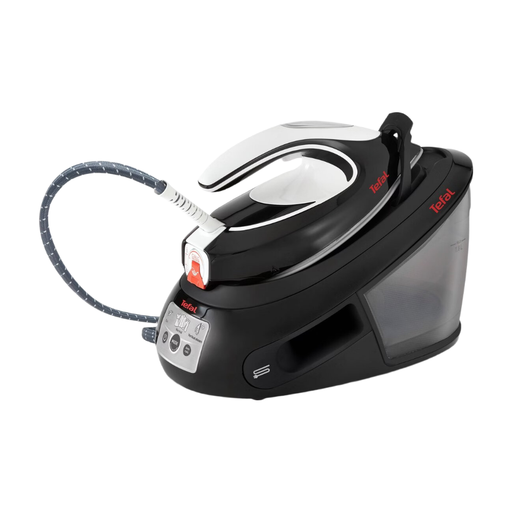 No image available
An option if you iron several garments and want a removable limescale collector.
Listed specification: 6.5 bar.
The product information lists a removable limescale collector.
 No image available
An option if you iron several garments per session and care about tank capacity and continuous steam output.
Listed specifications: 2400 W, 1.4-litre tank and 120 g/min continuous steam output.
The product information states that the appliance should be placed on a stable, level surface.
 No image available
An option if you iron regularly and want a model with no manual temperature setting.
Listed specification: 1.3-litre tank.
Philips describes the GC6842/30 as compact and as a model with no manual temperature or steam settings. The product information says it should be placed on a stable, level surface.
 No image available
An option if you want a removable tank and limescale maintenance features.
Listed specifications: 2400 W, 1.8-litre tank and 6 bar pressure.
The product name lists a 120 g steam boost and a steam output of 70 g.
The product information lists self-cleaning and anti-scale technology.
Not necessarily. The Consumers’ Association describes a steam generator as most useful for large loads and stubborn creases. If you usually iron one collar, consider a regular steam iron too.
Don’t assume so. Philips warns that a standard ironing board may not have a suitable rest for the base. Check the positioning requirements for the exact model and measure the space available.
Always follow the care label first. In its ironing guide, Philips recommends ironing the collar first and suggests using a clean tea towel as a protective layer for delicate or synthetic fabrics. This advice doesn’t guarantee that the fabric won’t be damaged.
Follow the instructions for the exact model number, as descaling procedures vary between series. For the Easy De-Calc series mentioned, Philips advises unplugging the appliance and leaving it to cool for two hours first. Don’t apply this advice to another model without checking.
If the appliance falls under the Dutch Commodities Act Decree on Electrical Equipment, the Netherlands Food and Consumer Product Safety Authority requires a CE mark. Check the marking and the identity of the specific appliance; the requirement doesn’t automatically apply to every product without first checking whether it falls within the scope of the rules.