Who is this relevant for?

If you iron a collar now and then

If all you want is a neat collar and you don’t want to set up a large ironing station for every shirt, weigh up the space a generator takes against a standard steam iron. The Consumentenbond suggests considering a steam iron if you do little ironing or have limited storage space.

If you have little storage space

If you iron regularly in a small home, it’s not just cupboard space that matters: you also need room for the complete appliance and the ironing board. Even a compact model still has a base unit.

If you iron several shirts in one go

If you often iron a pile of shirts, tank capacity may matter, alongside the weight of the iron and the space needed for the base unit. A larger tank is only practical if you can position and store the generator comfortably.

What should you look for when choosing?

Standard steam iron

Choose this if: you iron a collar now and then, have little space or don’t want a separate base unit.

The trade-off: The Consumentenbond recommends this type if you do little ironing or have limited storage space; the water goes in the iron itself.

Compact steam generator

Choose this if: you regularly iron several shirts and have room for both the base unit and a suitable ironing area.

The trade-off: Even a compact model needs space for its base unit, so measure the whole set-up rather than just the iron.

Generator for longer ironing sessions

Choose this if: you regularly iron several shirts as well as collars, and take maintenance and refilling into account.

The trade-off: Tefal lists a 1,8 L tank and a limescale collector for the SV8111E0; these features don’t prove that the model irons more precisely around a collar.

What to consider What to look for Who is this most important for?
Precision around the collar and buttons Look at the shape and reach of the soleplate tip, as well as the steam controls. Philips recommends laying the collar flat and ironing the underside first, followed by the outside. If I want to iron narrow collar sections and around buttons neatly, I focus on how easily I can position the iron there. For around 36% of consumers, this precision is the top priority.
Space for use and storage Measure your storage space and the stable area beside or on the ironing board, then compare these with the dimensions of the complete appliance. If I have little cupboard space, I want to know whether the whole appliance is easy to set up and put away. Space is the top priority for around 29% of consumers.
Several shirts in one go Compare the tank capacity and how it is refilled. Consider continuous steam output separately from a steam boost. If I’m ironing several shirts in one go, I don’t want to keep stopping to refill the tank. Around 21% of consumers prioritise longer ironing sessions.
Maintenance and running costs Check the care instructions for the exact model and find out what conditions apply to any additional warranty. If I want to understand the costs and maintenance involved, I also check how the appliance needs to be descaled. These factors matter most to around 14% of consumers.

Common mistakes

  • Assuming compact means it will fit on your ironing board

    A steam generator also has a base unit. It may be too large or heavy for the area where you usually iron.

    Before choosing, measure the available stable space and compare it with the dimensions of the complete appliance.

  • Looking only at the maximum steam boost

    A steam boost isn’t the same as continuous steam. Philips explains the order for ironing a shirt collar; the Consumentenbond recommends continuing to iron without steam after steaming, until the fabric is dry.

    Check the care label and consider how easy the iron is to manoeuvre around buttons and operate the steam controls. If needed, finish ironing without steam.

  • Confusing an additional warranty with your statutory rights

    According to the Dutch government, there is no fixed two-year statutory warranty period in the Netherlands. You don’t automatically need to pay for a warranty plan to have statutory rights.

    Before choosing a plan, read the terms to see what additional rights it actually provides.

Brands to compare

Philips

Philips describes the PerfectCare Compact GC7840/20 as compact and easier to store. It’s worth comparing if you’re considering a generator but have limited space.

  • Philips lists OptimalTEMP and a compact design for this model.
  • The product description doesn’t say whether the base unit will fit on your ironing board or how precisely it irons around a collar.

Braun

The CareStyle Compact IS 2143 BL is designed for a smaller set-up area and manoeuvring around buttons.

  • Braun lists a 1,5 L tank and says the soleplate is designed to glide backwards past buttons.
  • The claim of saving 50% space compares this model only with the Braun IS 7144, not with all steam generators.

Tefal

The Express Power SV8111E0 is worth comparing if longer ironing sessions and maintenance are important to you.

  • Tefal lists a 1,8 L tank, 120 g/min continuous steam and a limescale collector.
  • These manufacturer specifications don’t show that the model is more precise for shirt collars; check whether the base unit fits in your ironing area.

Products at Joybuy

This selection includes steam generators for regular shirt ironing, plus a compact 2-in-1 steamer and iron to compare if you only iron a collar now and then.

Philips 3000 Series PSG3000/20 steam generator

Philips 3000 Series PSG3000/20

A steam generator to compare if you iron shirts for longer as well as collars; remember to allow space for the base unit.

The product description lists a removable 1,4 L tank and 120 g/min continuous steam.

Joybuy

Philips PerfectCare Compact Essential GC6842/30

Philips PerfectCare Compact Essential GC6842/30

A compact generator to compare if you iron several shirts and have room for a separate base unit.

The product description lists a 1,3 L tank, 120 g/min continuous steam and automatic temperature control.

Joybuy
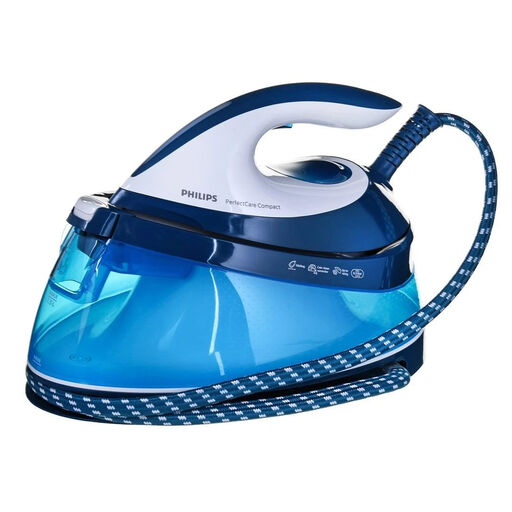
Philips PerfectCare Compact GC7840/20 steam generator

Philips PerfectCare Compact GC7840/20

A generator to compare if you regularly iron several shirts; measure the space for the complete appliance first.

The product description lists a 1,5 L tank, 120 g/min continuous steam and Smart Calc-Clean.

Joybuy

Morphy Richards EasySteam+ MUH-ISE4B steam generator

Morphy Richards EasySteam+ MUH-ISE4B

A steam generator to consider if you iron for longer as well as tackling collars, and want to factor in maintenance; allow space for the base unit.

The product description lists a removable 1,8 L tank, self-cleaning and anti-scale technology.

Joybuy

Russell Hobbs Steam Genie 2-in-1 28370-56

Russell Hobbs Steam Genie 2-in-1 28370-56

A 2-in-1 steamer and iron to compare if you mainly iron collars now and then and want to avoid a separate generator base unit.

The product description lists a ceramic soleplate, 20 g/min steam and a 3 m cord with a rewind system.

Joybuy

Frequently asked questions

How do you iron a shirt collar without using more steam than necessary?

First, check the care label and lay the collar flat. Philips recommends ironing the underside first, followed by the outside. The Consumentenbond recommends continuing to iron without steam after steaming, until the fabric is dry.

How do you descale a steam generator?

Follow the instructions for the exact model, as the steps vary depending on the limescale system. Tefal advises against using vinegar or descaling products in the tank of its steam generators. If your appliance has a limescale collector, switch it off and let it cool completely before removing it.

Should you buy an additional warranty in the Netherlands?

You don’t need one to have statutory rights: according to the Dutch government, you’re legally protected if a product is faulty, and the retailer must provide a solution. There is no fixed two-year statutory warranty period in the Netherlands. An additional warranty is only worth considering if its terms give you extra rights.

Is CE marking compulsory for a new electric iron in the Netherlands?

CE marking is compulsory for electrical equipment covered by the Dutch Electrical Equipment Decree. The Netherlands Food and Consumer Product Safety Authority explains that the manufacturer uses the mark to declare that the applicable requirements have been met; the mark itself is not an independent certification.
