
Applying patches during a seasonal wardrobe change
You want to apply an iron-on patch without damaging the fabric or adhesive layer. First, check the patch instructions, garment care label and controls on the exact iron you plan to use.


A steam generator is most useful if, alongside patches, you also iron a lot of laundry or tackle stubborn creases. For a few patches and very little ironing, a standard iron may be more practical. Always follow the instructions for the specific patch and the garment care label. For example, Vlieseline recommends a dry ironing step for Stretchfix, so check that your chosen appliance offers the required temperature and steam control.
You want to apply an iron-on patch without damaging the fabric or adhesive layer. First, check the patch instructions, garment care label and controls on the exact iron you plan to use.
You iron a lot of laundry, or thick items, in one go, so you’re considering a larger tank and more steam. Assess patch application separately, though.
You only do this occasionally and need to put the appliance away afterwards. A standard iron may be more practical than a system with a separate base.
Choose this option: if, in addition to applying patches, you regularly iron large piles of laundry or tackle stubborn creases. The Consumentenbond cites frequent ironing as a reason to consider a steam generator.
The trade-off: the larger tank and base take up space, and extra steam doesn’t prove that the appliance is suitable for a particular patch.
Choose this option: if you do little ironing or have limited storage space, and can find a model that supports the required temperature and any dry-pressing step.
The trade-off: a smaller tank and less steam may be less convenient when you have a large pile of laundry to iron.
Consider this: if the patch or repair material is designed for it, or if the area is subject to a lot of wear. Prym recommends adding a few stitches in areas prone to wear when using its tested iron-on repair fabric.
The trade-off: sewing it on takes extra work; check the instructions for the specific material.
| Buying concern | What should you look for? | Who is this most relevant to? |
|---|---|---|
| Pressing the patch and garment correctly | Read the patch instructions and garment care label; check whether the exact appliance allows the specified temperature and, if required, dry pressing. | I want to be sure the pressing method is right for both the patch and the garment fabric; around 36% of consumers put correct pressing first. |
| Large seasonal laundry loads and stubborn creases | Compare tank capacity and continuous steam output; also check how much space the base takes up. | If I’m ironing a lot of laundry in one go, capacity matters more than just the patch task; around 29% of consumers say a large pile of laundry is their main buying concern. |
| Different and delicate fabrics | Check the temperature controls on the exact model and compare them with garment care labels and patch instructions. | When dealing with different fabrics, I want to be able to adjust the settings without assuming an automatic setting is right for every patch; around 21% of consumers put this first. |
| Storage and maintenance | Measure the available storage and ironing space; read the maintenance instructions for the model you choose. | If I only use the appliance around a seasonal wardrobe change, I want to know whether the base can be stored away and whether maintenance will be manageable; around 14% of consumers say space and maintenance are their main buying concern. |
A steam boost and continuous steam output describe ironing functions; they don’t tell you whether the adhesive layer can be treated as directed in the patch instructions.
First, check the patch instructions, garment care label and the temperature and steam controls on the exact model.
A setting for ironable fabrics doesn’t confirm that the appliance can provide the specified temperature or dry-pressing step for a particular adhesive layer.
Compare the complete patch instructions with the model’s manual; don’t base your choice on an automatic setting alone.
The larger tank can be useful if you do a lot of ironing, but the separate base needs extra space.
Take your other seasonal laundry and available storage and ironing space into account, and compare a standard iron too.
The Philips 3000 Series PSG3000/20 lists continuous steam output of 120 g/min and a 350 g steam boost. Philips describes the PerfectCare PSG7300/70 as offering automatic steam.
The Express Airglide SV8026E0 lists continuous steam output of 120 g/min, a removable 1.8-litre tank and Calc Clear.
Braun describes the CareStyle 3 IS3257BK as compact, with Eco iCare and a shaped soleplate for ironing around seams and buttons.
These models are options for regular seasonal ironing. Use them for patches only if the patch instructions and the manual for the exact model are compatible, including when dry pressing is required.
 No image available
An option to compare for a larger pile of regular laundry; the product listing mentions temperature selection based on the garment care label.
Listed features: continuous steam output of 120 g/min, a 350 g steam boost and a 1.4-litre water tank. The product listing mentions separate steam settings.
 No image available
An option to compare for longer sessions of regular ironing; the product listing mentions automatic temperature control.
Listed features: continuous steam output of 120 g/min and a 1.3-litre reservoir. The product information does not mention a temperature dial or manual temperature setting.
 No image available
An option to compare for longer sessions of regular ironing; the removable tank and maintenance feature are useful points to consider.
Listed features: continuous steam output of 120 g/min, a 1.8-litre tank, a 380 g/min steam boost and Calc Clear.
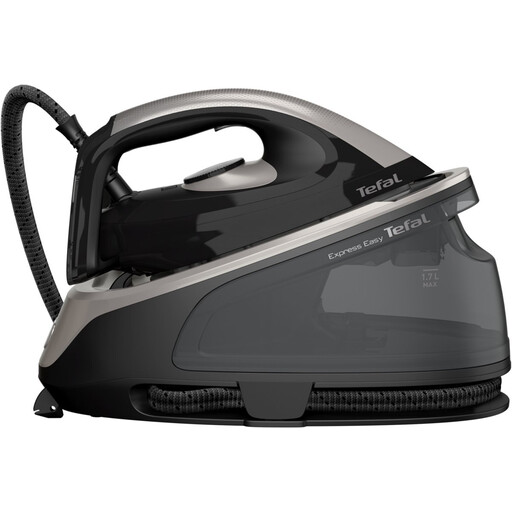 No image available
An option to compare for a larger pile of regular laundry; the product listing mentions a removable tank.
Listed features: continuous steam output of 120 g/min, a 1.7-litre tank, a 350 g/min steam boost and a locking system for storage.
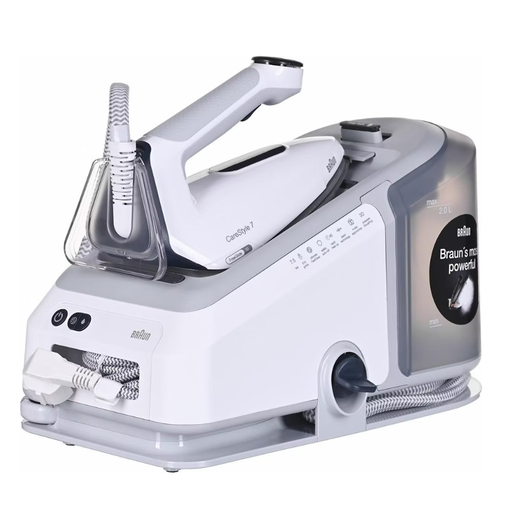 No image available
An option to compare for longer ironing sessions; the product listing mentions a 2-litre water tank.
Listed features: iMode selector, FreeGlide 3D soleplate and FastClean descaling.
Not necessarily: follow the instructions for the specific patch and the garment care label. Vlieseline recommends dry ironing Stretchfix first, followed by pressing with a damp cloth. This method doesn’t automatically apply to other materials.
Don’t assume so. The Consumentenbond points out that you can’t turn off the steam on every iron or steam generator. Check the manual for the exact model before choosing it for a dry-pressing step.
Follow the manual for the model you choose. For the maintenance procedure described, Tefal recommends unplugging the appliance and letting it cool down first. Don’t assume this instruction applies to another model.
When you buy from a business at a distance, you generally have a 14-day cooling-off period, although exceptions may apply depending on the circumstances. The product must also meet legal requirements; if there’s a problem, contact the seller.
No. According to European information about CE marking, it is relevant for certain products covered by applicable EU rules. It isn’t an independent quality mark and doesn’t prove that an appliance can use the pressing method specified for your patch. Check the product information and instructions for use instead.