
Weekly linen ironer
You regularly iron several linen napkins alongside other laundry and want to tackle stubborn creases. The Consumentenbond lists large amounts of ironing and stubborn creases as reasons to consider a steam generator.


For a substantial weekly ironing session involving stubbornly creased linen napkins, a steam generator is worth considering. For smaller, occasional loads, a standard steam iron may be more practical. When ironing mixed loads, compare how the exact model controls temperature and steam, and consider the space it needs and its model-specific descaling requirements. Published steam figures are manufacturers’ specifications, not directly comparable test results for linen napkins.
You regularly iron several linen napkins alongside other laundry and want to tackle stubborn creases. The Consumentenbond lists large amounts of ironing and stubborn creases as reasons to consider a steam generator.
You switch between napkins and other ironable fabrics during the same session and pay attention to how the appliance controls temperature and steam. The settings available vary by model.
You want to get through larger loads without stopping often to refill the water, but you also need space for the separate base. Whether the tank is removable and how it can be refilled depend on the model.
The Consumentenbond links steam generators with large amounts of ironing and stubborn creases; Philips says steam can help remove creases from linen more efficiently.
Choose this option if: linen napkins and other heavily creased items are often part of a larger ironing session.
Bear in mind: the separate base takes up space, and each model has its own maintenance instructions.
Choose this option if: you do little or only occasional ironing, or storage and ironing-board space are important considerations.
Bear in mind: according to the Consumentenbond, a standard steam iron has a smaller water tank and produces less powerful steam than a steam generator.
| Consideration | What should you check? | Who is this important to? |
|---|---|---|
| Stubborn creases in linen | Compare continuous steam in g/min separately from the steam boost; also check the descaling system. | If I iron linen napkins with stubborn creases every week, I want to distinguish continuous steam from a short burst of steam. Around 36% of consumers put removing creases from linen at the top of their list of priorities when buying. |
| Switching between fabrics | Check whether the exact model has automatic, fixed or manual settings, and follow the care labels. | When ironing a mixed load, I want to know whether I need to adjust the settings. Around 29% of consumers base their choice mainly on switching between fabrics. |
| Refilling during a session | Check the capacity in litres, whether the tank is removable and whether you can refill it while the appliance is in use. | When dealing with a larger weekly load, I don’t want to keep stopping to refill the water. Around 21% of consumers prioritise being able to keep ironing without frequent refills. |
| Space and maintenance | Measure the space available for the base and check the board’s weight capacity; read the descaling instructions for the exact model. | If space on the ironing board or in the cupboard is limited, I also want to know how much maintenance the generator needs. Around 14% of consumers give the greatest weight to space and maintenance. |
A steam boost is designed to deliver an extra burst of steam for a short time. Continuous steam is a separate function, and it matters when you’re ironing a pile of napkins.
Read both figures and their units for the exact model; don’t compare them as if they measure the same thing.
A steam generator also has a separate base that needs to sit securely. The Consumentenbond points out that a generator is larger and can be more difficult to move around.
Check the available space and the ironing board’s weight capacity in advance. Tefal recommends a sturdy board with a steam-permeable, perforated surface.
A scale collector or other anti-scale system doesn’t eliminate the maintenance required for that particular model. Limescale can affect steam production and ironing results.
Read the instructions for the exact model and let the appliance cool as directed before carrying out any maintenance.
Allow time for the cleaning steps required by your chosen model, too.
A manufacturer’s warranty or extended warranty doesn’t replace your right to a product that is fit for purpose. The Dutch Government states that the Netherlands has no fixed statutory warranty period; what you can reasonably expect from a product is what matters.
If a product is faulty, contact the retailer and treat any additional cover as separate from your statutory rights.
The Express range includes models with a removable tank and a scale collector.
The CareStyle 5 IS5249BK is a model to compare if you’re interested in a choice of programmes and how the appliance is operated.
The 3000 Series PSG3000/20 and PerfectCare 7000 PSG7300/70 use different approaches to steam and settings.
These models are steam generators for weekly ironing sessions with linen and other fabrics. Compare the stated steam figures, settings, tank capacity and maintenance features in particular.
 Image unavailable
A model to compare for mixed weekly ironing loads, with a removable tank and a choice of settings according to the product description.
Specifications: 120 g/min of continuous steam, a 350 g steam boost and a 1,4 l tank. The title states 2400 W.
 Image unavailable
An option to compare if you want to take continuous steam, tank capacity and an anti-scale feature into account.
Specifications: 120 g/min of continuous steam, a 1,8 l tank and a steam boost of 380 g/min. The product description mentions Calc Clear and a removable tank.
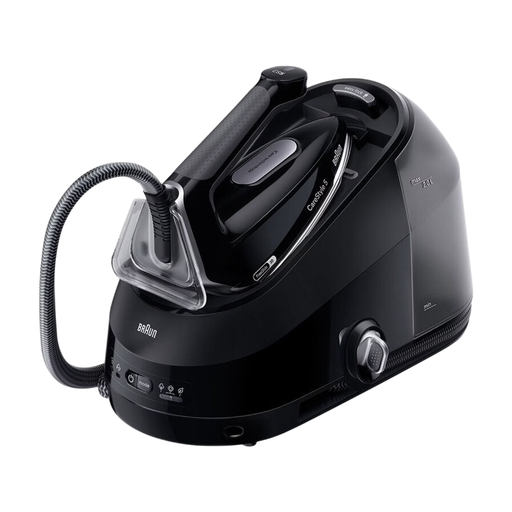 Image unavailable
Compare this model if you want to look at different programmes and automatic temperature control for a mixed load.
Specifications: steam output of up to 150 g/min, a 510 g steam boost and a 2 l tank. The product description mentions a removable tank and iCare temperature control.
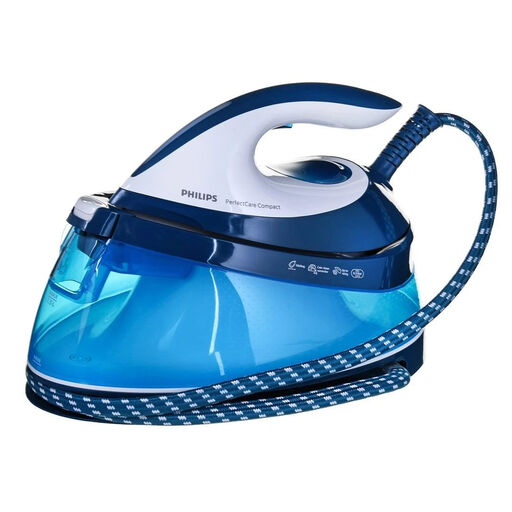 Image unavailable
A model to compare if you’d rather not set a separate temperature for each fabric when ironing different types of material.
The product description mentions OptimalTEMP and a removable tank. Specifications: 120 g/min of continuous steam, a 1,5 l tank and a 400 g steam boost.
 Image unavailable
An option to consider if you want to factor tank capacity and maintenance features into your choice for weekly ironing.
The title states a steam output of 70 g and a 1,8 l tank; the product description mentions a removable tank, self-cleaning and Cal-clean. The title also states a 120 g steam boost and a pressure of 6 bar.
No. According to the Consumentenbond, a standard steam iron may be more practical if you do little ironing or have limited storage space. A steam generator is mainly worth considering if you have a lot of ironing to do and need to tackle stubborn creases. Philips says steam can help remove creases from linen more efficiently.
Choose a board that’s sturdy enough to support the separate base, and check its weight capacity. Tefal recommends a sturdy board with a steam-permeable, perforated surface; this is the manufacturer’s advice.
Follow the instructions for the exact model. For models with a scale collector, Tefal advises switching the appliance off and letting it cool completely first, and recommends against using vinegar or descaling products on its steam generators. Philips also describes descaling procedures that vary by model.
No. According to the Dutch Government, the Netherlands has no fixed statutory warranty period; you’re entitled to a product that works properly for as long as you can reasonably expect it to. If a product is faulty, contact the retailer. A manufacturer’s warranty is in addition to this.
For a standard online consumer purchase, ACM ConsuWijzer says you generally have a statutory cooling-off period of up to 14 days after delivery, with exceptions for certain products. Check the retailer’s returns policy as well.