
People who often iron linen napkins
If you regularly want to smooth out a pile of napkins, heat and moisture can help with the heavier linen fibres. The Consumers' Association highlights this when discussing steam ironing.


A steam generator can be useful if you often iron a pile of linen napkins and have a permanent, stable place for the whole set-up. For just a few napkins or limited storage space, a standard steam iron may be more practical; the Consumers' Association lists small amounts of ironing and limited storage as reasons to consider one. If you’re looking at a generator, check the size and weight of the base as well as the iron itself.
If you regularly want to smooth out a pile of napkins, heat and moisture can help with the heavier linen fibres. The Consumers' Association highlights this when discussing steam ironing.
In an upstairs flat, you need space to set up, move and store the complete generator and ironing board. The Consumers' Association cites limited storage space as a reason to consider a standard steam iron too.
If you usually iron only a few napkins at a time, it’s worth comparing whether a standard steam iron would be simpler than a generator with a separate base.
Suitable if: you often iron a pile of linen napkins and have enough space for a stable ironing set-up.
Consider: the separate base takes up space and makes the complete set harder to move. A large amount of steam can also condense in the ironing board.
Suitable if: you usually iron a few napkins, have limited storage space or need to carry the appliance often. The Consumers' Association lists these as reasons to consider a standard steam iron.
Consider: the smaller tank may mean you need to refill it sooner during a longer ironing session.
| What to consider | What should you check? | Who is this for? |
|---|---|---|
| Smoothing and drying linen | Compare adjustable steam settings with the continuous steam and steam boost figures. Check whether you can finish drying the fabric without steam after steaming. | If I often iron linen napkins, I want to tackle creases and then leave the fabric dry. Around 36% of consumers prioritise smooth, dry linen. |
| Carrying and storage | Check the dimensions and weight of the complete set, and measure the storage space available. | In an upstairs flat, I want to know whether the whole set will fit in my ironing area and can be moved easily. Around 29% of consumers prioritise ease of handling at home. |
| Small loads of ironing | Think about how many napkins you usually iron in one go and whether a standard steam iron will be enough. | For a few napkins, I want an appliance that’s easy to pick up and put away. Around 21% of consumers particularly value convenience when ironing small loads. |
| Limescale maintenance | Check the descaling method and maintenance instructions for the exact model. | If I use steam regularly, I want to know what maintenance is needed to prevent limescale getting onto clean laundry. Around 14% of consumers prioritise easy limescale maintenance. |
A complete steam generator is larger and harder to move than a standard steam iron. A standard ironing board may also be too small or too lightweight.
Before buying, check the dimensions and weight of the whole set, the storage space available and whether your ironing board has enough capacity.
You may need a suitable ironing board or extra storage space.
A steam boost is different from continuous steam. Too much moisture can leave napkins and the ironing board wet; the Consumers' Association recommends ironing laundry without steam after steaming to dry it.
Compare the stated continuous steam and steam boost figures separately, and check whether you can use the appliance without steam to finish drying.
Even with an anti-scale feature, maintenance specific to the model is still important; limescale particles can end up on clean laundry.
Follow the descaling steps in the manual for the exact model.
The PSG3000/20 is a specific model you can use to compare steam specifications and the size of a generator with your needs.
The Express Essential SV6115E0 is a model to consider when choosing a generator; the specifications listed apply to this version.
The CareStyle 3 IS3257BK is a model to look at if you’re considering a compact generator with different operating modes.
This selection includes steam generators for regular ironing and a standard steam iron for smaller loads. For the item on offer, check that it has the required CE marking and EU declaration of conformity; CE marking is not an independent quality mark.
 No image available
An option if you regularly iron linen napkins and want to compare continuous steam with a separate steam boost.
Philips lists continuous steam of 120 g/min and a steam boost of 350 g for this model. The product name specifies 2400 W and a 1,4 L water tank.
 No image available
A model to consider if you’re looking for a steam generator; check that the complete set will suit your ironing area and storage space.
Before deciding, check the specifications, dimensions and maintenance instructions for this version.
 No image available
A standard steam iron to compare if you usually iron only a few napkins at a time.
The product name specifies a steam boost of 180 g/min, steam output of 40 g/min and a 300 ml water tank.
 No image available
A steam generator to consider if you’re looking for a removable tank and an Eco mode; check that the complete set will fit in your available space.
The product name specifies 2400 W, steam output of 70 g, a steam boost of 120 g, 6 bar and a removable 1,8 L tank.
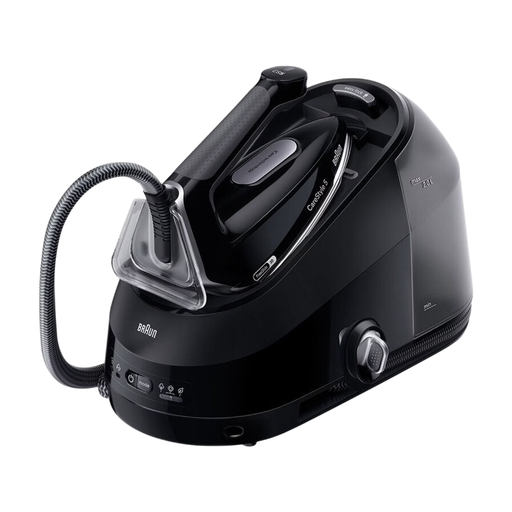 No image available
A model to consider if you’re looking for a generator for a pile of napkins; bear the weight of the complete set in mind when moving it.
The product information mentions an automatic programme that adapts to the fabric, but no adjustable steam output. Check whether that suits your preference for controlling the steam.
First, check the care label and iron the linen while it’s slightly damp, using an appropriate amount of steam. Then iron without steam until the fabric is dry, and leave the napkins to cool while dry.
Not always: a generator may be too large or heavy for a standard ironing board, and a lot of steam can condense in the board. Check the board’s capacity and use a well-ventilated board with a suitable protective cover.
Follow the manual for the exact model, as the process depends on its anti-scale system. Only empty the tank after use if the manual says you can.
No. According to the Dutch government, there is no fixed statutory guarantee period in the Netherlands: you’re entitled to a product that works properly for as long as you can reasonably expect it to. If a product is faulty, contact the seller; a manufacturer’s guarantee or an extended guarantee you’ve paid for is separate.
Electrical appliances offered for sale in the Netherlands must meet the applicable European requirements. According to Business.gov.nl, the manufacturer must apply the required CE marking and draw up an EU declaration of conformity; CE marking is not an independent quality mark.