
Family laundry in one go
If you iron shorts alongside other clothes, a larger water tank can mean fewer refills. The Consumers’ Association points to this as an advantage of steam generators.


A steam generator is a sensible choice if you regularly iron several items in one go. For the occasional pair of shorts, a standard steam iron is often more practical. Check the care label, continuous steam output and maintenance requirements, and make sure the base fits securely on your ironing board. For a specific appliance, also check whether CE marking is required and present.
If you iron shorts alongside other clothes, a larger water tank can mean fewer refills. The Consumers’ Association points to this as an advantage of steam generators.
If you want to tackle creases in shorts, compare continuous steam output and the soleplate. The Consumers’ Association discusses steam generators for people who iron frequently and want to tackle stubborn creases; the care label should always take precedence.
If storage space is limited or you iron different fabrics, consider how much room the base needs and how easy it is to adjust the temperature. The Consumers’ Association notes that a steam generator can be too large for a standard ironing board; Philips describes the temperature control on the PSG7200/20.
Choose this type if: you regularly iron several pairs of shorts and other items in one go.
Bear in mind: the separate base takes up space and may be too large or heavy for a standard ironing board, according to the Consumers’ Association.
Choose this type if: you only iron one pair of cotton shorts occasionally or have limited storage space.
Bear in mind: if you have a larger pile, you may need to refill the water sooner. A smaller tank is not necessarily a drawback for occasional use.
First, compare what matters most to you: ironing continuously without refilling, treating each item according to its care label, or choosing an appliance that’s easy to store. The Consumers’ Association highlights the larger tank and the space it takes up as factors to consider; GINETEX emphasises that the ironing symbol shows which treatment is permitted.
| What to consider | What to look for | Who does this matter most to? |
|---|---|---|
| Tackling creases | Compare continuous steam output in g/min, how adjustable it is and the shape of the soleplate. Also check whether the care label allows steam ironing. | If I’m ironing shorts with stubborn creases, I want to compare continuous steam output without ignoring the care label. Around 40% of consumers put tackling creases first. |
| Ironing without refilling | Check the tank capacity in litres, whether the tank is removable and how to check the water level. | When I’m working through a pile of family laundry, I’d rather not keep stopping to refill the water. Around 30% of consumers prioritise uninterrupted ironing. |
| Switching between fabrics | Check the care label on each item and see what temperature controls the model has; settings do not replace the care label. | If I’m switching between shorts and other ironable fabrics, I want to be able to follow the care label for each item. Around 20% of consumers make ease of adjusting the settings their top priority. |
| Space and maintenance | Measure your storage space and check that the base sits securely on your ironing board. Look up the descaling instructions for the exact model number. | If I need to put the appliance away after use, I want to know whether the base will fit and what maintenance it needs. Around 10% of consumers prioritise space and maintenance. |
The larger tank is most useful when you’re ironing several items in one go. Even after a short ironing session, the separate base still takes up space.
If you only iron occasionally, compare a standard steam iron too, and think about where you’ll store the appliance.
The base needs a permanent spot while you’re ironing, as well as storage space when you’ve finished.
The stated steam boost and continuous steam output are different figures. If you iron repeatedly, continuous output is a separate point to compare.
Compare the figures in g/min separately from the steam boost in grams; don’t assume one figure can stand in for the other.
The care label on the shorts determines the permitted ironing temperature and whether you can use steam. For example, GINETEX includes an ironing symbol for a maximum of 110 °C without steam.
Check the ironing symbol on each pair of shorts before choosing the temperature or steam setting.
Using a treatment that doesn’t match the care label can damage the garment.
Descaling procedures can vary between model ranges, so instructions for another appliance may not be suitable.
Find the manual using the exact model number and follow its safety instructions.
The PerfectCare range is worth considering if you want to compare models with temperature control.
The Express Easy SV6131 is a model to include when comparing tank capacity and stated steam output.
The CareStyle 1 IS 1013 GR is worth considering if you’re looking for a model with a manually adjustable thermostat.
Parts information may be useful if you want to find out how to look for model-specific spares before buying.
These steam generators are for anyone who irons several items in one go. Check the care label on each pair of shorts and make sure your ironing setup is stable. The Netherlands Food and Consumer Product Safety Authority states that CE marking is mandatory for electrical products covered by the relevant rules; check this for the specific appliance.
 No image available
An option to compare if you iron several items in one go.
120 g/min continuous steam; removable 1.4-litre water tank; 350 g steam boost; ceramic soleplate and temperature selection according to fabric type.
 No image available
An option to compare if you switch between different ironable fabrics and want temperature control without manual adjustment.
120 g/min continuous steam; 1.3-litre tank; 360 g steam boost; OptimalTEMP, SteamGlide soleplate and vertical steaming.
 No image available
An option to compare if you value a tank for several items and a stated descaling system.
120 g/min continuous steam; 1,800 ml tank; 380 g steam boost; Durilium AirGlide soleplate and Calc Clear.
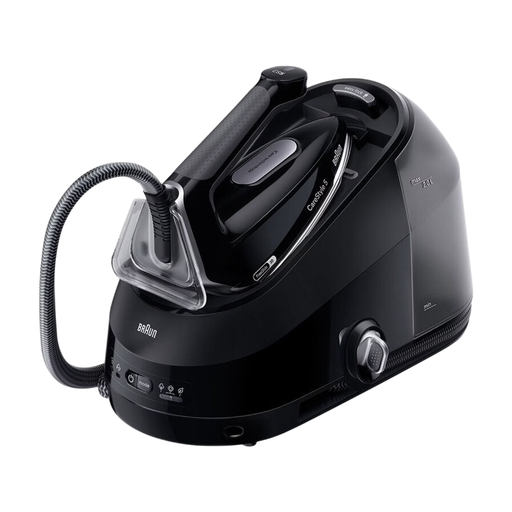 No image available
An option to compare if you switch between different ironable fabrics and want a removable tank.
Up to 150 g/min steam; removable 2-litre tank; 510 g steam boost; automatic iCare temperature control.
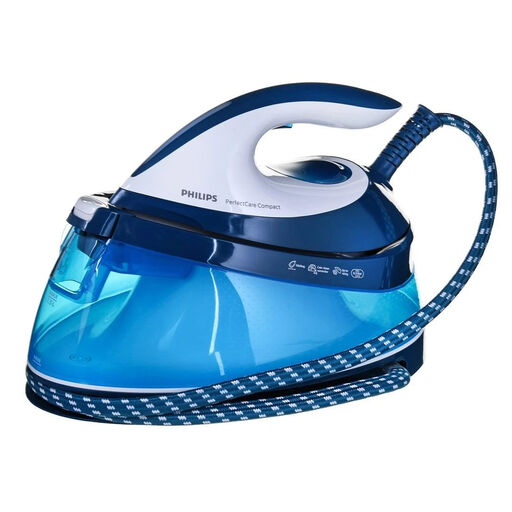 No image available
An option to compare if you want a tank that lasts for an ironing session and temperature control without manual adjustment.
120 g/min continuous steam; 1.5-litre tank; 400 g steam boost; OptimalTEMP, Smart Calc-Clean and vertical steaming.
No. Follow the care label on the shorts rather than relying on the fabric name alone. GINETEX also includes an ironing symbol for a maximum of 110 °C without steam.
It depends on the board and the dimensions of the base. The Consumers’ Association notes that a steam generator may be too large or heavy for a standard ironing board, so check that your setup is stable.
Look up the instructions for the exact model number and follow the steps provided. Philips describes different procedures for different ranges, so don’t automatically apply a warning for one model to another.
No. The legal guarantee does not give every appliance a fixed two-year term. ACM ConsuWijzer explains that you have a legal guarantee in addition to any manufacturer’s guarantee, and that the seller is responsible for providing an appropriate free solution if a product is faulty despite normal use.
CE marking is mandatory for electrical products covered by the relevant rules. The Netherlands Food and Consumer Product Safety Authority explains this requirement; check the marking on the specific appliance and don’t treat it as an independent product test.