If you only iron cuffs now and then, a compact steam iron may be enough; a steam generator iron generally takes up more storage space, according to the Consumers’ Association. If several people you live with regularly iron whole shirts, compare compact steam generator irons by soleplate tip, space required, stability and maintenance. Steam figures alone don’t tell you how easy it is to manoeuvre around buttons.
Who is this choice relevant to?
Occasional cuff ironer
You mainly want to tidy up cuffs and areas around buttons without storing a large appliance for occasional use. The Consumers’ Association says that a steam iron is worth considering if you have little ironing to do or limited storage space.
Ironer with limited storage space
You also iron whole shirts, but share a worktop, ironing board or cupboard and want to be able to put the appliance away easily after use.
Shared shirt ironer
Several people use the same appliance for longer ironing sessions. A stable place to set it up, refilling and model-specific maintenance are all important considerations.
What should you look for when buying?
Compact steam iron
Choose this if: you usually iron just a few cuffs or shirts and have limited storage space.
Bear in mind: you’ll generally need to refill it sooner during longer ironing sessions.
Compact steam generator iron
Choose this if: several people you live with regularly iron shirts and there’s a stable place for the base unit and ironing board.
Bear in mind: the separate tank and base unit need worktop and storage space.
| What to consider |
What should you check? |
Who should pay particular attention? |
| Ironing precisely around cuffs and buttons |
Check the shape of the soleplate tip, visibility around the buttons, the steam settings and the care labels on your shirts. |
If I mainly want to tidy up cuffs and areas around buttons, I look for a manageable soleplate tip and suitable steam settings. Around 33% of consumers say precision when ironing is their top priority when buying. |
| Storage and a suitable place to iron |
Compare the dimensions of the complete appliance with the available cupboard space, and check that the base unit and ironing board can stand securely. |
If I need to store the appliance in a shared cupboard after use, I want to know whether the complete base unit will fit. Around 27% of consumers say storage space is their top priority. |
| Safe shared use |
Check the instructions for the exact model, where to place the base unit and how everyone you live with will put the appliance away after use. |
If several people I live with use the appliance, I want clear arrangements for setting it down and storing it away. Around 20% of consumers put safe shared use first. |
| Purchase cost and limescale maintenance |
Weigh the purchase and maintenance costs against how often you iron, and read the descaling instructions for the exact model. |
If I only iron occasionally, I want to know whether the appliance and its maintenance suit the way I use it. Around 20% of consumers put cost and maintenance first. |
Common mistakes when buying a steam generator iron
-
Looking only at the steam boost or pump pressure
These figures don’t tell you how easily you can manoeuvre the soleplate around cuff buttons. The garment care label also determines whether and how you can iron the fabric.
Assess the soleplate tip and steam settings for the exact model, and check the care labels on your shirts before comparing specifications.
-
Assuming ‘compact’ means it will fit anywhere
Even a compact steam generator iron has a separate base unit. The complete appliance may therefore take up more space than your available cupboard, worktop or ironing board can accommodate.
Measure the available space and check that the base unit and ironing board can stand securely.
-
Using the descaling method for a different model
Maintenance procedures vary by model, and using an unsuitable method could damage the appliance.
Keep the instruction manual with the shared appliance and follow the procedure for the exact model.
Brands to compare
Philips
Philips describes the 3000 Series PSG3000/20 as a steam generator iron with a ceramic soleplate, 120 g/min continuous steam and a 350 g steam boost.
- The stated steam features may be worth considering if you iron whole shirts as well as cuffs.
- These are Philips specifications, not an independent assessment of how easily the soleplate tip moves around buttons. Check its shape and the storage space required separately.
Braun
Braun lists Eco, iCare and Turbo modes for the CareStyle Compact IS 2144 BK.
- The listed modes give you options to compare for different ironing tasks.
- Braun’s claim about saving time and space is based on an internal comparison with specific Braun models; it isn’t a general comparison with other compact steam generator irons.
Tefal
Tefal lists a removable 1,7 l tank, Calc Clear and a locking system for the Express Easy SV6131E0.
- For shared use, refilling, maintenance and moving the appliance are useful features to check on the exact model.
- A larger tank doesn’t automatically make an appliance more suitable for ironing cuffs occasionally; consider its size and soleplate too.
Joybuy products for cuffs and shared use
These models give you options to weigh up a steam iron for small ironing jobs against steam generator irons for several shirts and shared use.
 No image available
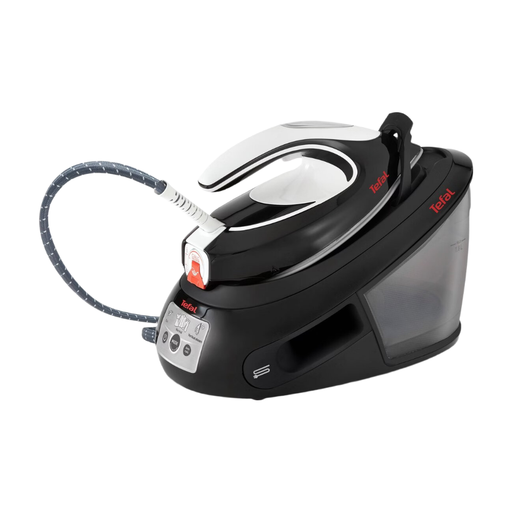
Tefal SV8055 Express Anti-Calc steam generator iron
If several people you live with iron shirts, you can compare this model with other steam generator irons and consider how much storage space it needs.
The product title lists a pressure of 6,5 bar.
Joybuy
 No image available
Philips 3000 Series steam generator iron PSG3000/20
If you iron shirts as well as cuffs, this is a model to compare for its soleplate and steam features. Also check that the tank and base unit will fit in your shared space.
Philips lists a ceramic soleplate, 120 g/min continuous steam and a 350 g steam boost.
Joybuy
 No image available
Philips PerfectCare Compact Essential GC6842/30
This is an option to consider if you’re thinking about a steam generator iron for shared ironing. Check the dimensions and where the base unit will sit in relation to your cupboard and ironing board.
The product name lists the GC6842/30 variant.
Joybuy
 No image available
Philips 3000 Series steam iron DST3031/20
If you mainly iron a few cuffs and think a generator might be too large, you could compare this steam iron as an alternative. Check whether the soleplate tip suits your shirts.
The product title lists a 180 g steam boost, 40 g/min steam output and a 300 ml water tank.
Joybuy
 No image available
Morphy Richards EasySteam+ MUH-ISE4B
If several people iron one after another, you can compare this model by tank capacity and storage options. Also check which maintenance instructions apply to everyone using it.
The product title lists 2400 W, a 1,8 l tank, a 120 g steam boost, 70 g steam output and an Eco mode.
Joybuy
Frequently asked questions
How do you iron a shirt cuff around the buttons?
First check the fabric care label and iron the unbuttoned cuff on both sides. Philips recommends carefully working around the buttons with the tip of the iron; check that the soleplate tip on your chosen model is suitable for this.
Can you use a steam generator iron on any ironing board?
Don’t assume so: according to the Consumers’ Association, a steam generator iron may be too large or heavy for a standard ironing board. Before buying, check that there’s enough space and that the complete appliance will stand securely.
How do you keep a shared steam generator iron clean?
Follow the maintenance instructions for the exact model and agree on who will look after it. Tefal recommends consulting the manual for its steam generator irons and warns against putting vinegar or descaling products in the appliance. Unplug it before maintenance and let it cool down.
What rights and safety rules apply when buying in the Netherlands?
CE marking is compulsory for electrical products covered by the relevant regulations, but the mark alone doesn’t prove that an individual product has been checked. When you buy remotely from a trader, you generally have a 14-day cooling-off period, according to the Dutch government. You’re also entitled to a product that meets the required standards, and the seller must provide a solution if something goes wrong.


