
If you iron several cotton covers
If you iron a pile of covers one after another, look at how the appliance handles cotton and at its continuous steam output. A steam boost is a separate specification.


A steam generator iron is worth considering if you regularly iron several cotton cushion covers or tackle stubborn creases. For the occasional single cover, a standard steam iron is often more practical. First check the care label on the cover, then consider whether you have enough space for the base unit, whether your ironing board can support it and what maintenance the model requires. A high steam boost on its own doesn’t tell you how well an appliance will smooth your covers.
If you iron a pile of covers one after another, look at how the appliance handles cotton and at its continuous steam output. A steam boost is a separate specification.
You’ll need room to set up both the base unit and the ironing board securely, and to put the appliance away after use.
Clear descaling and cleaning instructions help everyone follow the guidance for the specific model.
Choose this option: if you often iron several covers or tackle stubborn creases, and can give the appliance a permanent place.
Bear in mind: the larger base unit; lots of steam can also leave the cover and ironing board too wet.
Choose this option: if you only iron a cover now and then, or want to put the appliance away after every use.
Bear in mind: with a larger pile of washing, a smaller water tank may need refilling more often.
| What to consider | What to look for | Who it matters to |
|---|---|---|
| Steam and cotton | Compare continuous steam separately from the steam boost, and check the care label on the cover. | If I iron several cotton covers, I want to tackle creases without making the cover or ironing board too wet. Around 33% of consumers give smoothing cotton and removing creases their highest priority. |
| Shared ironing space | Compare the dimensions of the whole appliance with the space available, and check that the board can support the base unit securely. | If I share an ironing space with housemates, I want to be able to set the appliance down safely and put it away afterwards. For around 25% of consumers, having a practical shared space comes first. |
| Shared maintenance | Read the manual for the exact model and agree on who will maintain it. | If several housemates use the appliance, I want everyone to be able to follow the same descaling instructions. A clear maintenance routine is the main concern for around 25% of consumers. |
| Use and storage space | Consider how often you iron and how much room you have for the complete appliance. | If I only iron a cover now and then and have little cupboard space, compact storage is a key consideration. Around 17% of consumers prioritise how often they’ll use it and limited storage space. |
A steam boost and continuous steam are different specifications. Too much steam can leave the cover and ironing board wet.
Compare both figures separately and, where available, look at reviews of how well the iron performs on cotton.
A steam generator iron also has a base unit, which may be large or heavy for a shared ironing space.
Measure the available working and storage space, and check whether your ironing board can support the base unit securely.
If your current board or storage space isn’t suitable, you may need to find another place for it or arrange a suitable board.
Maintenance varies by model. Tefal advises against using vinegar or descaling products with its steam generator irons.
Keep the manual for the exact model somewhere all your housemates can refer to it.
For its PSG3000/20 steam generator iron, Philips lists a continuous steam output of 120 g/min and a ceramic soleplate. These are specific model details you can compare when choosing.
The Express Essential SV6116E0 is a steam generator iron for which Tefal provides a Dutch-language manual. This could help you agree on a shared maintenance routine.
Braun describes the CareStyle 3 IS3255BL as a compact model with a ComfortPro handle and FreeGlide 3D soleplate. These features may be worth considering if ease of handling and storage matter to you.
These steam generator irons are options to compare if you iron several cotton covers, with steam output, available space and maintenance all taken into account.
 No image available
A steam generator iron to compare if you iron several covers one after another; also check that you have enough room for the base unit.
Philips lists 120 g/min continuous steam and a 350 g steam boost for the PSG3000/20. The product name lists a 1,4 l tank and 2400 W power.
 No image available
This steam generator iron is another option to compare if you iron several covers. Check that it suits the working and storage space you have available.
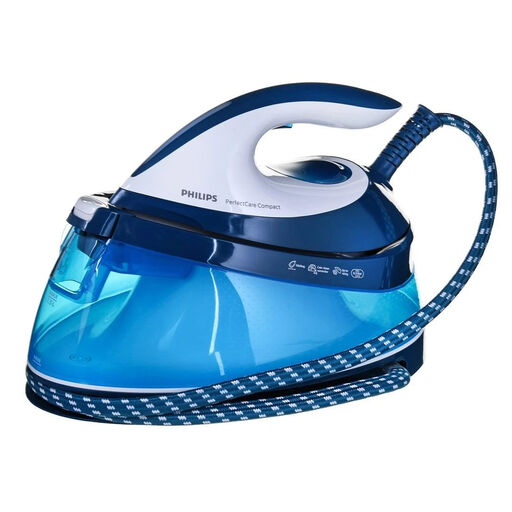 No image available
A steam generator iron to compare for longer ironing sessions; also check whether the stated tank capacity suits your needs.
The product name lists 2400 W, a 400 g steam boost and a 1,5 l tank.
 No image available
This steam generator iron may suit you if you’re comparing models with a larger tank; check whether the complete appliance will work in your shared ironing space.
The product name lists 2400 W, a pressure of 6 bar, an ECO setting and a removable 1,8 l tank.
No. The fibre name alone isn’t enough: follow the care label on the specific cover. The Consumers’ Association (Consumentenbond) advises adjusting the temperature and steam to suit the fabric; allow steamed fabric to dry and cool.
Not necessarily. A steam generator iron may be too large or heavy for a standard ironing board, so check that your board and the space available can support the base unit securely.
Follow the manual for the exact model and agree on who will carry out the maintenance. Tefal advises against using vinegar or descaling products with its steam generator irons. Unplug the appliance before cleaning and follow the instructions for your specific model.
If you buy as a consumer in the Netherlands, you’re entitled to a product that works as it should and can contact the retailer to find a solution. According to the Government of the Netherlands, there is no fixed statutory two-year guarantee period; the product’s expected lifespan depends on various factors, including the product itself.
Yes. Electrical appliances must meet the applicable product safety requirements. The Netherlands Food and Consumer Product Safety Authority (NVWA) outlines, among other things, the obligations of manufacturers of electrical equipment and the scope of the Low Voltage Directive. A product listing in a shop alone doesn’t prove that a particular item meets all the requirements.