Who is this guide for?

Anyone who wants to quickly touch up one skirt

If you mainly want to make one skirt look smart after a wet journey, a quick start and minimal storage space may matter more than a large water tank. The Dutch Consumers' Association considers a conventional steam iron a practical choice if you have little ironing to do.

Anyone who regularly irons cotton

If skirts are part of a larger pile of cotton clothes, a separate water tank can be handy, as it means fewer refills. Also consider how much room the appliance needs and follow the maintenance instructions for your specific model.

Anyone who takes care with their clothes

If your skirt has a lining, trim or other delicate feature, check the full care label first. GINETEX explains that care symbols take account of the most delicate parts of a garment.

What should you consider when choosing?

Conventional steam iron

A good fit if: you usually touch up one garment or have limited storage space.

The trade-off: the Dutch Consumers' Association says this type is more compact and heats up faster, but a smaller tank is less suited to a long ironing session.

Compact steam generator

A good fit if: you regularly iron several garments and want a separate water tank.

The trade-off: check whether the base will fit in your storage space and whether your ironing board can accommodate the complete system.

Steam generator with a larger tank

A good fit if: you often have longer ironing sessions and want to refill less often.

The trade-off: tank size and descaling systems vary by model, so also consider the appliance's overall size and maintenance needs.

What to consider What to check before buying Who is it for?
Quickly touching up one skirt Compare the type of appliance, its dimensions and the space taken up by the base. If I only want to touch up my skirt after a journey, I want to get started quickly and avoid storing a bulky base. Around 36% of consumers say being able to quickly smooth out one skirt is their main priority when buying.
Following the care label Check the ironing symbol and any restrictions relating to steam, lining or trim. If my skirt has a delicate lining or trim, I want to know which treatments are suitable for the entire garment. Around 29% of consumers say avoiding damage to their skirt is their top priority.
Refilling less often Check the tank capacity, whether the tank is removable and how much space the appliance needs. If I iron several cotton garments in a row, I want to minimise interruptions to refill the tank. Around 21% of consumers say longer ironing sessions are their main priority when buying.
Carrying out maintenance Check the descaling method and the instructions for the exact model. If I use the appliance regularly, I want to be able to maintain it by following clear instructions for my specific model. Around 14% of consumers say easy maintenance is their top priority.

Pitfalls when buying and using

  • Buying a generator for one quick ironing job

    The separate tank and base are most useful for longer ironing sessions; if you only occasionally iron one garment, a conventional steam iron may be more practical.

    Before buying, compare how many garments you usually iron in one session and how much space you have for the appliance and ironing board.

  • Assuming cotton can always take maximum heat and steam

    The fabric name alone does not determine what treatment the whole garment can withstand. A lining, colour or trim may limit the treatments you can use.

    Read the full care label and follow the stated temperature and steam restrictions.

  • Confusing a steam boost with continuous steam

    A steam boost measured in grams and continuous steam measured in grams per minute are different specifications. Manufacturer figures also do not prove how well the appliance will iron your skirt.

    Compare the same specification for exactly the same model version, and don't treat figures as directly comparable test results.

  • Using vinegar without checking the maintenance instructions

    The correct descaling method varies by model. Tefal advises against using vinegar and descaling products with its steam generators.

    Follow the manual for the exact model. Unplug the appliance before maintenance and let it cool down as directed by the manufacturer.

Brands to compare

Philips

The PSG3000/20 is an example of a 3000 Series steam generator with manual controls.

  • Philips lists continuous steam of 120 g/min and a 350 g steam boost for the PSG3000/20.
  • These are manufacturer figures, not measured results on a wet skirt; also compare the dimensions and controls with your ironing needs.

Tefal

The Express Power SV8111E0 is an example of a model with a larger removable tank and a removable scale collector.

  • Tefal lists a 1.8-litre tank and continuous steam of 120 g/min for this model.
  • Whether the tank, base and maintenance method suit you depends on how you use the appliance and how much space you have.

Braun

The CareStyle 7 Pro IS7282BL is a model to compare for its handle and adjustable programmes during longer ironing sessions.

  • Braun lists continuous steam of 180 g/min for the IS7282BL, along with Eco, iCare, Turbo and ProSteam settings.
  • The figure of 190 g/min applies to the other version, the IS7286BK, and is not a specification for the IS7282BL.

Joybuy products for this ironing situation

This selection includes steam generators for longer sessions and conventional steam irons for occasional touch-ups.

Philips 3000 Series PSG3000/20 steam generator

Philips 3000 Series PSG3000/20 steam generator

A steam generator to compare if you iron several garments as well as a skirt.

Power: 2400 W; tank: 1,4 litres; steam boost: 350 g.

Joybuy

Philips PerfectCare Compact Essential GC6842/30 steam generator

Philips PerfectCare Compact Essential GC6842/30

A steam generator to compare if you regularly iron several garments one after another.

Joybuy

Morphy Richards EasySteam+ MUH-ISE4B steam generator

Morphy Richards EasySteam+ MUH-ISE4B steam generator

A model to compare for longer sessions when you want to refill less often.

Power: 2400 W; tank: removable, 1,8 litres; Eco mode; pressure: 6 bar; steam boost: 120 g; steam output: 70 g.

Joybuy

Xiaomi BHR9034EU handheld steam iron

Xiaomi BHR9034EU handheld steam iron

A compact steam iron to compare if you mainly touch up one garment; this is not a steam generator.

Version: dual voltage.

Joybuy
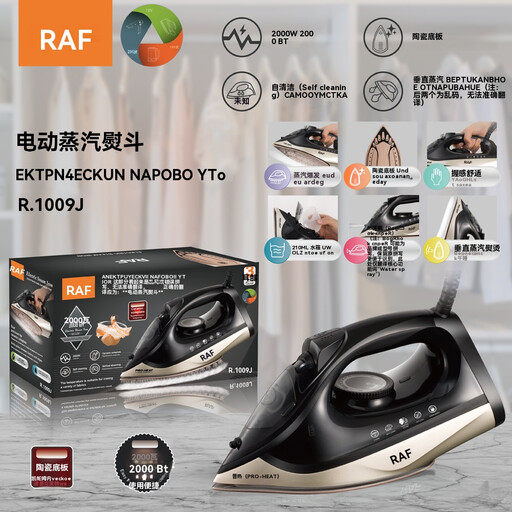
RAF 2000W steam iron with ceramic soleplate

RAF 2000W steam iron with ceramic soleplate

A conventional steam iron to compare for occasional touch-ups; it is not a steam generator.

Power: 2000 W; tank: 210 ml; ceramic soleplate; self-cleaning function.

Joybuy

Frequently asked questions

Can I immediately iron a cotton skirt that's wet from the rain using lots of steam?

Don't rely on the word 'cotton' alone: check the label first, including any restrictions on steam, lining and trim. A steam generator is not a guaranteed way to dry the skirt; let excess moisture drain away first and only iron it if the label allows.

Will every steam generator fit my existing ironing board?

No, you can't assume that. The Dutch Consumers' Association points out that a generator may be too large or heavy for a standard ironing board. Check the space available and whether your board can support the appliance.

How do I descale a steam generator?

Follow the manual for the exact model. Tefal advises against using vinegar and descaling products with its steam generators; the method may vary between versions. Unplug the appliance before maintenance and let it cool down as directed by the manufacturer.

Am I always entitled to exactly two years' legal guarantee in the Netherlands?

No. According to the Dutch government, there is no fixed statutory guarantee period in the Netherlands; what you can expect from a product depends on several factors, including the product and the circumstances. Report any fault to the seller. A manufacturer's guarantee is in addition to this.

Is a CE mark relevant to a steam generator?

Yes, for electrical and electronic equipment covered by the relevant EU rules. The European Union lists this type of equipment among the product groups subject to CE rules; the manufacturer is responsible for meeting the applicable product requirements and applying the mark. A CE mark is not a quality certificate issued by a central EU body.
