
If you iron dresses regularly
If you iron several cotton dresses in one session, a separate water tank and fewer refills may matter to you. The Consumers' Association explains the differences between a steam iron and a steam generator.


A steam generator may be worth considering if you regularly iron several cotton dresses in one go. Its separate water tank is a practical difference compared with a conventional steam iron. If you only iron occasionally, or storage space and a small ironing area are your main concerns, consider a conventional iron too. Check the garment care label, the space needed for the base, the descaling instructions and the compliance information for the specific appliance.
If you iron several cotton dresses in one session, a separate water tank and fewer refills may matter to you. The Consumers' Association explains the differences between a steam iron and a steam generator.
If you only iron occasionally and need to store an appliance and ironing board in a small shared living space, size is a factor. The Consumers' Association lists limited storage space as a reason to consider a conventional steam iron.
If your dresses have different care labels, linings or finishes, check the permitted temperature and steam treatment for each garment. GINETEX advises following the maximum temperature on the care label, rather than relying on the fibre type alone.
Suitable if: you occasionally iron one dress and have limited storage space.
The trade-off: The Consumers' Association describes a conventional iron as more compact and generally cheaper; the water is held in the iron itself.
Suitable if: you regularly iron several dresses in a row, but also need to fit the base into a small room.
The trade-off: The separate tank may mean fewer refills, but you’ll need to check the dimensions, weight and space available on your ironing board.
Suitable if: temperature settings, maintenance or ease of use around seams and details are priorities.
The trade-off: Settings and descaling instructions vary by model. Manufacturer claims about faster ironing or smoother gliding are not independent comparative test results.
| What to consider | What should you check? | Who is this important for? |
|---|---|---|
| Creases and multiple dresses | Compare continuous steam output in g/min with the steam boost; also check the tank capacity and how it is refilled. | If I iron several cotton dresses in a row, I want to refill less often and tackle stubborn creases. Around 28% of consumers prioritise ironing performance. |
| Space and ironing board | Measure your storage space and check the dimensions, weight and load capacity of your ironing board. | In a small room, I want to be able to set down and store the base without my ironing board being too small or too lightweight. Space is the main priority for around 22% of consumers. |
| Garment care label | Check the ironing symbol and any restrictions on steam for each dress. | For dresses with different care labels or finishes, I want to be able to adapt the treatment to each garment. Around 17% of consumers prioritise fabric care. |
| Maintenance and costs | Check the model’s descaling instructions and the terms of any additional warranty. | If I use the appliance regularly, I want to know what maintenance it needs and what extra costs may be involved. This is the main priority for around 17% of consumers. |
| Safe use in shared accommodation | Check where hot parts can be placed and the appliance’s compliance information; don’t connect extension leads to each other. | In shared accommodation, I want to use a safe place and socket without plugging too many appliances into one extension lead. Around 16% of consumers make safe use their main priority. |
A steam boost measured in g is not the same as continuous steam output in g/min, and on its own it doesn’t tell you how well the iron smooths cotton. The Consumers' Association distinguishes between product specifications and how ironing results are assessed.
Compare the steam boost and continuous steam output separately. If available, use an independent assessment of ironing performance on cotton.
Even a steam generator described as compact has a separate base, which may be too large or heavy for your usual ironing board.
Measure the available working and storage space, and check your board’s surface area and load capacity before choosing.
The care label shows how the garment may be treated, including its different parts and finishes. The word ‘cotton’ alone doesn’t determine which temperature or steam setting is suitable.
Read the label on each dress, then choose the appropriate temperature and steam setting.
A paid-for additional warranty does not replace your statutory rights. ACM ConsuWijzer distinguishes between statutory guarantees and additional retailer or manufacturer warranties.
Before deciding, compare the terms and extra cover of an additional warranty with your existing statutory rights.
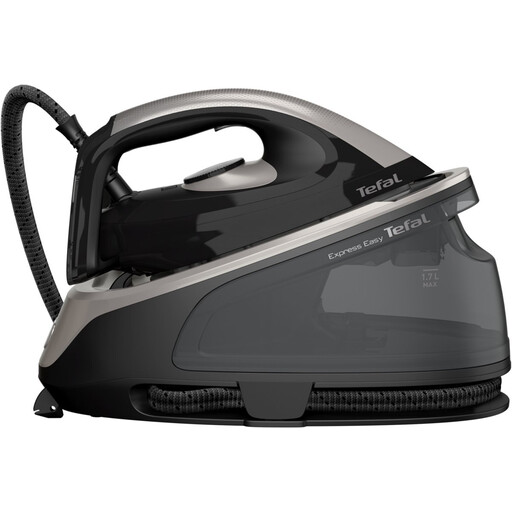
The Express Easy range includes steam generators with a removable tank.
Braun describes the CareStyle 3 IS3255BL as compact and highlights its shaped soleplate for buttons and seams.
Philips describes the PerfectCare 6000 Series PSG6064/80 as compact and highlights its OptimalTEMP technology.
According to Tristar, the ST-8930 has a manually adjustable thermostat and a fixed tank.
These steam generators are options to compare for ironing cotton dresses in student accommodation. Check the dimensions, ironing specifications, maintenance instructions and compliance information for each version.
 No image available
The product title describes a compact model; measure the space for the base and check that your ironing board can support it.
According to the product title: 2400 W, a 350 g steam boost and a 1.4-litre tank.
 No image available
The product title describes a compact model. Check the dimensions and weight of the base before deciding whether it will fit in your room and on your ironing board.
 No image available
If maintenance is important to you, check the descaling instructions for this exact version and compare them with how often you expect to iron.
 No image available
If you iron several dresses in a row, the tank is a useful point of comparison. Check the stated capacity and whether you can refill it while ironing.
 No image available
Compare the stated tank capacity and steam output with your ironing sessions; also check the descaling instructions for this model.
According to the product title: 2400 W, steam output of 70 g, a 120 g steam boost, 6 bar and a removable 1.8-litre tank.
No, not necessarily. The Consumers' Association describes a conventional steam iron as a sensible choice if you do little ironing or have limited storage space; a generator may be more appealing if you iron several garments in a row.
No. Follow the ironing symbol on the dress’s care label. GINETEX says the maximum temperature should be based on this, rather than on the fibre type alone; also check whether steam is permitted.
That depends on the dimensions and weight of the generator you choose, and your board’s load capacity. The Consumers' Association warns that a steam generator may be too large or heavy for a standard ironing board, so check both in advance.
Follow the descaling procedure for the exact model. The Consumers' Association explains that limescale can block the steam channels, so instructions for one appliance are not automatically suitable for another model.
Use a suitable socket and don’t connect extension leads to each other. The Fire Service also warns against plugging too many appliances into one extension lead; follow the instructions for safely setting down and storing the hot appliance too.