
If you often iron cotton dresses
If you regularly iron several dresses or tackle stubborn creases, compare the continuous steam output and tank capacity with the extra space taken up by the base.


If you regularly iron several cotton dresses, a steam generator may be worth considering: the iron is lighter, and the larger tank needs refilling less often. At the same time, the Dutch Consumers’ Association points out that the base and tank can make the appliance larger and more awkward to move or store. If you iron less often or regularly need to carry the appliance up and down stairs, compare a conventional steam iron too. Always check the garment care label and the space available on your ironing board.
If you regularly iron several dresses or tackle stubborn creases, compare the continuous steam output and tank capacity with the extra space taken up by the base.
In a flat upstairs, the size and weight of the whole system matter, not just those of the iron. The Dutch Consumers’ Association describes steam generators as large and heavy to move and store.
If care labels give different ironing instructions, temperature settings and the ability to adjust the steam are relevant factors in your choice.
A good fit if: you regularly iron several cotton dresses and have room for a separate base and tank.
Trade-off: the iron is lighter, but the complete appliance may be larger and heavier to carry and store.
A good fit if: you iron a dress occasionally, have little storage space or often move the appliance between floors.
Trade-off: the appliance is more compact, but the iron is heavier and the smaller tank needs refilling sooner.
When comparing steam generators for cotton dresses, look at continuous steam output separately from the steam boost: the two figures do not describe the same thing. The Dutch Consumers’ Association says test results for cotton provide more direct evidence of ironing performance than manufacturer specifications alone.
| Factor to consider | What should you check? | Who should give this more weight? |
|---|---|---|
| Smoothing cotton | Compare continuous steam output with the steam boost and, where possible, look for a test result for cotton. | If I regularly iron several cotton dresses, I want to know what continuous steam adds, not just how high the steam boost is; around 33% of consumers say smoothing cotton is their main concern when buying. |
| Carrying and storage | Check the dimensions, total weight, carry lock and the space available for the base. | In a flat upstairs, I want to be able to move and store the whole appliance without hassle; around 27% of consumers prioritise portability and storage space. |
| Temperature and steam | Read the garment care label and check whether temperature and steam can be adjusted separately, as well as any limitations of an automatic setting. | For dresses with different care instructions, I want to tailor the treatment to each fabric; around 20% of consumers say protecting fabric is their main concern when buying. |
| Descaling and dampness | Check the descaling instructions for the specific model, any replacement parts and whether your ironing board is suitable. | If I want to keep my ironing area dry and make maintenance easy to plan, I look at steam control and descaling; around 20% of consumers say maintenance and moisture control are their main concerns. |
A separate tank can make the iron lighter, but the base and tank together take up extra space and add to the weight you need to carry.
If you live in a flat upstairs, compare the weight and dimensions of the complete appliance and think about where you will place and store the base.
Manufacturers generally list both continuous steam and a separate steam boost. Too much steam can also leave your dress and ironing board too damp.
Compare the two figures separately and, if you want to assess how well it irons cotton, look for a test of the specific model.
An anti-scale system slows the build-up of limescale, but does not eliminate the need for maintenance.
Before buying, read the descaling instructions for the exact model and check whether any replacement parts are needed.
Some systems require replaceable anti-scale cartridges. Check which parts need replacing, and when, for each model.
The Philips 3000 Series PSG3000/20 is worth considering if you iron cotton regularly.
The CareStyle Compact IS 2143 is worth considering if size and storage space are important.
The Express Easy SV6131 is worth considering if you value a removable tank and being able to top it up while ironing.
The Silence Steam range is worth exploring if noise while ironing in a flat is a particular concern.
This selection includes steam generators for regular ironing and a conventional steam iron for those looking for a more compact appliance. The relevant EU safety requirements for low-voltage equipment apply to mains-powered electrical appliances with a rated voltage of 50–1.000 V AC. For the specific product, check the CE marking and EU Declaration of Conformity. The European Commission explains that CE is a declaration made by the manufacturer, not a certificate issued by a central EU body.
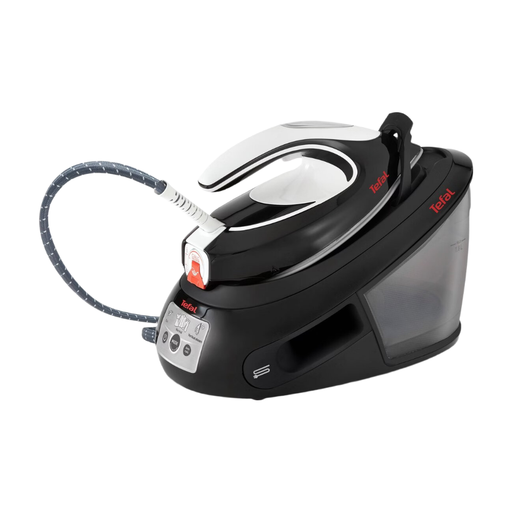 Image unavailable
An option to compare if you regularly tackle creases and want a removable limescale collector.
The product specifications list continuous steam of 120 g/min, a steam boost of 450 g/min, automatic temperature and steam settings, and a removable limescale collector. The stated product weight is 4 kg, so bear this in mind if you carry the appliance between floors.
 Image unavailable
An option to compare if you want to refill less often when ironing regularly.
Philips lists continuous steam of 120 g/min and a steam boost of 350 g. The product details specify a 1,4-litre tank that can be removed from the base and a power rating of 2400 W.
 Image unavailable
An option to compare if you iron several garments and want a transport lock.
The product specifications list continuous steam of 120 g/min, a steam boost of 360 g, a 1,3-litre tank and automatic temperature control.
 Image unavailable
An option to compare if you want a removable tank and are mindful of the weight you have to carry.
The product details list steam output of 70 g/min, a steam boost of 120 g and a removable 1,8-litre tank. The stated product weight is 2,83 kg; check whether that suits the way you move the appliance around your home.
 Image unavailable
A conventional steam iron to compare if you have limited space or move the appliance regularly.
The product details list continuous steam of 40 g/min, a 300 ml tank, a product weight of 1,2 kg and dimensions of 29 × 12,1 × 14,3 cm. According to the Dutch Consumers’ Association, this type of iron needs refilling sooner than a steam generator.
No. Follow the ironing instructions on the specific dress. The Dutch Consumers’ Association outlines the different maximum temperatures shown on garment care labels and warns that too much heat can damage the fabric.
That depends on the board and the appliance’s total weight and size. The Dutch Consumers’ Association warns that a steam generator may be too large or heavy for a standard ironing board, so check the specifications of both before you choose.
Follow the descaling instructions for the exact model and use no more steam than you need. The Dutch Consumers’ Association advises ironing without steam to dry garments after steaming, if necessary. Check the manual before using softened water or additives.
For the specific mains-powered appliance, check the CE marking and EU Declaration of Conformity. For equipment within the relevant voltage range, EUR-Lex sets out the EU low-voltage rules. The European Commission explains that CE is a declaration made by the manufacturer, not a centrally issued safety certificate.
Not automatically. According to the Dutch government, you have a statutory warranty in the Netherlands, and the seller must provide a solution if a product is faulty. An extended warranty may only be worthwhile if its terms give you rights beyond those you already have.