
If you iron heavily creased aprons
You’ll want to know whether the iron can smooth cotton and which steam setting is suitable for your apron. The Consumers’ Association notes that cotton is harder to get smooth than lightweight synthetic fabrics.


If you regularly iron several cotton aprons or tackle deep creases, a steam generator with a separate tank may be worth considering. If you only iron one apron and have little storage space, a standard steam iron could be more practical. The Consumers’ Association notes that cotton is harder to get smooth than lightweight synthetic fabrics. So check the care label, steam settings, available space and maintenance requirements for the specific model.
You’ll want to know whether the iron can smooth cotton and which steam setting is suitable for your apron. The Consumers’ Association notes that cotton is harder to get smooth than lightweight synthetic fabrics.
If you have a pile of aprons to iron before guests arrive, you’ll need to consider how often you have to refill the tank, how easy the iron is to handle and where to put the base unit.
If you only iron one apron occasionally, consider whether a separate steam station will fit on your ironing board and in your cupboard afterwards.
Suitable for: anyone who regularly irons several aprons or other cotton items in a row and wants to tackle stubborn creases.
The trade-off: the separate base unit takes up more space and requires attention when it comes to heating up and maintenance. The Consumers’ Association says a steam generator is mainly an option for people who do a lot of ironing.
Suitable for: anyone who occasionally irons one apron, has limited space or wants a simpler appliance.
The trade-off: the built-in tank is smaller, and, according to the Consumers’ Association, heavily creased cotton can take more effort to smooth out.
The Consumers’ Association notes that cotton is harder to get smooth than lightweight synthetic fabrics. When ironing aprons before guests arrive, the main things to consider are the steam settings, tank, space for the base unit and descaling.
| What to consider | What should you check? | Who should pay particular attention? |
|---|---|---|
| Cotton creases | Check whether the steam can be adjusted or has an automatic setting, whether there’s a steam boost, and whether you can iron without steam after steaming. Follow the apron’s care label. | When I iron a cotton apron, I want to smooth out the creases without damaging the fabric. Around 37% of consumers put a smooth finish on cotton first. |
| Several aprons | Compare the tank capacity, whether the tank is removable and how the iron feels in your hand. | When I have several aprons to iron before guests arrive, I don’t want to keep stopping to refill the tank. An uninterrupted ironing session is the main reason to buy for around 27% of consumers. |
| Space and storage | Measure the space available for the base unit and check that your ironing board can support it securely. Compare the dimensions of the exact model. | If my ironing board or cupboard has limited space, the base unit needs to fit too. Space is the biggest consideration for around 18% of consumers. |
| Limescale maintenance | Look up the descaling procedure for the exact model and check whether it has a rinseable limescale collector or uses a replaceable cartridge. | I want to know in advance how to remove limescale and whether any parts need replacing. Maintenance is the main priority for around 18% of consumers. |
A stated steam output per minute is not an independent measure of how smooth cotton will be. Too much steam can make the apron or ironing board damp.
Check the steam settings and the care label, and compare independently tested ironing results where possible.
A steam generator has a base unit as well as an iron. This can be awkward on a small ironing board.
Measure the available space in advance and check that your setup can support the base unit securely.
Even with a limescale system, maintenance is still required. Models with replaceable cartridges may need new ones to be purchased.
Follow the instructions for the exact model and check whether the system uses a cartridge or a rinseable collector.
For the 3000 Series PSG3000/20, Philips lists a stated continuous steam output of 120 g/min and a steam boost of 350 g.
For the CareStyle 5 IS5249BK, Braun lists Eco, iCare and Turbo programmes, with a stated steam output of 150 g/min.
For the Pro Express Ultimate II GV9711E0, Tefal lists a removable 1.2 L tank, a removable limescale collector and a continuous steam output of 155 g/min.
The Compact Steam DG7520F0 is a steam generator range that Rowenta has designed for compact storage; according to the product information, this model has a lockable base unit.
These steam generators are options to compare for ironing cotton aprons. For each model, allow space for the base unit and check the maintenance instructions.
 No image available
An option if you want to compare a removable tank and stated steam output figures; the base unit needs extra space.
Stated: continuous steam output of 120 g/min, a steam boost of 350 g and a removable 1.4 L tank.
 No image available
Compare this model if stated steam output figures and a 1.3 L tank are important to you; make sure you also have space for the base unit.
Stated: continuous steam output of 120 g/min, a steam boost of 360 g and a 1.3 L tank.
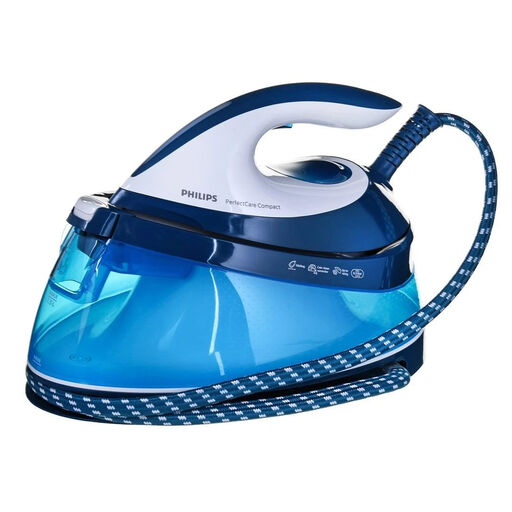 No image available
Worth comparing if you’re looking for a removable tank and a stated steam boost; allow for space for the base unit.
Stated: continuous steam output of 120 g/min, a steam boost of 400 g and a removable 1.5 L tank.
 No image available
An option to compare if a removable tank and stated anti-limescale function are important to you; check how much storage space you’ll need.
Stated: steam output of 70 g, a steam boost of 120 g, 6 bar and a removable 1.8 L tank.
No. Set the temperature and steam according to the care label on the specific apron. Prints and other details may need a different approach; leave the apron to cool and dry after steaming.
Only use steam once the iron is hot enough, and don’t steam continuously. If needed, finish by ironing without steam to dry the fabric, and check whether you can adjust the steam output.
Follow the instructions for the exact model, as the procedure varies depending on the limescale system. Tefal advises against using descaling products and vinegar with its steam generators; always check the instructions for your model.
The Netherlands Food and Consumer Product Safety Authority states that a CE mark is required for electrical products covered by those rules. Check the mark on the product itself; a model name or steam specification alone doesn’t confirm that it meets the applicable requirements.
According to the Dutch Government, online purchases from a business often come with a 14-day cooling-off period. Before buying, check the terms that apply to your specific order.