
If you iron several aprons in one go
A larger water tank can mean fewer refills during a longer ironing session. The Consumentenbond suggests a steam generator as an option if you do a lot of ironing and often need to tackle stubborn creases.


A steam generator makes most sense if you often iron several cotton aprons with stubborn creases: the Consumentenbond points to the larger water tank, which means fewer refills when you have a lot of ironing to do. You will need room for the separate base unit and ironing board, though. If you only iron one apron now and then, a standard steam iron may be more practical. Check the care label on each apron before choosing the temperature and steam setting.
A larger water tank can mean fewer refills during a longer ironing session. The Consumentenbond suggests a steam generator as an option if you do a lot of ironing and often need to tackle stubborn creases.
The separate base unit needs a suitable spot next to or near the ironing board, as well as space for storage. Measure up beforehand: the Consumentenbond highlights the size and weight of the setup as factors to consider.
The right descaling method varies by model. The Consumentenbond recommends following the instructions, while Philips directs owners of its generators to the procedure for their specific model.
Suitable for: regularly ironing several aprons or tackling stubborn creases one after another.
Trade-off: the larger base unit takes up more space and may take longer to heat up than a standard steam iron, according to the Consumentenbond.
Suitable for: usually ironing one apron or having little room for a separate base unit.
Trade-off: the smaller tank may mean you need to refill sooner while ironing. The Consumentenbond highlights this difference when choosing between the two types of appliance.
| What to consider | What should you check? | Who is this important for? |
|---|---|---|
| Creases in cotton | Compare continuous steam in g/min separately from the steam boost; check whether the steam output is adjustable. | If I want to remove stubborn creases from cotton aprons, I look at the steam output while ironing, not just a short burst of steam. Consumers who prioritise crease removal make up around 36% of consumers in this breakdown of preferences. |
| Several aprons per session | Compare the tank capacity and check whether the tank is removable and easy to refill. | When I have a pile of aprons to iron, I want as few interruptions as possible to refill the water tank. Consumers who want to refill less often make up around 29% of consumers in this breakdown of preferences. |
| Space in the utility room | Measure the space for the base unit, ironing board and storage; check that the board stands securely. | If my utility room has limited space, the whole setup needs to fit there safely and practically. Consumers who are mindful of space make up around 21% of consumers in this breakdown of preferences. |
| Limescale and maintenance | Look up the descaling method for the exact model and check how easy it is to access parts for maintenance. | If you use your generator regularly, you will want to know how limescale and maintenance are handled for that model. Consumers who prioritise maintenance make up around 14% of consumers in this breakdown of preferences. |
A steam boost is not the same as continuous steam output. Too much steam can also leave your apron and ironing board damp.
Compare continuous steam and adjustability separately. Use the steam boost only when a crease needs extra attention.
A steam generator has a separate base unit, so the whole setup takes up more room than a standard iron.
Measure the space on your ironing board, as well as the room needed to set up and store the appliance.
The care label tells you which treatment is suitable for the specific apron; the fibre type alone is not enough to go on.
Check the ironing symbol on each apron before setting the temperature and steam.
An additional guarantee does not replace your statutory rights if a product is faulty. The Dutch government explains that the Netherlands does not have a fixed statutory guarantee period.
Check what extra cover an additional guarantee provides, and contact the retailer if your product develops a fault.
The PSG3000/20 and PerfectCare 7000 PSG7200/20 offer different combinations of features to compare. Check the exact version.
The Pro Express Ultimate II GV9721E0 is worth comparing if adjustable steam settings and a limescale collector are important to you.
The CareStyle 5 IS5249BK combines steam settings with an ergonomically designed iron. Consider how comfortable it is for the way you use it.
These steam generators are options to compare for longer ironing sessions with cotton aprons.
 No image available
An option to compare if you iron several aprons in one go and want to know the stated tank capacity.
2400 W; 350 g steam boost; 1,4 l water tank. Philips also lists 120 g/min continuous steam for the PSG3000/20.
 No image available
A steam generator to compare if you regularly iron several cotton aprons in one go.
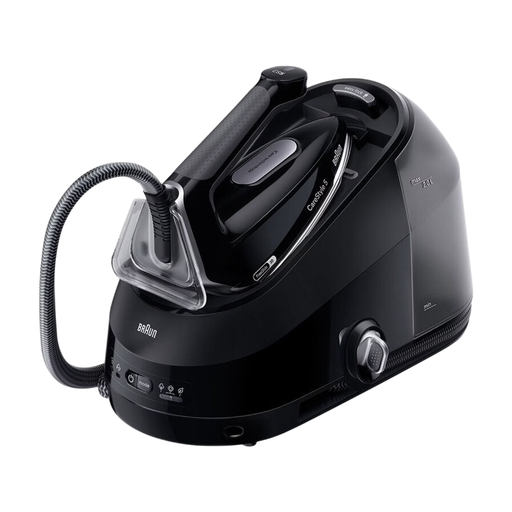 No image available
A model to compare for longer ironing sessions; check that the version and controls suit your ironing space.
Braun lists up to 150 g/min continuous steam and a 510 g steam boost for the IS5249BK.
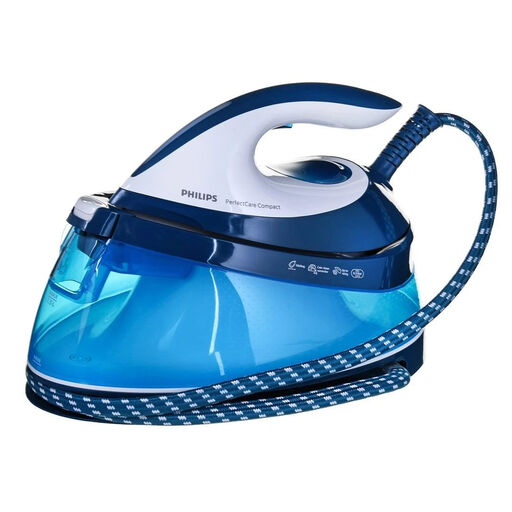 No image available
An option to compare if you are looking for a steam generator for ironing several aprons in one session.
2400 W; 400 g steam boost; 1,5 l water tank.
 No image available
A steam generator to compare if the stated tank capacity is important to you during longer ironing sessions.
2400 W; steam output of 70 g; 120 g steam boost; 6 bar pressure; removable 1,8 l water tank.
No. Follow the care label on the specific apron, rather than choosing the temperature based only on the cotton fibre. The GINETEX table distinguishes between different maximum ironing temperatures and a setting for ironing without steam.
Use only as much steam as you need, then iron without steam until the fabric is dry. The Consumentenbond recommends this as a way to let your ironing dry.
Follow the descaling procedure for the exact model, as the method varies from one appliance to another. Philips refers owners to the instructions for their specific model, and the Consumentenbond also recommends following the manual.
If your product is faulty, contact the retailer. Depending on the circumstances, you may be entitled to a repair, replacement or refund. The Dutch government explains that there is no fixed statutory guarantee period in the Netherlands.