
Livraison le jour même et le lendemain

Qualité garantie

Débloquez vos offres de bienvenue: Livraison GRATUITE | Jusqu'à -80 % | 30 jours d'essai gratuits à JoyPlus
Téléchargez l'application
A steam cleaner can be useful for tile grout, kitchen surfaces, windows and some hard floors. However, sofas, carpets and car seats often need a different type of appliance: a cleaner with a spray function and suction. If you focus only on the wattage or the number of accessories, you could end up buying an appliance that isn’t suited to the cleaning tasks you have in mind.
A higher wattage mainly indicates how much electrical power an appliance uses. It doesn’t automatically tell you how powerful the steam jet is, how quickly the appliance heats up or how well it extracts dirty water. So, also check the heat-up time, steam pressure, steam settings and suction power.
A 1000 W handheld steam cleaner may be suitable for small areas and detail work, while a 1500 W multifunction steam cleaner with a larger tank may be more practical for several rooms. For carpets and upholstery, suction power is also more important than steam temperature alone.
Steam and high temperatures aren’t suitable for every floor, sofa or type of car upholstery. Untreated wood, laminate joints, silk, velvet and certain heat-sensitive plastics can be damaged. Test the appliance on an inconspicuous area first and follow the product instructions.
When choosing a steam cleaner for sofas and carpets, check that the fabric is water- and heat-resistant. For textiles, a carpet cleaner with a spray and suction function is often a more sensible choice than an appliance that only produces steam.
A steam cleaner with accessories can be useful, but only if the attachments suit the jobs you need to do. Check whether it comes with items such as a floor cloth, window squeegee, grout brush, detail nozzle or upholstery attachment. Also consider storage space, hose length and power cord length. Accessories that are fiddly to change often end up unused.
Steam pressure in bar gives an indication of the pressure at which steam leaves the appliance. Domestic models commonly have a pressure of around 2.5 to 4 bar. However, this doesn’t automatically make a powerful steam cleaner suitable for every material. Adjustable steam settings are more useful if you want to clean both grout and more delicate surfaces.
Claims about temperature or cleaning performance should be treated as information from the manufacturer or seller. According to some brands’ own product information, certain models can reach temperatures of around 135–145 °C. Always check whether this refers to the steam outlet, the boiler or a theoretical maximum setting.
A small tank of around 250 to 400 ml keeps the appliance compact and lightweight. This makes it a good fit for a handheld steam cleaner for the kitchen, bathroom or windows, or for a quick clean. A 1.5 to 1.6-litre tank is more convenient when you want to clean several rooms in one go, but it generally makes the appliance heavier.
A short heat-up time is handy for everyday use. Also check how long you can work continuously according to the specifications, and whether you can refill the tank while the appliance is in use. Only use the liquid specified in the instructions. Some models explicitly state that the tank must only be filled with clean water.
For a steam cleaner for floors, steam output is often the most important feature, particularly for sealed hard floors. For sofas, carpets, stairs and car seats, suction power and water tanks matter more. An appliance with separate clean- and dirty-water tanks prevents used water from being spread around again.
For an upholstery or carpet cleaner, hose length, brush width and drying time are also important. Suction power is often given in kPa. Only compare this figure between products whose specifications have been measured in the same way; also check any warnings about fabrics needing to be water-resistant.
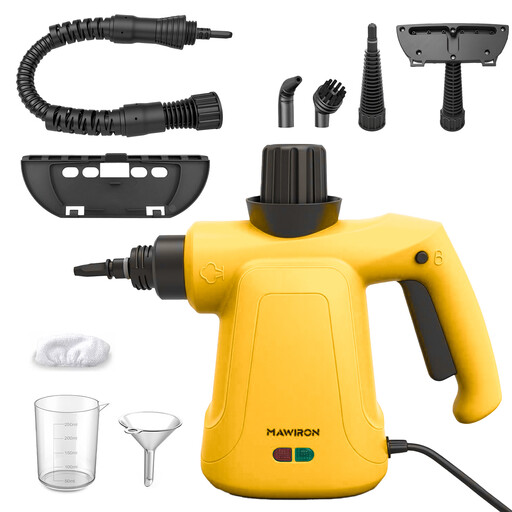
Why it suits this profile: The compact design, 400 ml tank and nine attachments make it a good fit for smaller cleaning jobs around the home, in the car or on upholstery.
The product specifications state both the tank capacity and the number of accessories, so you can judge in advance whether it’s suitable for shorter tasks.
1000 W power, a 400 ml tank and nine listed attachments for a range of uses.
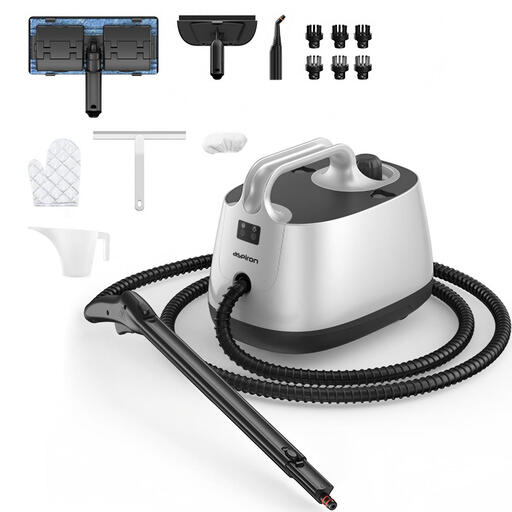
Why it suits this profile: This model is designed for households tackling several rooms, from hard floors and windows to the kitchen, bathroom and car interior.
The description lists the tank capacity, pressure, heat-up time and accessories separately, so you don’t have to judge it on wattage alone.
1500 W, up to 4 bar according to the product information, a 1.5-litre tank and 21 accessories.
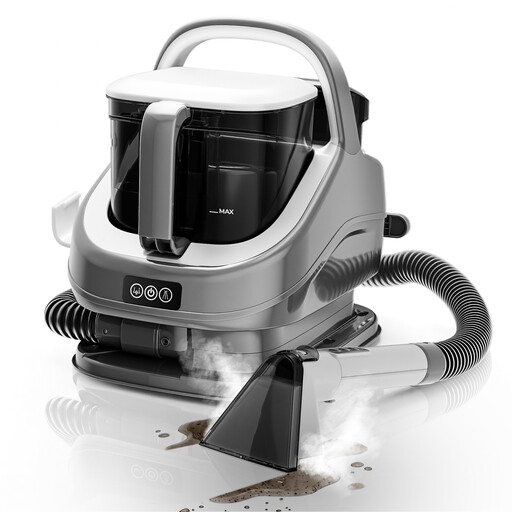
Why it suits this profile: This model is designed for sofas, carpets, stairs, pet messes and car seats that need spraying and dirty-water extraction.
This isn’t a steam-only model: the description lists three cleaning modes, 13 kPa suction power and separate clean- and dirty-water tanks.
1300 W, 13 kPa, a 1400 ml clean-water tank and a 1200 ml dirty-water tank.
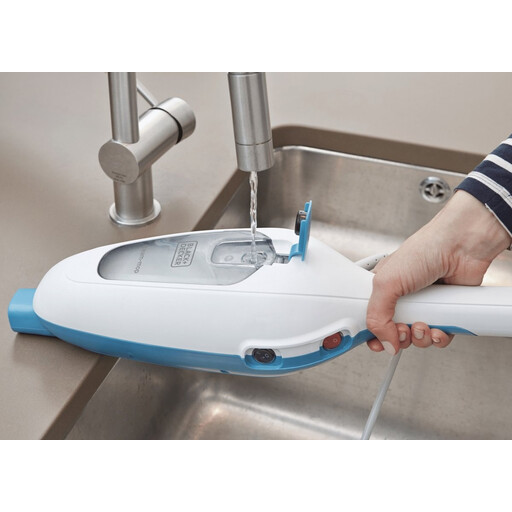
Why it suits this profile: The steam mop design is intended for sealed hard floors and quick cleaning in the kitchen, bathroom and living areas.
The product information specifically states that it’s for use on sealed hard floors. This makes its intended use clearer than that of a model with a more general description.
1300 W, a 0.38-litre tank, a heat-up time of around 30 seconds and a 4-metre power cord, according to the product listing.
We’ve put together a complete, up-to-date list of products that meet these strict selection criteria and the applicable European safety requirements.
It depends on the material and the appliance. A standard steam cleaner can make textiles warm and damp, but it won’t always remove dirt from the fibres. For cleaning sofas and carpets, a model with a spray function, brush and suction power is often a better choice. Always test it on a hidden area first.
Energy consumption depends on the wattage and how long you use the appliance. A 1300 W model theoretically uses 1.3 kWh if it runs continuously at full power for an hour. In practice, consumption is often lower because of heat-up and pause periods. The main ongoing considerations are water quality, descaling advice and replacing cloths or filters.
Its lifespan depends on how often you use it, how well you maintain it, limescale build-up and how it’s stored. Let the appliance cool down, clean the tanks and accessories, and store it somewhere dry. Before buying, check whether replacement parts, cloths and filters are available separately. In the long run, that may matter more than an extra brush in the box.
