
Livraison le jour même et le lendemain

Qualité garantie

Débloquez vos offres de bienvenue: Livraison GRATUITE | Jusqu'à -80 % | 30 jours d'essai gratuits à JoyPlus
Téléchargez l'application
A steam cleaner can loosen baked-on dirt, grease and stains without adding standard cleaning products. However, not every model is suitable for every task. A lightweight steam mop for a sealed tiled floor works differently from a handheld steam cleaner for grout or a spot cleaner with suction for carpets.
The biggest buying mistakes usually stem from three misconceptions:
Always follow the instructions and test the steam cleaner in an inconspicuous area first.
The heat-up time determines how quickly you can get started. For short cleaning jobs, around 25 to 30 seconds is practical. A larger tank with a heat-up time of several minutes is better suited to a full cleaning session.
Steam pressure, measured in bar, indicates the pressure at which steam is released. A model with 2.5 to 3 bar may be suitable for everyday dirt, kitchen surfaces and grout. Models offering up to 4 bar are designed for more intensive use, but require extra care on sensitive materials.
Also check whether the cleaner has multiple steam settings. A low setting is more suitable for light dirt, while a higher setting can help tackle grease and stubborn grime. According to ROUNY’s product description, the Steamo X has two steam levels, with a stated temperature range of 98 to 135 °C. Figures like these are product specifications, not a guarantee that every type of dirt will disappear in a single pass.
A small tank keeps the appliance lightweight, but means you will need to refill it more often. For example, the BLACK+DECKER FSM13E1 has a 0.38-litre tank and, according to the product description, provides up to 11 minutes of continuous steam. That makes it suitable for a quick clean around the kitchen or bathroom.
For several rooms, a larger tank is more convenient. The ASPIRON AS-CA019 lists a 1.5-litre tank. The Clean Koala Multi Steam Cleaner lists 2.2 litres and a stated continuous operating time of up to 60 minutes. The actual duration depends on the selected steam setting and the surface being cleaned.
Only use the type of water specified in the instructions. Several manufacturers warn against adding cleaning products, perfume, oil or vinegar to the tank. In areas with hard water, demineralised water may help reduce limescale, provided this is recommended in the instructions.
A steam cleaner for hard floors is mainly intended for sealed vinyl, tiles, ceramic surfaces or treated wood. A steam mop loosens dirt, but usually does not pick up spilled water. If you want to remove stains from carpets, sofas or car interiors, look for a carpet cleaner, upholstery cleaner or spot cleaner with suction.
The Uwant B400 lists suction of up to 18,000 Pa, a 14 cm brush and combined clean- and dirty-water tanks. This makes this type of product more suitable for treating individual stains than for mopping an entire hard floor.
When considering accessories, pay attention to practical details:
With corded models, a longer cable is often more useful than a large number of accessories that are rarely used.
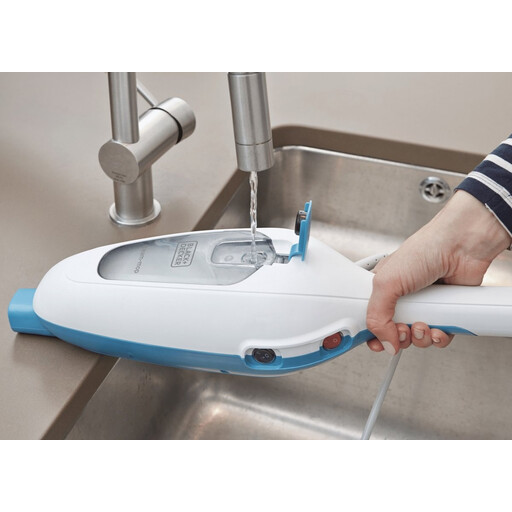
Why it suits this profile: A straightforward steam mop for households that mainly want to clean sealed hard floors quickly.
The product description states a 30-second heat-up time and a 4-metre cable, so you do not have to judge the appliance on wattage alone.
1300 W, 0.38-litre tank, weight of 1.8 kg and, according to the product description, up to 11 minutes of steam.
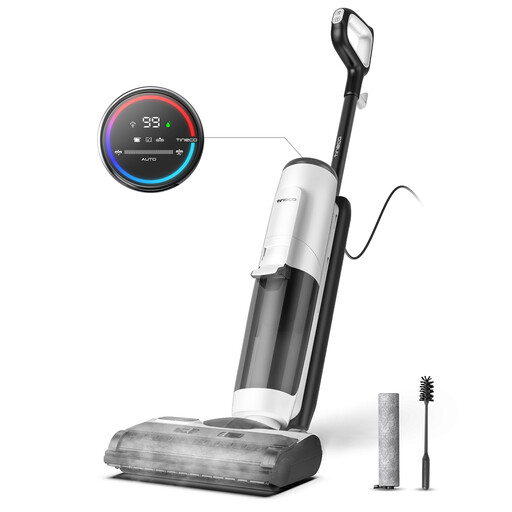
Why it suits this profile: An interesting option for anyone looking for a combination of floor cleaning and dirt collection for indoor floors.
The product specifications clearly state that the appliance is intended for hard indoor floors and not for flammable liquids or rough surfaces.
Combines vacuuming and steam cleaning, digital display, additional brush roller and a stated weight of 6 kg.
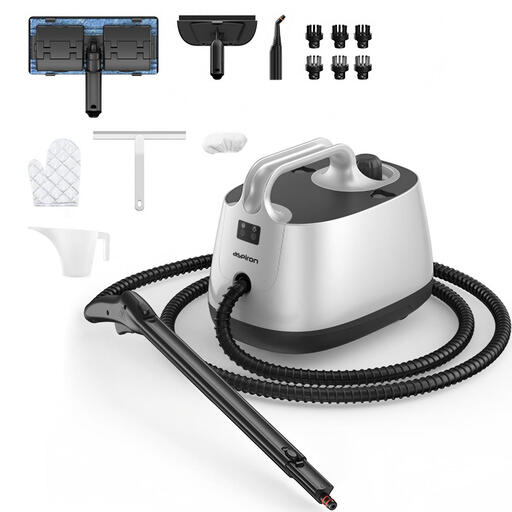
Why it suits this profile: A multifunctional steam cleaner for anyone who wants to tackle floors, bathrooms, kitchens, windows and hard-to-reach areas with one appliance.
The accessory kit is designed for multiple uses, although you should check in advance whether you really need all 21 attachments.
1.5-litre water tank, wheels, flexible hose, 21 accessories and a stated pressure of up to 4 bar.
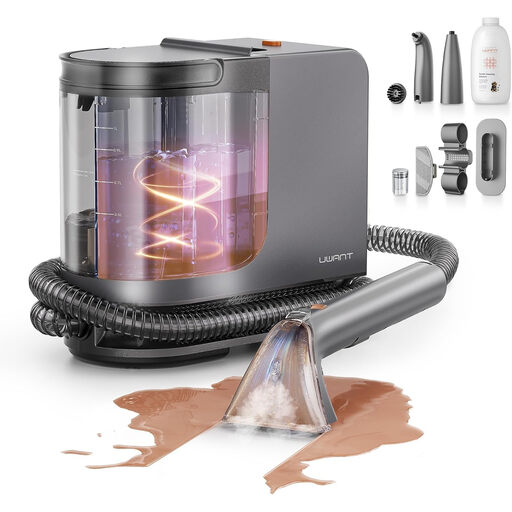
Why it suits this profile: Designed for localised stains on carpets, sofas, bedding or car interiors, rather than large floor areas.
The stated suction power and separate water collection make it clear that this is a spot cleaner, not a conventional steam mop for everyday mopping.
600 W power, stated suction of up to 18,000 Pa, 14 cm-wide brush and a 2-in-1 water tank.
We have compiled a complete, up-to-date list of products that fully meet these strict selection criteria and the applicable European safety regulations.
Chemical-free cleaning does not mean you can afford to be less careful. Steam can cause burns and is unsuitable for electrical appliances, people and animals. Keep the following points in mind:
Electricity costs depend on the appliance’s power rating and operating time. A 1,300 W appliance running for 20 minutes theoretically uses around 0.43 kWh. Calculate the actual cost by multiplying this consumption by your current electricity tariff. A longer heat-up time or higher power rating is therefore not always economical if you only need to treat a small stain.
Only if the laminate is approved for steam cleaning by the manufacturer and the joints are properly sealed. Check the instructions for both the flooring and the appliance. Use a low setting and test an inconspicuous area first. Extra caution is needed with untreated wood, damaged finishes or open joints.
No. A steam cleaner can loosen dirt, but old stains, grease and discolouration react differently depending on the fibre and material. For carpets, upholstery and car interiors, a spot cleaner with suction is often more suitable. Avoid over-wetting the material and follow the care instructions.
The service life depends, among other things, on water quality, frequency of use, storage and maintenance. Regularly descaling the appliance according to the instructions, washing the pads and storing the cleaner somewhere dry can help limit wear. Do not use additives unless they are explicitly approved, as they may damage the heating element or seals.
