
Vandaag of morgen in huis

Kwaliteit gegarandeerd

Welkomstaanbiedingen ontgrendelen: GRATIS bezorging | Tot 80% korting | Gratis 30 dagen JoyPlus-proefperiode
Download de app
A steam cleaner can help remove baked-on grease, dirt from grout, stains and residue from hard surfaces. However, not every model is suitable for every task. A handheld steam cleaner is practical in the kitchen, while a steam mop is more convenient for larger floors. If you focus mainly on wattage or the number of accessories, you could still end up buying an impractical appliance.
Pay particular attention to these three common pitfalls:
Pressure is usually shown in bar or kPa. A higher figure can help loosen dirt, but the result also depends on the steam flow, the distance from the surface and the attachment being used.
A powerful steam cleaner for grout, hobs or car interiors generally benefits more from an adjustable steam setting than from a high pressure figure alone. A lower setting is often wiser for delicate upholstery. Product claims about loosening dirt come from the manufacturer or seller, so treat them as product information rather than a guaranteed result.
A small tank makes an appliance lightweight and quick to use. This suits a handheld steam cleaner for a washbasin, cooker or shower screen. For multiple rooms, a larger tank is more convenient because you will not need to refill it as often.
Also check the heat-up time. According to their product information, some models are ready in approximately 15 to 30 seconds, while larger appliances may take several minutes. Also check whether refilling is only permitted once the appliance has cooled completely and been unplugged from the mains.
For a steam cleaner for floors, a stable handle, a wide mop head and washable cloths are important. For a steam cleaner for the bathroom or kitchen, a detail brush, precision nozzle and scraper are more useful. If you want to clean windows, you will need a suitable window tool.
Check the following in advance:
A chemical-free steam cleaner generally uses water only. Do not add all-purpose cleaner, perfume, vinegar or descaler unless the instructions expressly allow it. Doing so can cause blockages, vapour formation or damage.
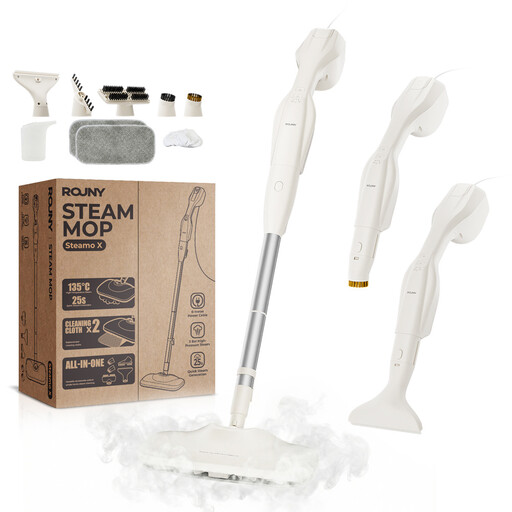
Why it suits this profile: This model combines a steam mop with a handheld cleaner. You can start with hard floors and later tackle kitchen edges, windows or corners.
The specifications list two steam levels, so you do not have to use the same intensity on every surface.
According to the product information: approximately 25-second heat-up time, a 6-metre cord, 250 ml tank and several attachments.
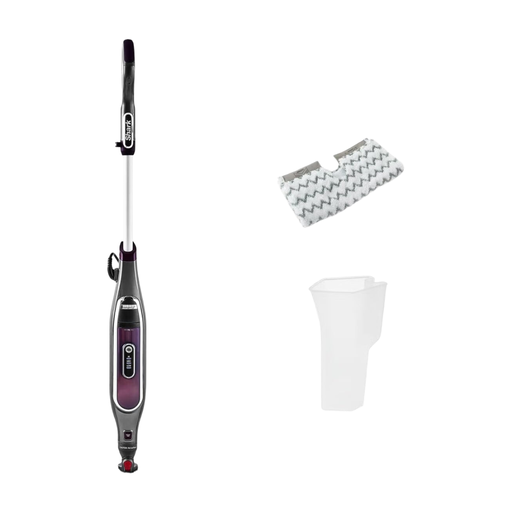
Why it suits this profile: A focused choice for households that mainly clean sealed hard floors and value straightforward controls.
It is not an overloaded multifunctional set, but a steam mop focused on hard floors, with a steam button and two washable pads.
According to the product specifications: 1200 W, 380 ml capacity, 6-metre cord and an automatic mop head.
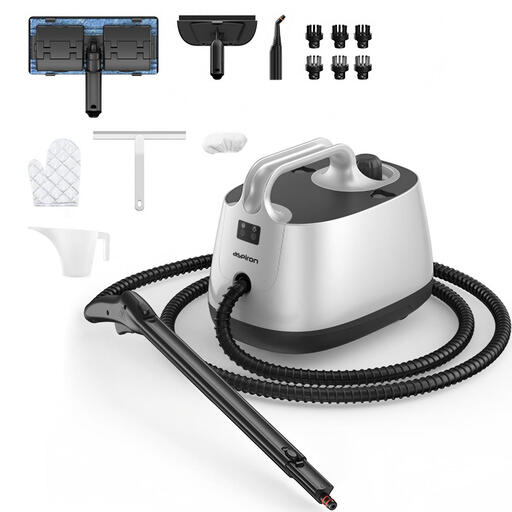
Why it suits this profile: This model is designed for longer cleaning sessions across multiple rooms, including bathrooms, kitchens, floors, windows, furniture and car interiors.
The large tank reduces interruptions during bigger jobs. However, check beforehand that the dimensions and accessories suit your storage space.
According to the product description: 1.5-litre water tank, up to 4 bar, 21 accessories, wheels and a child lock on the handle.
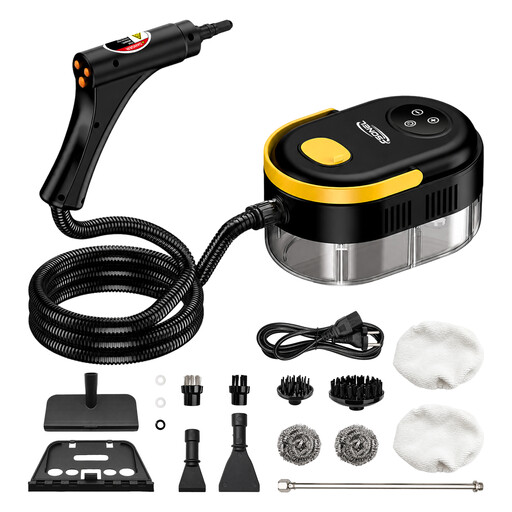
Why it suits this profile: A handheld model is useful for kitchens, windows, barbecues, grout and other areas where you do not need a large steam mop.
The choice remains straightforward: focus mainly on the included tools and whether the handle is comfortable to hold during short cleaning sessions.
According to the product title: extensive accessories and adjustable steam settings for kitchens, floors, windows and grills.
Steam cleaners generally use water only, so you do not need to add standard cleaning products. This does not mean that all dirt will disappear without pre-treatment. Wipe away loose dirt first and allow the steam to work briefly on grease or baked-on residue.
For safe use:
The service life depends on maintenance, water quality and frequency of use. Limescale can build up more quickly in areas with hard water. Therefore, use only the descaling method specified by the manufacturer, and never add descaler directly to the tank unless this is permitted.
We have put together a complete, up-to-date list of products that fully meet these strict selection criteria and the applicable European safety regulations.
No. Only use a steam cleaner on floors where the manufacturer permits steam cleaning. Untreated wood, waxed floors and some types of laminate can be sensitive to heat and moisture. Check the floor manufacturer’s instructions and test a hidden area first.
It can be for some models and fabrics, but always check the care instructions. Use a low steam setting, do not hold the nozzle in one place for long and allow the fabric to dry thoroughly. Silk, velvet and other heat-sensitive materials are often unsuitable.
Consumption depends on the power rating and usage time. A 1,200-watt model that heats and steams for half an hour theoretically uses approximately 0.6 kWh; actual consumption may be lower due to thermostatic control and interruptions. A short heat-up time mainly reduces waiting time, not necessarily energy consumption.
