
Playing in daylight
If you play with windows or lamps near the screen, compare its brightness and reflection handling together. RTINGS.com explains how a matte coating can reduce mirror-like reflections.


For stealth games in a bright room, first compare reflections and the measured brightness of the specific screen. Then assess shadow detail and motion handling. RTINGS.com identifies mini-LED as an option for bright rooms, but it’s still important to check tests of the exact model. A mini-LED LCD is particularly worth considering if you want to balance daylight visibility with HDR contrast, while a standard LCD may suit you if advanced HDR contrast is less important. OLED is an option if you can control the light in the room and are comfortable weighing up the risk of HUD elements remaining visible over time.
If you play with windows or lamps near the screen, compare its brightness and reflection handling together. RTINGS.com explains how a matte coating can reduce mirror-like reflections.
If you want to spot small, bright clues against dark backgrounds, look at local dimming and possible halos around light sources. RTINGS.com notes that the number of dimming zones alone does not guarantee picture quality.
If you often move the camera, compare motion handling at the refresh rate you can actually use. The resolution and refresh rate you can achieve also depend on your PC or console and the connection.
For stealth games in a bright room, reflections, detail in dark scenes, motion and compatibility with your system can all be deciding factors.
| What to consider | What to check | Who it matters to |
|---|---|---|
| Visibility in daylight | Compare independent tests of reflections and SDR brightness for the exact model. | If I play during the day with windows or lamps next to the screen, I want to be able to follow dark corridors without reflections overpowering the details. Around 36% of consumers put daylight visibility first. |
| Shadow detail and HDR contrast | Look for tests of dark scenes, local dimming and sustained brightness; don’t treat an HDR label or the number of dimming zones as a substitute for these. | If I want to make out small, bright clues against a dark background, I look at how the screen handles scenes like these and check for possible halos. Around 29% of consumers give shadow detail top priority. |
| Motion clarity | Compare tested motion handling at the refresh rate you actually use. | If I want to keep track of details during fast camera movements, I look for visible blur rather than relying on the advertised refresh rate alone. Around 21% of consumers put motion clarity at the top of their list. |
| Resolution and connection | Check which resolution and refresh rate are available through the port you use, and whether your PC or console supports that combination. | If I want to use a particular picture mode, I first check whether my gaming device and connection can output it. Around 14% of consumers make system compatibility their top buying priority. |
A brightness rating on its own doesn’t tell you how much reflection you’ll see or how bright the screen stays over time. Peak brightness can differ from sustained brightness.
Compare reflections and SDR brightness and, if HDR matters to you, check sustained performance in a test of the exact model.
More dimming zones don’t guarantee effective local dimming; halos may still be visible around small light sources.
Look for a model test featuring dark scenes and local dimming before comparing a mini-LED monitor with a different panel type.
On a dual-mode monitor, the highest refresh rate may come with a lower resolution. LG lists 5K at 165 Hz and QHD at 330 Hz for the 27GM950B-B.
Check the resolution and refresh rate for each input, then compare them with what your PC or console supports.
According to the Dutch government, there is no fixed statutory warranty period of exactly two years. An additional manufacturer’s or retailer’s warranty does not replace your statutory rights against the seller.
Check what cover an extended warranty product provides and consider it separately from your statutory rights.
The Q27G3XMN/BK is a 27-inch QHD model with a VA panel and mini-LED, worth comparing if shadow contrast matters to you.
The UltraGear 27GM950B-B is a 27-inch mini-LED model with two resolution and refresh rate modes to compare.
The Evnia 32M2N6800M/00 is a 31.5-inch 4K IPS model for anyone looking to compare a larger screen and high resolution.
These Joybuy product picks focus on gaming monitors for fast-moving action and, for some models, viewing detail in dark scenes.
 No image available
An option to compare if you’re looking for a QHD gaming monitor with a high advertised refresh rate.
The product information lists a Rapid IPS panel, 200 Hz, QHD and HDR support.
The advertised response time is 0.5 ms; compare motion handling tests in the mode you use.
 No image available
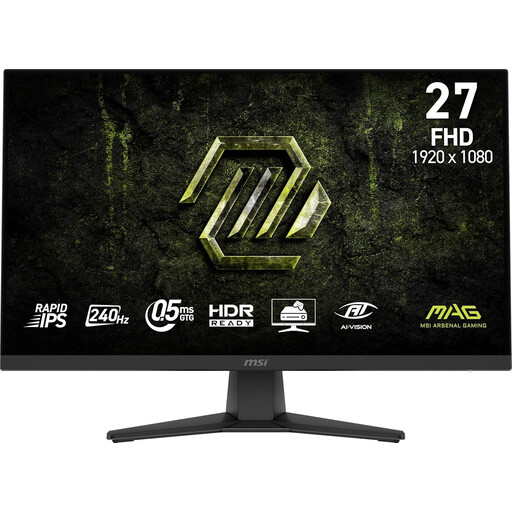
An option to compare if you’re looking for an FHD monitor with a high advertised refresh rate.
The product information lists an IPS panel, 1920 × 1080, 240 Hz and a matte finish.
The description mentions AI Vision for dark areas; this is the name of a feature, not an independent assessment of shadow detail.
The advertised response time is 0.5 ms; check motion handling tests.
 No image available
An option to compare if you want to match the advertised refresh rate to your system’s connection.
The product information lists a Fast IPS panel and FHD resolution.
The advertised maximum refresh rate is 300 Hz via DisplayPort and 240 Hz via HDMI.
Brightness is listed as 300 cd/m² typical; the description also mentions HDR10.
 No image available
An option to compare if you’re looking for a curved ultrawide gaming monitor.
The product information lists 3440 × 1440, 144 Hz, a 1500R curvature and a Fast VA panel.
The title lists 400 nits HDR; compare independent brightness and HDR tests of the exact model.
 No image available
An option to compare if you’re looking for WQHD resolution and a high advertised refresh rate.
The product information lists 2560 × 1440, 240 Hz and a Rapid VA panel.
The advertised response time is 0.5 ms. The description mentions Night Vision and AI Vision for gaming; these feature names are no substitute for a shadow detail test.
No, certification is no substitute for testing the specific model. Compare measurements of local dimming, contrast and brightness, and consider the conditions in your room.
Check which combination the monitor supports through the input you’ve chosen, then compare it with your PC or console. LG lists 5K at 165 Hz and QHD at 330 Hz for the 27GM950B-B, so those modes don’t combine the same resolution and refresh rate.
Bear in mind that displaying the same static elements for long periods can cause burn-in on OLED screens. Consider your usage pattern and the manufacturer’s terms for the exact model.
That depends in part on the amount of light in the room and the specific panel. Compare reflection measurements and black levels for the exact model. RTINGS.com describes differences between the WOLED and QD-OLED generations it has tested, but that comparison does not automatically apply to newer panel types.
For online consumer purchases, a statutory cooling-off period generally applies; according to ACM ConsuWijzer, it ends 14 days after delivery. There are exceptions to the right to cancel, so check which terms apply to your purchase.