
Vandaag of morgen in huis

Kwaliteit gegarandeerd

Welkomstaanbiedingen ontgrendelen: GRATIS bezorging | Tot 80% korting | Gratis 30 dagen JoyPlus-proefperiode
Download de app
A stationery set can often seem like a straightforward purchase. Yet sets vary greatly in writing comfort, nib width, ink type and suitability for paper or other surfaces. A colourful packet tells you little about how nicely a pen will write after a few weeks.
For school pupils, students, teachers, office workers, journalers and hobbyists, there are three main pitfalls to watch out for:
The nib width determines how much control you have over your lines. For small notes, diaries and technical sketches, 0.5 mm gel pens, rollerballs and drawing pens are a practical choice. A 0.7 mm nib generally writes a little fuller and works well for everyday writing and colour-coding.
For mechanical pencils, pay attention not only to the diameter but also to the lead hardness:
A soft 2B lead gives more contrast but can smudge more easily. An HB lead is usually more practical for writing, maths and technical drawing.
Gel pens use gel ink that often glides smoothly across paper. When choosing a set, check that the ink colour, nib width and closure are clearly stated. Retractable pens are handy for a pencil case or desk because the tip can be protected.
Rollerballs with liquid ink can produce a fine line. If you're left-handed, quick-drying ink is worth considering, but always test on your own paper: drying time also depends on the surface.
For brush pens and colour pens, the difference between a flexible brush tip and a fixed tip is important. A brush pen is suitable for varying line widths, while a classic felt-tip pen produces more consistent lines.
Acrylic markers are designed for more than just paper. The product information for the Faber-Castell Shake & Paint sets states they can be used on metal, ceramic, plastic, glass, textile, stone, canvas and wood, among others. The result may vary depending on the surface, so test on an inconspicuous area first.
Activation is also different from ordinary pens. According to the product description, you need to shake the marker 20 to 30 times and press the tip repeatedly until the ink flows. After use, store markers with the cap firmly closed.
For school supplies and creative sets, pay attention to age recommendations and small parts. The Faber-Castell Brush Pen Sets, for example, mention EN 71 as a quality label. This is product information from the listing and not a guarantee that every application is suitable for every child. Always follow the safety instructions on the packaging.
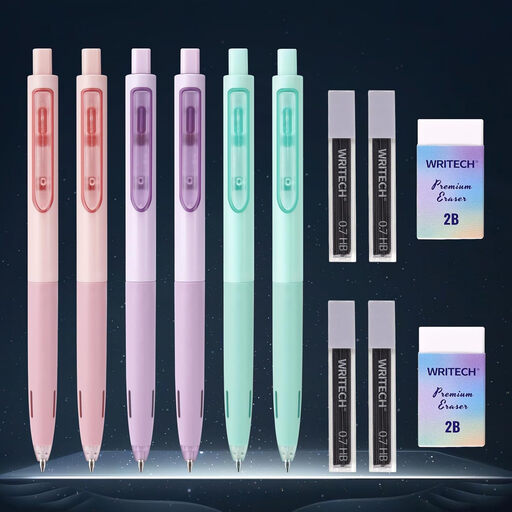
Why this fits the profile: An accessible combination for school, home working and simple sketches, with multiple pencils and extra materials in one pack.
The set specifies 0.7 mm HB refills, four tubes with a total of 48 leads and two extra 2B erasers. This makes it clear in advance what refill materials are included.
Six mechanical pencils, ergonomic soft grip, retractable tip and included refills.
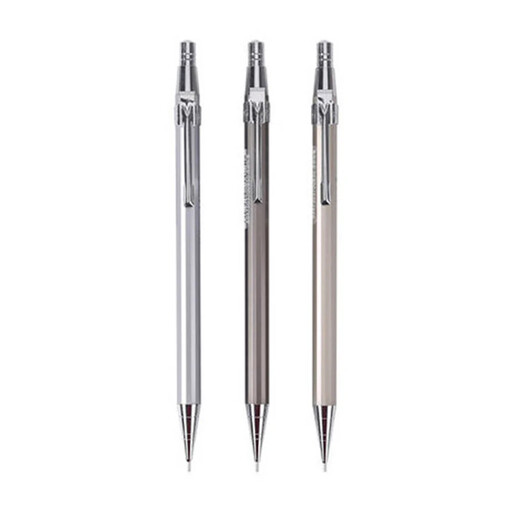
Why this fits the profile: Aimed at those who value a metal casing, a finer line and a controlled feel when writing or drawing.
The specifications clearly state a 0.5 mm black lead, metal casing and push-button mechanism. You don't have to rely on appearance alone.
Set of three, 0.5 mm tip, metal body and automatic lead advance via a push button.

Why this fits the profile: Designed for creative projects where ordinary colour pens aren't enough, for example on wood, glass, canvas or ceramic.
The set states two tip sizes of 1 and 3 mm, six metallic colours and an ink level indicator. The marker does need to be shaken and primed before use.
Water-based acrylic ink according to the product description, two tip sizes and use on multiple surfaces.
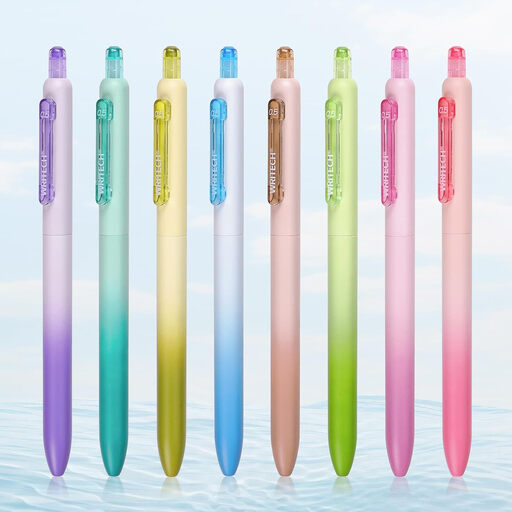
Why this fits the profile: Handy for diaries, bullet journals, summaries and notes where multiple colours and a fine line are desired.
The product information states eight colours, a 0.5 mm twin-ball tip, retractable closure and a silent click mechanism. This makes the features verifiable before purchase.
Eight retractable gel pens, 0.5 mm fine tip, multiple colours and soft grip according to the product specifications.
We've put together a full, up-to-date list of products that fully meet these strict selection criteria and current European safety regulations.
For everyday writing, 0.5 mm and 0.7 mm are commonly used sizes. Choose 0.5 mm for small letters and notes in a diary. A 0.7 mm nib can be more comfortable when you want a clearer, fuller line.
Store gel pens with the tip retracted or with the cap firmly closed. Close brush pens and acrylic markers immediately after use. Store them according to the product instructions, usually in a dry place away from direct sunlight. Test new markers on a scrap piece of paper first.
Yes, especially if you write or draw daily. Check the diameter, such as 0.5, 0.7 or 1.8 mm, and the hardness, such as HB or 2B. Refills of the wrong size may not fit properly or may break more easily. A set with included leads and erasers can delay the first refill, but check later that individual refills are available.
