
Photographing complete product sets
You want to show notebooks, pens and packaging from a consistent angle. Adobe and MPB highlight controlled lighting, an uncluttered background and steady framing as key considerations for product photography.


For complete stationery sets, consistent framing and controlled lighting are often the best place to start. Only buy another camera if test shots show that your current camera or smartphone isn’t up to the job. A suitable macro lens or a compact camera with a close-up mode can help capture small text or details on paper, but check the magnification, which lens is included and how much room you’ll have for lighting.
You want to show notebooks, pens and packaging from a consistent angle. Adobe and MPB highlight controlled lighting, an uncluttered background and steady framing as key considerations for product photography.
You want to show the texture of paper, small text or a finish on its own. So pay attention to the lens’s magnification, the working distance and how much room is left for lighting.
You share the space or equipment and want to be able to set up the same framing easily each time. Also consider whether interchangeable lenses are practical, or whether a camera with a fixed lens would be better for several people to use.
Adobe recommends a controlled environment with suitable lighting and an uncluttered background. So consider your photography space as well as the camera itself.
Choose this if: your current camera or smartphone already captures enough detail and you mainly photograph complete sets.
Bear in mind: a fixed setup won’t automatically give you the magnification of a dedicated macro lens for very small details.
Choose this if: you want to take wider shots and have the option of adding a close-up lens later.
Bear in mind: the lens mount must match the camera body; a standard kit doesn’t automatically include a macro lens.
Choose this if: small labels, paper texture or the finish of a single item are important.
Bear in mind: at short working distances, there may be less room to light your subject.
Choose this if: you want a camera that’s ready to use quickly, without changing lenses.
Bear in mind: use test shots to check that the framing and detail are right for your product photos.
| What to consider | What should you check? | Who is this important for? |
|---|---|---|
| Colour and lighting | Review test shots under the lighting in your workspace and check whether you can reproduce the lighting, background and camera settings. | I want coloured pens and paper to look recognisable under changing workshop lighting; around 29% of consumers prioritise consistent colour and lighting. |
| Small details | Check the magnification of the lens or close-up mode actually included, and review a test shot of the smallest detail you need to show. | I want to show small text or paper texture clearly; around 29% of consumers prioritise the legibility of small details. |
| Repeatable overhead shots | Check that the entire set fits within the available shooting distance, that you can read the screen from the camera angle and that a tripod can be positioned safely. | I want to photograph recurring sets from the same overhead angle every time; around 21% of consumers prioritise repeatable composition. |
| Easy to share | Check what’s included in the kit, the lens mount and any accessories you’ll need. Consider whether users can easily return the setup to its original position after each turn. | I want several people to be able to use the camera without complicated lens changes; around 21% of consumers prioritise easy shared use and a complete setup. |
Maximum magnification depends on the lens or close-up mode you use. It doesn’t automatically apply to every kit with the same camera body.
Check exactly what’s included in the kit, the lens mount and the maximum magnification of the supplied lens.
Presentation, background and lighting all play an important part in product photography. A different camera won’t automatically fix problems with your setup.
Take comparable test shots with a consistent setup before deciding which camera feature you’re missing.
A lens for capturing small details still needs to leave room for lighting in your actual photography space. You’ll also need a suitable wider frame for a complete set.
Test both the smallest detail and the full set in the place where you’ll be taking photos.
The EOS R50 is an APS-C mirrorless camera with an RF mount. A separate RF close-up lens is one possible addition.
The Z50II is a mirrorless camera with a Nikon Z mount. For detailed close-ups, the separate NIKKOR Z MC 50mm f/2.8 is one lens option.
The α6400 is an APS-C camera with an E mount. The separate E 30mm F3.5 Macro is an option for capturing small details.
The X-S20 uses interchangeable X lenses. The separate XF30mmF2.8 R LM WR Macro is designed for capturing small details.
The Tough TG-7 is a compact camera with a fixed lens and built-in close-up modes, for anyone who doesn’t want to change lenses.
These Joybuy cameras are product picks related to this topic. Check whether the features and included accessories of each model suit the way you photograph stationery.
 No image available
The included storage bag could be useful in a shared workspace where the camera needs to be put away between sessions.
The product listing describes the Pocket 3 as a compact handheld camera and mentions a Ulanzi storage bag.
 No image available
The listing mentions a mini tripod, which could suit a fixed setup. Use test shots to check whether the level of detail meets your needs.
The product title lists 64 MP, a 330° rotating lens, a 1.72-inch touchscreen and Wi-Fi.
 No image available
The title mentions 18× zoom. Check whether this lets you frame the complete set properly from your actual shooting distance.
The product title lists 5K, 80 MP and 18× zoom.
 No image available
The product title mentions optical zoom. Check whether the range suits the space in your photography area when the full set is in shot.
The product title lists 4K, 64 MP, 12× optical zoom and Wi-Fi.
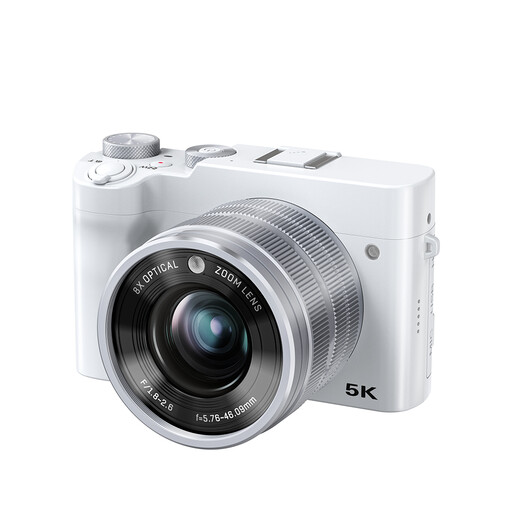 No image available
Use test shots to check whether the images show enough detail for the stationery you want to photograph.
The product title lists a dual lens, 5K, 64 MP and 8× optical zoom.
Not necessarily. If your current camera or smartphone captures enough detail, first try an uncluttered background, controlled lighting and consistent framing. Then compare test shots to work out which camera feature, if any, you’re actually missing.
Mark where the product and tripod go, and check the lighting, framing and focus again at every session. A tripod helps you keep the composition consistent while you move products around; first check that it can be positioned safely in the available space.
No. Check which lens is actually supplied and its maximum magnification. Canon specifies up to 1:2 for the separate RF 35mm F1.8 MACRO IS STM; the separate Nikon, Sony and Fujifilm lenses mentioned are specified for 1:1.
For consumer purchases, statutory guarantees are separate from any manufacturer’s warranty. According to ACM ConsuWijzer, the seller is responsible for providing an appropriate solution if a product is faulty. For online consumer purchases, the Dutch Government says you generally have 14 days to change your mind, although there are exceptions. Don’t assume these consumer rules also apply to business purchases.
Not without considering the rules first: according to the Dutch Data Protection Authority, identifiable people in photos are personal data, and you need a lawful basis under the GDPR to take and publish them for business purposes. For employees, the regulator says that in most cases this means obtaining consent. Keep other people out of shot, or check which lawful basis applies in your situation before taking and publishing photos.