
Vandaag of morgen in huis

Kwaliteit gegarandeerd

Welkomstaanbiedingen ontgrendelen: GRATIS bezorging | Tot 80% korting | Gratis 30 dagen JoyPlus-proefperiode
Download de app
A stand mixer can knead bread dough, mix cake batter and whip cream, so you don’t have to spend ages doing it by hand. However, not every model is suited to the same recipes. A large bowl, high wattage or lots of speed settings doesn’t necessarily tell you much about how it’ll perform day to day.
For home bakers and keen cooks, there are three common pitfalls to watch out for:
Don’t just look at the highest wattage. Check whether the product information gives a rated power and recommends a maximum running time. Cake batter and whipped cream need less power than heavy bread or pizza dough.
A baking stand mixer usually comes with three basic attachments:
When making heavy dough, use a low to medium speed and stick to the maximum quantity in the manual. A stand mixer with a dough hook isn’t automatically suitable for unlimited quantities.
A stand mixer with a bowl of 5 to 6 litres is often a good fit for families and regular baking sessions. Bear in mind the difference between the bowl’s total capacity and the recommended filling capacity.
For example, the Monsga SM100 is listed with a stainless steel bowl that holds up to 6 litres, with a recommended capacity of 5 litres. That’s a more useful guide than simply looking at the number on the box. A very large bowl can actually be less practical for small quantities, as the whisk or beater may not reach the ingredients as effectively.
Also check:
A stand mixer with 8 speeds offers more settings than a model with six, but you’ll notice the difference mainly with recipes that need precise control. A pulse function can be useful for short bursts of mixing.
Stability is just as important. Look for:
A quoted noise level is only useful for comparison if the measurement distance and conditions are the same. Some models list figures of around 68 to 75 dB. Treat these as technical indicators, not a guarantee that the appliance will sound equally quiet in every kitchen.

Why it suits this type of user: The 6-litre bowl, six speeds and three basic attachments make this a straightforward choice for cakes, bread, pizza and pastries.
The product information lists a 450W copper motor, a recommended maximum continuous running time of six minutes and a noise level of 68–72 dB at one metre. Check the manual for guidance on your recipe.
According to the product description: 6L stainless steel bowl, tilting head, dough hook, whisk, beater and four suction cups.

Why it suits this type of user: This model is designed for people who regularly knead, mix and whisk, and want a choice of speed settings.
The product information distinguishes between 1000W peak power and 600W rated power. This gives you a more realistic picture than the highest wattage alone.
According to the product description: 8 speeds, a recommended working capacity of 5 litres, a stainless steel bowl, whisk, beater, dough hook and splash guard.
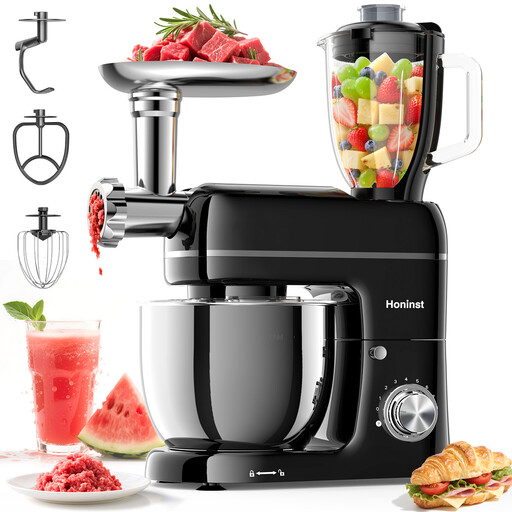
Why it suits this type of user: As well as kneading, mixing and whisking, this model comes with attachments for grinding and blending, according to the product information.
The design combines a tilting head with a safety switch. The product information also lists a pulse function and a maximum motor rating of 1300W; check the manual before using it for heavy tasks over long periods.
According to the product description: 6QT stainless steel bowl, eight speeds plus pulse, meat grinder, blender, dough hook, beater and whisk.

Why it suits this type of user: This isn’t a traditional stand mixer, but a multifunctional food processor for chopping, blending, grating, slicing and grinding, all in a more compact design.
The product information recommends short pulse intervals, blending for a maximum of 60 seconds per cycle and allowing the appliance to cool for two minutes under heavy load. This helps prevent overloading through prolonged use.
750W, 1,8-litre mixing container, stainless steel blades and, according to the product description, removable parts that are dishwasher-safe.
We’ve put together a complete, up-to-date list of products that meet these strict selection criteria and current European safety regulations.
Always place a stand mixer on a flat, stable worktop. Lock the bowl and attachment in place before you start. Switch off the machine and unplug it before changing the whisk, beater or dough hook.
Clean the bowl and attachments straight after use, following the manual. Never immerse the motor unit in water. Also check whether the parts are actually dishwasher-safe; for some models, this applies only to removable attachments, not the motor housing.
Yes, if the model has a dough hook and the manufacturer says it can handle bread or yeast dough. Use a low to medium speed and don’t exceed the maximum dough capacity. A large bowl doesn’t automatically mean the motor can handle any quantity of dough.
For regular family use, 5 to 6 litres is often practical. If you mainly make small batches, a smaller bowl may be easier to work with. Always check the recommended capacity, not just the bowl’s total capacity.
Energy use depends on the power rating and how long you use the appliance. A 1000W machine theoretically uses more energy per hour than a 450W model, but a shorter mixing time can narrow the difference. Use the lowest suitable speed and don’t leave the appliance running unnecessarily.
