
Player practising orbital manoeuvres
Wants to control thrust precisely and check which inputs their simulator supports.


If you already have a suitable stick, a standalone throttle is the obvious choice. If you also need directional control, consider a complete HOTAS set. Choose extra axes and adjustable thrust only if your specific game and platform support those inputs. A headset doesn’t change the controls you need, and none of these devices guarantees more accurate orbital manoeuvres.
Wants to control thrust precisely and check which inputs their simulator supports.
Is looking for a standalone throttle to use alongside their stick, potentially with extra assignable controls.
Needs both directional control and a throttle, and checks whether their game supports those devices.
Start with your current setup: a standalone throttle complements a suitable stick, while a HOTAS set combines both. Then check which axes and functions your simulator can assign.
| What to consider | What to look for | Who this matters most to |
|---|---|---|
| Controlling thrust | Check whether your game supports a throttle axis and whether you need an easily accessible zero position. | If you want to control thrust with a separate input during orbital manoeuvres, make this your priority; around 36% of consumers prioritise precise thrust control. |
| Extra directions of movement | Decide which movements you use and check whether your game can assign those axes. | If you want to control separate movements in addition to the main throttle, focus on assignable extra inputs; around 29% of consumers prioritise this need. |
| Suitability for your setup | Check whether the box includes a stick and whether the device works with your platform and simulator. | If you don’t already have a stick, or want to avoid duplicate equipment, check which components are included; around 21% of consumers prioritise the contents of their setup. |
| Positioning and accessibility | Measure the space on your desk and think about which buttons you’ll want to reach while playing. | If you play with a headset and want the controls within easy reach, positioning matters; around 14% of consumers prioritise their setup. |
A HOTAS set combines a stick and a throttle; a standalone throttle such as the TWCS doesn’t include a stick. So if you already own a stick, a complete set could give you duplicate equipment.
Compare the exact contents of the box with your current setup before choosing a model.
An extra analogue control is only useful for your manoeuvres if the game supports the relevant input and lets you assign it.
Before buying, check the axis and button settings for your simulator and platform.
Offers standalone throttles and complete HOTAS sets. The right option for you depends in part on the stick you already own.
The X56 is a stick-and-throttle set for anyone who also wants to compare options with extra analogue controls.
The CDT-VMAX is a standalone throttle for an existing setup.
The VelocityOne Flightdeck is a PC HOTAS with separate stick and throttle units.
These product picks feature stick or throttle controls. Check that the controls and platform for each model are compatible with your simulator.
 No image available
A flightstick with throttle controls could suit you if you want stick and thrust inputs in one device; check which functions your simulator can assign.
The product name lists USB-C, 8 axes, 27 programmable buttons and an OLED display. The listed platforms are Xbox Series X|S, Xbox One and PC Windows 10/11.
 No image available
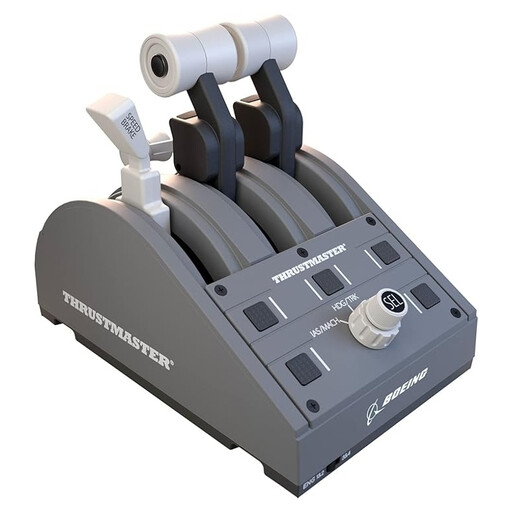
A throttle quadrant is an option if you want separate throttle controls; check that its shape and layout suit your space simulator.
The product name lists USB and support for PC, Xbox, Xbox One X and Xbox Series S. Check compatibility with the specific game you play.
Yes, if you already have suitable directional controls. The TWCS is sold as a standalone throttle; before choosing it, check whether your game supports the axes you want to use.
No. First check which inputs the game supports. The Kerbal Space Program Wiki lists keys for increasing and decreasing thrust, as well as cutting it off immediately, but that doesn’t confirm that every device mentioned will work with every version of the game. Check your simulator’s input settings.
First, assign the throttle axis and, if your game supports it, set up an easily accessible control to cut off thrust. Then test the full travel; you can adjust the friction on a TWCS. This is setup advice, not a promise of more accurate manoeuvring.
No, a headset doesn’t determine which thrust controls you need. If you want to connect your headset to a controller, check the connections on the exact model and your headset; Turtle Beach lists a 3.5 mm jack for the VelocityOne Flightdeck.
According to ACM ConsuWijzer, online purchases generally come with a cooling-off period of up to 14 days after delivery, subject to legal exceptions. Your statutory guarantee is separate from any seller’s or manufacturer’s warranty. If a product is faulty, the seller is responsible for resolving the issue under the applicable conditions.