
Vandaag of morgen in huis

Kwaliteit gegarandeerd

Welkomstaanbiedingen ontgrendelen: GRATIS bezorging | Tot 80% korting | Gratis 30 dagen JoyPlus-proefperiode
Download de app
A stand mixer with bowl can make bread dough, cake batter, whipped cream and sauces much easier to prepare. However, it is not wise to look only at the wattage or the number of accessories. A high motor rating does not automatically indicate how well the machine handles heavy dough. A large bowl can also be inconvenient if you mainly make small portions.
In this buying guide, you’ll learn what to look for, which marketing claims to assess critically and which models suit different households.
Manufacturers sometimes state peak power and sometimes nominal power. These figures are not directly comparable. An electric mixer with a higher peak power rating will not necessarily perform better during prolonged kneading.
Also consider:
When working with heavy yeast dough, taking breaks is important. Honinst, for example, states that heavy dough should not be processed for more than 10 minutes at a time on one of its models, after which the machine must cool down. Aucma states a maximum continuous operating time of 6 minutes for another model. Always check the manual for the model you choose.
A 5-litre stand mixer or 6-litre stand mixer provides room for family-sized portions, but the stated capacity is not the same as the usable dough capacity. A 6-litre bowl should therefore not be filled to the brim.
For small quantities, a large bowl can actually be less practical. If you mainly cook for two people, around 4 litres may be enough. For several loaves, pizzas or large quantities of cake batter, 5 to 7 litres is more suitable.
A multifunctional stand mixer can do more than mix, but not every package contains the same components. Check whether the box actually includes a:
Extra attachments may also be available separately. Check compatibility with the specific model as well.
A stand mixer with stainless steel bowl is generally practical for everyday use, as stainless steel does not retain odours from dough, cream or sauces and is easy to clean. Check the handle, the shape of the bowl and whether you can add ingredients while mixing.
As a guide:
In addition to the bowl capacity, check the maximum dough capacity. The Kenwood Go KZM35, for example, states a capacity of up to 1.4 kg of dough, while the Bosch MUMS2AW00 can process up to 1.7 kg of dough and 2.4 kg of batter, according to the product information.
A stand mixer with 6 to 10 speeds gives you more control than a model with only a few settings. Use a low speed to combine flour and liquid, a medium-high setting for batter and a higher setting for whipped cream or egg whites.
A pulse function is useful for short, powerful bursts. A tilt-head design makes it easier to change the bowl and attachments. Do check that the head locks securely during use.
A mixer for baking should stand firmly on a flat, dry worktop. Non-slip feet or suction cups can help prevent movement, but they are no substitute for a safe set-up. Also look for:
A stated noise level, such as 68 to 72 dB for the Aucma ASM1559, is a technical indication under specific measuring conditions. Do not take the stated level as a guarantee that the machine will be quiet in practice.

Why it suits this profile: This model offers a 5-litre stainless steel bowl, 10 speeds and three essential attachments for cakes, bread, pizza and whipped cream.
The product information lists 400 W, 10 speeds, a pulse function, overheating protection and four suction cups. This means you can assess its performance based on more than wattage alone.
5L stainless steel bowl, tilt head, dough hook, whisk, beater and splash guard.

Why it suits this profile: The 7-litre bowl and 1200 W motor are well suited to households that often prepare larger quantities of batter or dough.
The bowl capacity, motor power and automatic speed control are listed separately. This makes comparisons more meaningful than simply looking at marketing terms.
1200 W, 7L stainless steel bowl, built-in scales and automatic speed control.
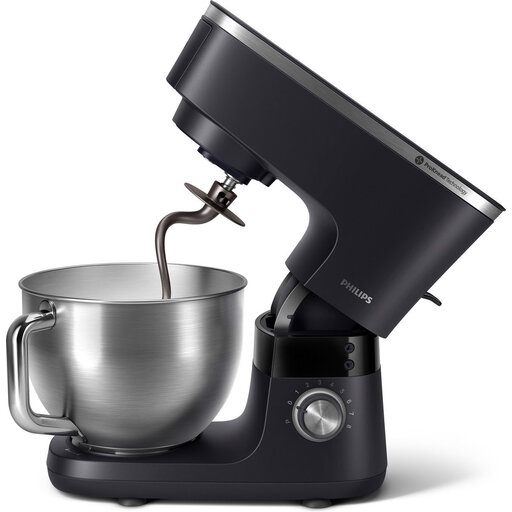
Why it suits this profile: If you want to use a blender and meat grinder as well as a dough mixer, this model combines several functions in one appliance.
The accessories are specified clearly: a 1.5-litre glass blender and a meat grinder. According to the product information, Philips also offers a HomeID app and a timer with automatic shut-off.
1000 W, 8 speeds, 5.5L bowl, blender and meat grinder included.
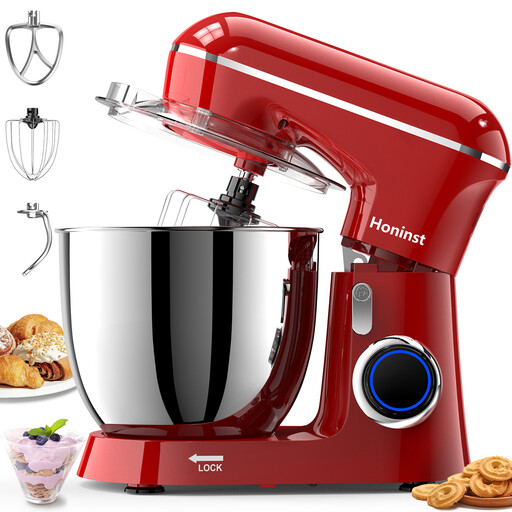
Why it suits this profile: The bowl, with a capacity of approximately 6.2 litres, is designed for larger household portions of bread, cake, pizza and other baked goods.
The product information lists 10 speeds, a splash guard, non-slip suction feet and overheating protection. For heavy dough, make sure you follow the recommended rest periods.
6.5QT stainless steel bowl, 10 speeds, dough hook, whisk and beater.
We’ve put together a complete, up-to-date list of products that fully meet these strict selection criteria and the applicable European safety regulations.
A mixer with dough hook works most evenly when you start at a low speed. Add liquid and dry ingredients gradually, and follow the maximum quantity stated in the manual. For whipped cream or egg whites, use a whisk or beater; for cake batter, the flat beater is usually the best choice.
Unplug the appliance before changing attachments or cleaning it. The motor unit must not be immersed in water. Check which parts are dishwasher-safe for each model. According to the manual, metal or painted attachments may sometimes be better washed by hand.
For an average household, 5 to 5.5 litres is often practical. Choose 6 litres or more if you regularly make large quantities of bread dough, pizza dough or cake batter. Always check the maximum dough capacity, not just the number of litres.
Yes, provided the model has a dough hook and the amount of dough stays within the stated limit. When working with heavy yeast dough, use a low speed and take breaks as recommended in the manual. A mixer with a beater or whisk is also suitable for batter, cream and egg whites.
Consumption depends on the motor power, the selected speed and how long the machine is used. A 1000 W machine does not automatically use 1000 watts continuously; actual consumption varies while mixing. Mixing for shorter periods and processing the correct quantity can help limit unnecessary energy use.
