
Baker making large batches
You’re baking several batches to sell and want to match the batch size to the mixing bowl. Bear in mind that a stated capacity for cake batter doesn’t automatically tell you how much cream you can whip.


Choose a stand mixer based on both the smallest and largest amount of cream you plan to whip at a time, and check that it comes with the right whisk. A larger bowl can be useful if you’re doing more baking, but it doesn’t guarantee that the whisk will reach a small amount of cream. Keep cream cakes safely chilled during storage and sale, too.
You’re baking several batches to sell and want to match the batch size to the mixing bowl. Bear in mind that a stated capacity for cake batter doesn’t automatically tell you how much cream you can whip.
You can work in batches, but want a mixer that takes up little room between baking sessions and when stored away.
You want to whip cream and clean the parts properly, while keeping the finished cakes safely chilled.
Choose a mixer to suit your batch sizes and workspace, and plan how to chill your cakes separately from your choice of appliance.
| Buying consideration | What to look for | Who is this important for? |
|---|---|---|
| Amount per batch | Check the minimum and maximum amount of whipping cream for the exact model. Don’t infer it from the bowl capacity or a stated capacity for cake batter. | If I’m making several batches to sell, I want to know whether the mixer will handle both my smallest and largest batches. Around 36% of consumers prioritise having the right batch size for each round of whipping. |
| Control while whipping | Check which whisk is included and which speed settings the exact model offers. | If you mainly make whipped cream, you’ll want to choose a whisk and controls to suit the recipe. Around 29% of consumers give control over whipping their top priority. |
| Cleaning and chilling | Follow the cleaning instructions for the whisk. You’ll also need to plan how to chill the cakes and monitor their temperature. | If I’m selling cream cakes, I want to clean the parts thoroughly and store the cakes properly. Around 21% of consumers prioritise cleaning and safe storage. |
| Space and other baking | Measure the space available and compare the dimensions and included attachments for the exact model. | If you want to use the mixer for more than just your bake sale, weigh the storage space it needs against attachments for things like cake batter or dough. Around 14% of consumers give space and use for other baking their top priority. |
A large bowl doesn’t prove that the whisk will reach a small amount of cream. Stated capacities for cake batter or dough don’t tell you the minimum or maximum amount of cream you can whip either.
Check the suitable amount of cream for the exact model variant, and take both your smallest and largest planned batches into account.
For larger amounts, you may need to work in several batches.
KitchenAid says that its standard wire whisk with an aluminium hub is not dishwasher-safe. Cleaning instructions can vary between whisks.
Check the part number and follow the cleaning instructions for the whisk that actually comes with your mixer.
A stand mixer won’t chill finished cream cakes. For perishable food sold from home or at markets and events, the NVWA specifies a storage temperature below 7 °C. Follow any lower temperature stated on the packaging.
Plan how you’ll keep the cakes chilled during storage, transport and sale, and monitor the food temperature.
As well as a mixer, you’ll need a way to keep the cakes chilled and check their temperature.
The Go KZM35.000GY is a compact model, while the Chef XL KVL4100S has a larger bowl for more baking.
The MUM58200 is a MUM5 model with a 3.9-litre bowl, designed for a range of baking tasks.
The Artisan 5KSM125EER has a 4.7-litre bowl and comes with a wire whisk, flat beater and dough hook.
This selection includes stand mixers for whipping cream and other baking tasks. Compare the stated bowl size, whisk and usage restrictions for each model.
 No image available
For anyone looking for a stand mixer for whipping cream and other baking tasks.
5.5-litre bowl; 11 speeds; metal construction; 4.5-inch LED touchscreen.
 No image available
For anyone who wants to whip cream and make dough or cake batter.
10 speeds; 600 W; includes dough hook, flat beater, whisk and splash guard.
 No image available
For anyone looking for a mixer for cream and other baking tasks.
6 speeds; includes whisk, dough hook and flat beater. The product description says not to run the mixer continuously for more than 6 minutes.
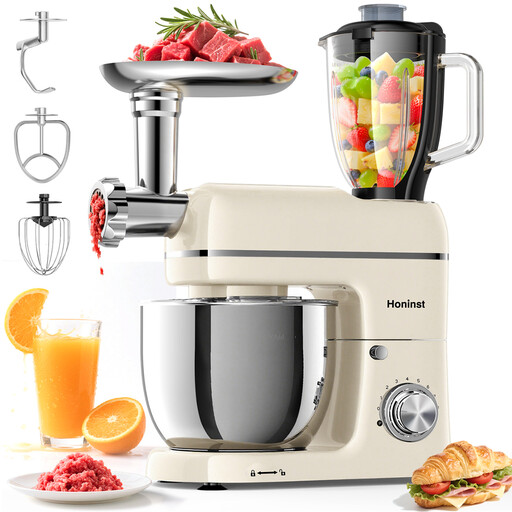 No image available
For anyone looking for a stand mixer with a whisk and extra kitchen functions.
8 speeds; tilt-head design. The title lists a meat grinder, juice blender, dough hook, flat beater and whisk.
 No image available
For anyone looking for a more compact mixer for whipping cream and baking.
4-litre bowl; 30 cm high; 6 speeds; a whisk is listed as an included attachment.
Use the wire whisk or balloon whisk designed for your model. KitchenAid says its wire whisk is suitable for whipping cream. When buying, check which whisk comes with the exact model.
KitchenAid recommends using cold cream and a cold bowl and whisk. This is the manufacturer’s preparation advice, not a guarantee that every quantity will whip well in every mixing bowl.
Yes, if they’re perishable cream cakes. For perishable food in the Dutch selling situations described, the NVWA specifies a storage temperature below 7 °C. Follow the packaging if it specifies a lower temperature. Make sure you have refrigeration and check the food’s temperature.
According to the NVWA, an HACCP food safety plan is required if you prepare and sell food several times a year. Food safety rules also apply to private sellers at markets and events. Don’t assume there’s a general exemption for a one-off sale.
Yes. The NVWA checklist for selling at markets and events says that customers must be told about allergens in unpackaged food. Using a mixer doesn’t replace this separate requirement to provide information.