
Bakers short on worktop space
You want to mix biscuit dough but still be able to put the mixer away between uses. Compare its external dimensions with the space needed to use the bowl.


Start by checking the available width, depth and height. Also make sure you can use and remove the bowl in that space. A compact model may be practical if storage is your main concern; a larger bowl or extra feature matters most if you have the space and will make use of it. Manufacturer figures for other recipes are not a separate performance test using spiced biscuit dough.
You want to mix biscuit dough but still be able to put the mixer away between uses. Compare its external dimensions with the space needed to use the bowl.
You’re looking for a suitable included beater and a capacity that works for your recipe. The bowl’s capacity in litres alone doesn’t tell you how much biscuit dough a mixer can handle.
You want to make larger or successive batches and are weighing usable capacity against the extra space the mixer takes up.
Best suited to: limited worktop or storage space; according to Kenwood, the Kenwood Go KZM35.000GY measures 33.5 × 18 × 30 cm and has a 4-litre bowl.
Keep in mind: the stated 0.5 kg of flour for cake is not a confirmed quantity for every spiced biscuit dough; compare your recipe with the instructions for the specific model.
Best suited to: those with room for the Bosch Serie 2 MUMS2EW01 who want a straightforward set with a beater, whisk and dough hook.
Keep in mind: Bosch lists the dimensions as 266 × 266 × 277 mm and does not specify a built-in scale for this model; also check the clearance around the moving arm.
Best suited to: those who want to weigh ingredients in the bowl may want to compare the Bosch MUM5XW20; the KitchenAid Artisan 5KSM125 is worth considering if you want an included flat beater and the capacity to make larger standard biscuit batches.
Keep in mind: Bosch lists the MUM5XW20 dimensions as 282 × 280 × 271 mm. KitchenAid states a capacity of 108 standard biscuits measuring 5.1 cm for the relevant model group; this won’t necessarily be the capacity for your recipe.
| What to consider | What should you check? | Who is this important for? |
|---|---|---|
| Worktop space and storage | Measure the width, depth and height of the space where you’ll use and store the mixer. Also check there’s room to operate the bowl and arm. | If I’m short on space, I want to know that the mixer won’t just fit, but will also be practical to use. Around 36% of consumers make space and storage their top priority. |
| Beater for your recipe | Check which attachments are included with the exact version and which beater the manufacturer recommends for your type of dough. | If I mainly make biscuit dough, I want an included attachment that suits my recipe. Around 29% of consumers give mixing dough their highest priority. |
| Batch size | Compare the quantity in your recipe with the capacity specified for the model; don’t treat a figure for another type of recipe as a fixed limit. | If I make several batches in a row, I weigh the quantity I need against the space the machine takes up. Around 21% of consumers make batch size their top priority. |
| Cleaning and service | Check the cleaning instructions for each part and see which accessories are included with that version. | If I’m mainly looking for a suitable basic model, I also want to know what’s involved in cleaning it and who to contact if something goes wrong. Around 14% of consumers prioritise cost and maintenance. |
A bowl’s capacity in litres doesn’t tell you how much of your biscuit dough the mixer can handle. Manufacturer figures may be based on different recipes.
Compare the ingredient quantities in your recipe with the instructions for the exact model. Don’t treat a figure for cake or standard biscuits as a proven maximum for spiced biscuit dough.
The external dimensions don’t tell you how much clearance you need to remove the bowl or operate the arm.
Measure the space where you’ll use and store the mixer. Before deciding where to put it, allow room around the bowl, arm and controls.
In the Netherlands, statutory rights are separate from a commercial manufacturer’s warranty and depend on what you could reasonably expect from the product during normal use.
Keep your proof of purchase and contact the seller if an unexpected fault develops. Consider any extended warranty product separately.
The Go range is worth considering if limited worktop width is a key factor in your choice.
The Serie 2 MUMS2EW01 has a more basic set of attachments; the Serie 4 MUM5XW20 we looked at adds weighing in the bowl and a timer.
The Artisan 5KSM125 is worth considering if an included flat beater and the ability to make larger standard biscuit batches are important to you.
This Joybuy selection includes stand mixers with a range of bowl capacities and attachments. Compare the listed version with your recipe and check the available space, especially if the external dimensions aren’t stated in the product name.
 No image available
An option to compare if you’re looking for a 5.5-litre bowl and multiple speed settings; check that the mixer will fit on your worktop before buying.
The product name specifies a 5.5-litre bowl, 11 speeds, a 4.5-inch LED touchscreen and a silver finish.
 No image available
This version is worth comparing if you’re looking for a 5.5-litre bowl; measure the available space before making your choice.
The product name specifies 11 speeds, an LED touchscreen, five preset menus, a 5.5-litre bowl and a Lake Green finish.
 No image available
An option to compare if worktop width is limited; Kenwood lists the external dimensions as 33.5 × 18 × 30 cm.
Kenwood specifies a 4-litre bowl, a K-beater, a whisk and a dough hook. The stated quantity of flour for cake isn’t a confirmed capacity for every type of biscuit dough.
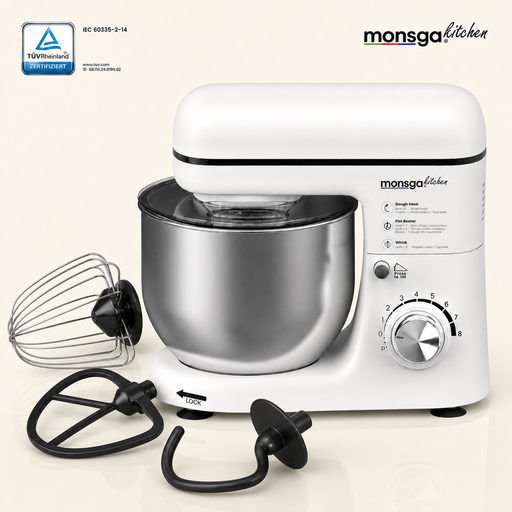 No image available
This version is worth comparing if you want a flat beater for biscuit dough and a 5-litre bowl; check the dimensions to make sure it suits your kitchen.
The product name specifies a 5-litre stainless steel bowl, eight speeds, a dough hook, whisk, beater and splash guard.
 No image available
A 6-litre bowl may be useful if you’re comparing mixers for larger batches; also check that the mixer will fit where you plan to use it.
The product name specifies six speeds, a pulse function and a tilting head, with a dough hook, whisk and beater.
Measure the space where you’ll use and store it in three dimensions. Compare those measurements with the stated external dimensions, and separately check that you can operate the bowl and moving arm there; the external dimensions alone don’t guarantee enough clearance.
KitchenAid recommends the flat beater for biscuit mixtures. For another mixer, check which beater is included with the exact version and follow the model-specific instructions; a dough hook designed for bread dough isn’t automatically suitable for every biscuit recipe.
It depends on the part and the version. Bosch states that the accessories for the MUMS2EW01 are dishwasher-safe; check the instructions for the specific bowl, whisk and beater before cleaning them.
According to ACM ConsuWijzer, online purchases generally come with a statutory cooling-off period of up to 14 days after delivery, subject to applicable exceptions. Statutory rights are separate from any manufacturer’s warranty: if a product doesn’t perform as you could reasonably expect during normal use, the seller is responsible for providing a solution.
The NVWA states that electrical equipment covered by the Commodities Act Decree on Electrical Equipment must carry a CE mark. Low-voltage rules apply, among other things, to equipment with a rated AC voltage of 50 to 1000 V; check which rules apply to a specific version and consult its rating plate and product information.