
Small-cake baker
You mainly make cake batter and want to know whether the beater and bowl are suitable for the batch size you usually prepare.


For small batches of cake, choosing the right beater and a bowl that suits your usual recipe matters more than simply opting for a high wattage or large capacity. Choose a compact model if you need to put the mixer away after each use; a larger bowl is mainly useful if you also make bigger batches. Before buying, check that the exact version carries the CE mark: the Netherlands Food and Consumer Product Safety Authority says this is mandatory for electrical appliances covered by the relevant product regulations.
You mainly make cake batter and want to know whether the beater and bowl are suitable for the batch size you usually prepare.
You share the worktop and need to put the mixer away after use. Its size and ease of handling are therefore important factors in your choice.
You want to know how many parts you’ll need to clean after baking, and what care instructions apply to the bowl and attachments.
Start with the beater and the amount of batter you usually make. Then compare the worktop space required and how easy the individual parts are to clean.
| What to consider | What to look for | Who is this important for? |
|---|---|---|
| Mixing small batches | Check which mixing attachment is included and whether the manual gives guidance for small quantities. | If I make small cakes, I want the beater to suit my usual batch size; around 33% of consumers prioritise mixing small quantities. |
| Storage | Measure the available width, depth and height; also allow space to lift the mixer head and remove the bowl. | When I share the worktop and need to put the mixer away after use, I focus on its dimensions; around 27% of consumers give storage space top priority. |
| Cleaning | Check the cleaning instructions for each part of the exact version; don’t assume all attachments are dishwasher-safe. | If I share the kitchen after baking, I want to know how many parts I’ll need to clean; around 20% of consumers prioritise ease of cleaning. |
| Noise | Look for a review of the exact model under similar conditions; the number of speed settings alone tells you nothing about its noise level. | When other people are using the kitchen or an adjoining room, I want to take noise into account; around 20% of consumers prioritise noise for the benefit of other household members. The Consumers’ Association of the Netherlands includes noise in its kitchen appliance tests. |
A high wattage or large bowl doesn’t automatically mean small batches will be mixed well. The shape of the beater and guidance on smaller quantities matter too.
Start by choosing a beater suited to cake batter, then check the recommended recipe size for the exact version.
According to the Consumers’ Association of the Netherlands, food processor accessories aren’t always dishwasher-safe. Cleaning them incorrectly can damage the parts.
Read the cleaning instructions for every included part in the manual for the model you choose.
For the Kenwood Go KZM35.000RD, Kenwood gives a cake capacity of 1,8 kg, while the Joybuy product page states a maximum of 1,4 kg of batter. These figures aren’t necessarily comparable, as cake capacity and batter quantity may refer to different things.
Compare the full model code and check exactly what each capacity figure refers to.
The Go range is worth considering if you want to put your mixer away after use. The specifications below apply to model KZM35.000RD.
The MUM Serie 2 offers a bowl and several separate mixing attachments to compare. The specifications listed apply to MUMS2EW01.
The Artisan 5KSM175 range is worth comparing if you’re considering extra accessories and a second bowl; check the full model and colour code.
Model SMF04BLEU gives you an idea of the space a stand mixer with a larger bowl and included mixing attachments may need.
These stand mixers are options to compare for making cake batter, with different bowl sizes, attachments and storage requirements. Before buying, check that the exact version carries the mandatory CE mark; the Netherlands Food and Consumer Product Safety Authority explains that this product requirement is not the same as an assessment of an individual listing.
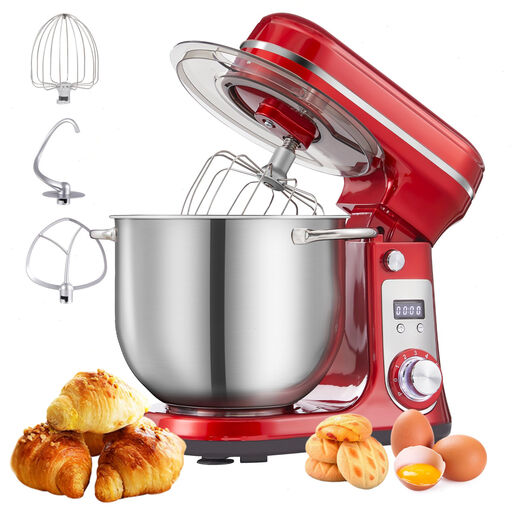 No image available
The 6 L bowl makes this an option to compare if you also make larger batches; for small cakes, check that the attachment suits your recipe.
The product name lists six speed settings and a pulse function.
 No image available
The product description mentions a mixing beater for batter, making this model worth comparing with your cake-making needs.
The description lists a 5 L bowl, a tilt head, a whisk, dough hook, beater and splash guard.
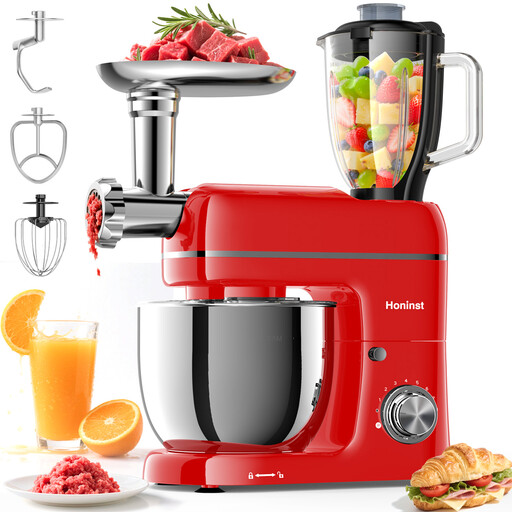 No image available
The flat beater listed makes this model worth comparing for cake batter; with the extra functions, remember to allow storage space for the attachments too.
The product name lists a meat grinder and juice blender; the description mentions a tilt head, safety lock and flat beater.
 No image available
The listed K-beater and 30 cm height make this an option to compare if you want to mix batter and put the mixer away after use.
The product description lists a 4 L bowl, six speed settings, a pulse function and a stowaway cord.
 No image available
The flat beater described makes this model worth comparing for cake batter; check the cleaning instructions for the attachments supplied with your exact version.
The product name lists eight speed settings and a 5.0 L bowl; the description mentions a tilt head, splash guard and dishwasher-safe accessories.
For cake batter made with butter, KitchenAid and Laura’s Bakery describe the flat beater as a suitable choice. For a specific appliance, follow that model’s manual; a whisk is commonly used for cream and egg whites.
Use clean equipment and check whether each attachment can go in the dishwasher. The Consumers’ Association of the Netherlands points out that accessories aren’t always dishwasher-safe; also follow the cleaning instructions for your specific model.
For online purchases from a business, you usually have a 14-day cooling-off period, according to the Dutch government. You’re also entitled to a product that conforms to the contract; there’s no fixed statutory guarantee period in the Netherlands, and the retailer is your point of contact if something goes wrong.
The Netherlands Food and Consumer Product Safety Authority says CE marking is mandatory for electrical appliances covered by the relevant product regulations. Check the marking on the exact version; this legal product requirement doesn’t in itself confirm that an individual listing has been checked.