
Baker making small lunchbox portions
You mainly make small amounts of cake batter and want to know whether the beater will reach and mix all the ingredients. The maximum bowl capacity alone won’t tell you that.


For small lunchbox cakes, don’t choose based on maximum bowl capacity alone. What matters is whether the beater can reach and mix the ingredients in your recipe. If kitchen space is limited, compare the dimensions; extra features are mainly worth considering if you’ll use the mixer for other baking too.
You mainly make small amounts of cake batter and want to know whether the beater will reach and mix all the ingredients. The maximum bowl capacity alone won’t tell you that.
You want to use a stand mixer without taking up more worktop or storage space than necessary.
You want to use the same mixer for larger cakes, whisking or kneading too, so you’re comparing accessories and extra features.
For small lunchbox recipes, the first thing to check is whether the mixer can handle your portion. The space you have, what else you bake and how you use it day to day will help you choose the right model.
| What to consider | What should you look for? | Who is this important for? |
|---|---|---|
| Small portions | Check the beater and any information about small quantities; maximum capacity isn’t the same as the minimum amount it can mix. | I want the beater to mix even a small lunchbox recipe; the maximum capacity alone doesn’t tell me enough. Around 36% of consumers prioritise mixing small portions. |
| Space and lifting | Compare the dimensions with the space where the mixer will sit and be stored. If you’ll move it often, check its weight too. | If I need to put the mixer away after use, I want to know whether that’s practical in my kitchen. Around 29% of consumers prioritise the space available in their kitchen. |
| Other baking | Check which accessories are included with the exact model and whether they’re suitable for the recipes you make. | I want one mixer that can handle larger cakes, whisking and kneading too. Around 21% of consumers prioritise versatile baking. |
| Use and care | Check what’s included in the box, how the manual says to clean the parts and who to contact if something goes wrong. | I want parts that are practical to clean and to know who to contact if something goes wrong, without choosing attachments I won’t use. Around 14% of consumers prioritise maintenance and support. |
A stated maximum capacity for cake batter doesn’t tell you whether the beater will reach and mix a small amount properly.
Compare the amount in your recipe with any guidance on small portions, and check which beater comes with the exact model.
The Consumentenbond describes stand mixers as suitable for tasks such as mixing cake batter, whisking and kneading. Food processors are mainly designed for slicing, grating and chopping.
Start by choosing a mixer for your main task—cake batter—and only look at slicing and chopping features if you need them too.
Extra parts are only useful if you’ll use them. A manufacturer’s warranty is in addition to your statutory rights.
Check what’s in the box and read the terms and conditions. If there’s a fault, contact the retailer about a solution under your statutory warranty rights, as advised by the Rijksoverheid.
The Go KZM35.000GY is worth considering if kitchen space is limited; according to Kenwood, the kMix KMX750BK has a 5-litre bowl.
The MUM5XW20 is worth considering if you want to weigh ingredients in the machine or make larger recipes too.
The Artisan 5KSM125EMH is worth considering if you also want to use the mixer for whisking and kneading.
The Bake Partner QB525838 is an option if you’d like to use other kitchen attachments as well as mixing.
This Joybuy selection includes stand mixers for cake batter and a range of home baking tasks. The NVWA states that electric stand mixers sold in the Netherlands must carry CE marking; check that the specific product is marked before you buy.
 No image available
An option if you want to consider other baking and mixing tasks alongside small cakes.
The product name lists a 5,5-litre bowl and 11 speeds.
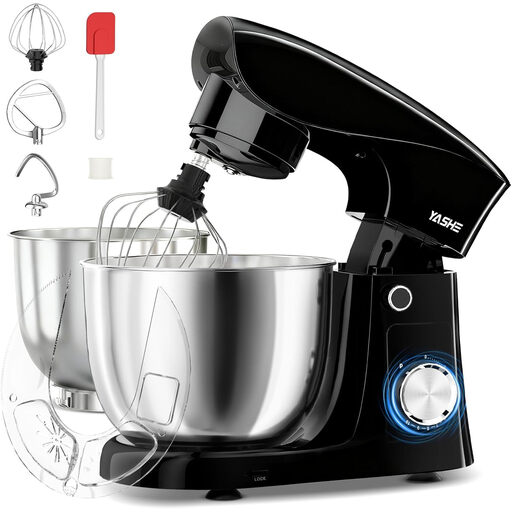 No image available
An option if you want to check whether the included bowls suit the different quantities you make.
The product name lists two bowls and a dough hook.
 No image available
An option to compare if you want one mixer for cake batter and other mixing tasks.
The product name lists 10 speeds, 600 W of power, and a whisk, beater and dough hook.
 No image available
An option if you want to consider whisking and kneading as well as cake batter.
The product name lists 10 speeds, 400 W of power, and a whisk, beater and dough hook.
 No image available
An option if kitchen space is limited and you also want to use the mixer for cake batter.
Kenwood lists dimensions of 33,5 × 18 × 30 cm and a K-beater, whisk and dough hook.
Start with the mixing task and the quantity in your recipe. The Consumentenbond describes stand mixers as suitable for cake batter, but wattage or maximum bowl capacity doesn’t confirm that the mixer can handle a small portion well. Check the beater and the information for the exact model.
Follow your model’s manual for assembly and cleaning. The Voedingscentrum advises against tasting raw cake batter, as raw eggs and flour can contain harmful bacteria. Wash your hands before and after handling raw dough or batter.
The Voedingscentrum advises wrapping plain cake well to stop it drying out. This advice doesn’t automatically apply to cakes with perishable fillings or toppings, for example; assess those ingredients separately.
According to the Rijksoverheid, you should contact the retailer about a solution under your statutory warranty rights. The Netherlands has no fixed statutory warranty period; a manufacturer’s warranty is an extra and doesn’t replace your statutory rights.
Yes. The NVWA states that CE marking is mandatory for electrical products. Before buying, check that the specific product carries the marking.