
Baker with limited worktop space
You want to make savoury scones regularly, but need to be able to put the mixer away after use or operate it under low cupboards.


A mixer is worth considering for savoury scone dough if you use it regularly and have enough room both to use it and store it. Choose one based on your usual batch size, the clearance needed to lift the head and how easily you can stop mixing in time. For the occasional small batch, mixing by hand may be enough.
You want to make savoury scones regularly, but need to be able to put the mixer away after use or operate it under low cupboards.
You want to mix the butter and liquid briefly and stop in time, rather than choosing a mixer based solely on its power for heavy dough.
You want a bowl and attachments that suit your usual scone batch, and possibly other baking too.
A good fit if: you regularly make small batches and have little permanent worktop space. Bosch and KitchenAid publish model dimensions or bowl details; also measure the clearance above the raised head.
The trade-off: a smaller bowl may limit batch size, and the external dimensions don’t tell you how much room you need to raise the head.
A good fit if: you want to prepare other dishes as well as scones; Kenwood lists baking attachments and food processor parts for the Prospero+ KHC29.J0WH.
The trade-off: extra parts take up space and need cleaning, and the contents of the box vary by version.
A good fit if: you only make a small batch of scones occasionally and don’t need a mixer for other tasks; you can rub cold butter into the flour by hand before briefly bringing the dough together.
The trade-off: you do the mixing yourself, but don’t have to store a mixer and its separate parts.
| What to consider | What should you check? | Who is this important for? |
|---|---|---|
| Worktop and cupboard space | Compare the external dimensions with your worktop and measure the clearance needed to raise the head and remove the bowl. | If I have limited worktop space, I want to know whether the mixer will fit and whether I can put it away after use. Around 36% of consumers prioritise space. |
| Control when mixing briefly | Check the speed settings and included attachments; follow your recipe’s mixing order and stop point. | When I make scones, I want to mix the dough briefly and stop as soon as it comes together. Around 29% of consumers prioritise mixing control. |
| Bowl and batch size | Compare the quantity in your recipe with the model-specific capacity information; bowl volume and maximum processing capacity are different measures. | If I make small or varied batches, I want a bowl that suits them, rather than choosing based on a large capacity alone. Around 21% of consumers prioritise batch size. |
| Cleaning and everyday use | Check the cleaning instructions for the exact bowl and attachments, and think about where you’ll store the separate parts. | If I want to tidy up quickly after a small baking session, I consider how easy the parts are to clean and store. Around 14% of consumers prioritise ease of use. |
With scones, the key is to mix briefly and stop in time; the stated motor power alone won’t tell you how the dough will turn out.
Also check the speed settings and recommended attachment, and follow your recipe’s method.
A stand mixer with a tilt head also needs room to lift beneath the cupboards and enough clearance to remove the bowl.
Measure your worktop and check the clearance needed to raise the head on the exact version before choosing a spot.
The Joybuy listing for the Bosch MUMS2AW00 states 1000 W and 5.5 L in the title, while Bosch lists 700 W and a 3.8 L bowl for this model.
Compare the full model code and check the manufacturer’s and seller’s details before deciding whether the version suits your batch sizes.
The MUM Series 2 is one option to compare if you’re looking for a compact model with baking attachments.
The Prospero+ KHC29.J0WH is worth considering if you want to compare extra parts for other food preparation tasks.
The 3.3 L Mini, model 5KSM3311X, is one option to compare if a smaller mixer is your priority.
Compare these stand mixers for home use by bowl capacity, included attachments and the space available. Before buying, also check that the specific electrical appliance on offer carries the required CE marking: the Netherlands Food and Consumer Product Safety Authority says it is mandatory for electrical products.
 No image available
Check the exact version and bowl details before deciding whether this mixer suits the quantity in your recipe.
The Joybuy title states 1000 W and 5.5 L; Bosch lists 700 W and a 3.8 L bowl for the MUMS2AW00. Check which specifications apply to the item on offer.
 No image available
The listed speeds and attachments are worth comparing if you want to adjust the mixing as you follow your recipe.
The product name lists a 5 L bowl, 10 speeds, a pulse function, a dough hook, a whisk and a beater.
 No image available
Compare the bowl with the size of your usual batch and check whether the controls are suitable for brief mixing.
The product name lists a 6 L bowl, 6 speeds, a pulse function, a dough hook, a whisk and a beater.
 No image available
Compare this version with the space you have and the batch sizes you usually make.
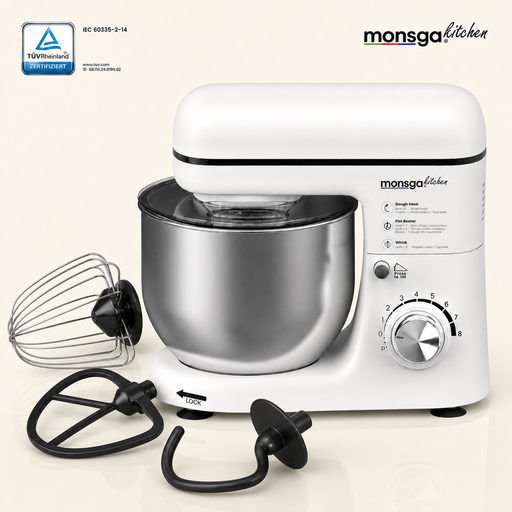 No image available
The stated bowl capacity and attachments can help you compare this version with your recipe and method.
The product name lists a 5.0 L stainless steel bowl, 8 speeds, a whisk, dough hook, beater and splash guard.
Follow your recipe and the mixer’s instructions; there isn’t one attachment that suits every scone-making method. KitchenAid’s scone recipe uses a dough hook on speed 1, while other methods start by briefly mixing cold butter and flour to make crumbs. Stop as soon as the dough just comes together, as directed by your recipe.
As well as measuring the height with the head down, allow room to raise it and remove the bowl. Check the clearance required for the exact version before choosing a permanent spot.
Switch off the appliance and unplug it before removing or cleaning any parts. Follow the cleaning instructions for your specific model’s bowl and attachments; don’t immerse the mixer body in water.
The Netherlands Food and Consumer Product Safety Authority says CE marking is mandatory for electrical products. A model name or product description doesn’t in itself confirm that the specific item on offer carries the marking, so check before buying.
When you buy remotely from a business, you’re generally entitled to a 14-day cooling-off period, according to the Dutch Government. Check the applicable terms and exceptions; purchases from private sellers aren’t automatically covered by the same rules.
No. If there’s a problem with a consumer purchase, the seller is responsible for providing a solution under the legal guarantee. According to the Dutch Government, the Netherlands doesn’t have a fixed two-year statutory guarantee period for all products; what you can expect from a product depends, among other things, on the product and how it’s used.