
Home baker making several batches
Wants to match the amount of scone dough to the bowl and the model’s stated capacity, mixing in several batches if needed. Kenwood and Bosch list different bowl and capacity details for each model variant.


When choosing a mixer for savoury scones, focus on the batch size you want to make each time and the mixing attachment supplied. For scones, it’s more important to mix briefly, just until the dough comes together, than to knead it for a long time. A larger bowl can be handy for bigger batches, but always check the dough capacity specified for the exact model.
Wants to match the amount of scone dough to the bowl and the model’s stated capacity, mixing in several batches if needed. Kenwood and Bosch list different bowl and capacity details for each model variant.
Wants a mixer that’s practical to store when it’s not being used for a family get-together, without overlooking the right mixing attachment. Kenwood lists the dimensions and supplied attachments for the Go KZM35.000RD.
Wants a suitable attachment and a low-speed setting, so mixing can stop as soon as the dough comes together. A scone recipe from KitchenAid Netherlands describes briefly mixing at speed 1 and leaving the dough fairly rough.
| What to consider | What should you check? | Who is this important for? |
|---|---|---|
| Brief mixing and attachment | Check which mixing beater or dough hook comes with the model variant and whether you can select a low speed. | When I make scones, I want to stop as soon as the dough comes together, rather than keep mixing until it’s smooth. Around 36% of consumers prioritise dough texture when making this choice. |
| Batch size per mixing session | Weigh the planned amount and compare it with the capacity stated for the exact model; bowl volume in litres is not the same as dough capacity. | For a family get-together, I want to know whether my planned amount will fit in one go or whether I’ll need to make several batches. Around 29% of consumers focus mainly on batch size per mixing session. |
| Space and ease of use | Compare the dimensions of the model variant with the space where you’ll use or store the mixer, and consider whether any extra features will be useful to you. | If I have limited worktop and storage space, I want to know in advance where I can keep the mixer when I’m not using it. Around 21% of consumers prioritise space and everyday convenience. |
| Accessories and aftercare | Check what’s in the box and compare any additional warranty with your statutory rights against the seller. | I don’t want to buy attachments I won’t use, and I want to know who to contact if the product is faulty. Around 14% of consumers focus mainly on purchase and aftercare costs. |
Bowl volume and the stated maximum dough quantity are different specifications. Bowl size alone doesn’t tell you how much scone dough you can mix at once.
Weigh the planned batch and check the capacity stated for the exact model.
Accessories sold separately aren’t automatically included or compatible with every mixer.
Before buying, check the exact model code, compatibility and what’s included in the box.
The Dutch government distinguishes between statutory rights and additional manufacturer or purchased warranties. If a product is faulty, the seller is your point of contact.
Check what additional cover includes, and contact the seller if the product is faulty.
Kenwood’s Dutch product information includes the compact Go KZM35.000RD and the larger Chef XL KVL4110S.
The MUM5XW20 is an option if you want an integrated scale.
The Artisan 5KSM175PSEFL is worth considering if you’re looking for several mixing attachments and two bowls.
Smeg offers stand mixers and separate accessories, including flat beaters.
This Joybuy selection includes stand mixers and a dough maker. Compare the listed attachments, settings and bowl or dough capacity with your recipe; a larger bowl doesn’t automatically mean the mixer is suitable for a larger batch of scone dough.
 No image available
An option to compare if you’re looking for a 6-litre bowl and several mixing settings for your baking.
The title lists 6 speeds, a pulse function, a mixing beater, dough hook and whisk. The product description states that the appliance should not be used continuously for more than 6 minutes without a rest.
 No image available
Compare this dough maker if you’re looking for a model whose product information specifies a maximum dough quantity.
The product name lists automatic kneading and a maximum dough capacity of 2.5 kg; the product description mentions a manual mode.
 No image available
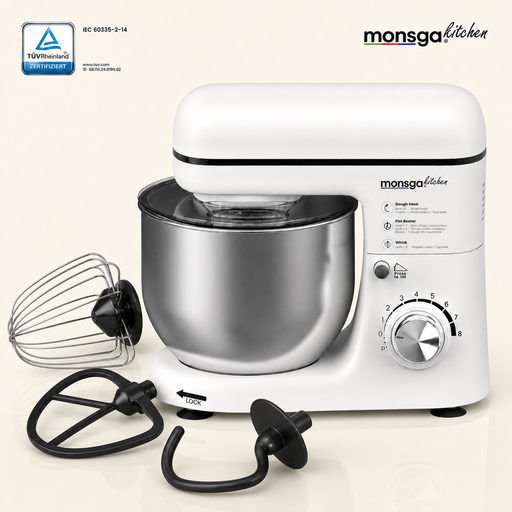
An option to compare if you’re looking for a mixer supplied with both a mixing beater and a dough hook.
The title lists a 5-litre bowl and 8 speeds; the attachments listed are a whisk, dough hook and mixing beater. The title also mentions a splash guard and 1000 W peak power.
 No image available
Compare this model if you’re looking for a mixer with a 5.5-litre bowl and several speed settings.
The product name lists 11 speeds and a 4.5-inch LED touchscreen.
 No image available
An option to compare if you want a choice of different speeds and pre-set programmes when mixing.
The product name lists 11 speeds, 5 pre-set menus and a 5.5-litre bowl.
No, follow the method in your scone recipe. KitchenAid Netherlands recommends briefly mixing at a low speed until the dough just comes together; it can remain rough. The Consumers’ Association describes prolonged kneading as a technique for bread dough.
Not necessarily: the number of batches you’ll need depends on the recipe weight and the amount allowed for the exact model. The stated capacity in litres refers to the bowl, not automatically to the amount of scone dough you can mix in it.
The Netherlands Nutrition Centre recommends keeping your fridge at 4 °C and not leaving food that spoils quickly out of the fridge for more than 2 hours. This is food safety advice, not a mixer specification.
No. According to the Dutch government, statutory rights apply alongside any manufacturer’s warranty, with no fixed statutory warranty period. If a product is faulty, the seller is your point of contact; an additional warranty you buy does not replace those statutory rights.
Not in every case. According to the Dutch government, a 14-day cooling-off period often applies to distance sales; check the relevant terms and exceptions. According to the Dutch government, an online purchase from a private individual does not count as a distance sale in this context.