
Bakers with limited worktop space
You want to set up and use your mixer without the bowl and ingredients taking up all your remaining worktop space. Compare the appliance’s dimensions with the space you’ll need while using it.


Choose a stand mixer that fits on your worktop while leaving enough space to position the bowl and add ingredients. For savoury scone dough, short, controlled mixing matters more than prolonged kneading, so check which beater comes with the model you’re considering. If you only make a batch now and then, you can also make scones by hand and do without an appliance.
You want to set up and use your mixer without the bowl and ingredients taking up all your remaining worktop space. Compare the appliance’s dimensions with the space you’ll need while using it.
You want to mix cold butter with the other ingredients and stop as soon as the dough comes together, rather than kneading it for a long time.
Sometimes you make a small batch, and sometimes a larger one. Compare your recipe with the specifications for the exact model, but don’t assume the bowl capacity tells you what size batch it can mix successfully.
First, measure the space for the appliance and for using it. Then look at the beater and the quantities you usually make; extra attachments may also need storage space.
| What to consider | What to look for | Who this matters to |
|---|---|---|
| Space for setup and use | Measure the space for the appliance and check there’s also room to position the bowl, add ingredients and use the controls. | If I have limited worktop space, I want to know whether I can use the mixer comfortably too. Around 33% of consumers prioritise space. |
| Short, controlled mixing | Check whether a standard beater is included and whether you can stop mixing easily. | I want to mix the dough only as much as the recipe requires, not treat it like bread dough. Around 33% of consumers prioritise control over mixing. |
| Batch size and bowl | Compare the quantity in your usual recipe with the specifications for the exact model; bowl capacity alone doesn’t determine what size batch it can mix well. | If my batch sizes vary, I want a model that suits the quantities I usually make. 20% of consumers prioritise batch size. |
| Use and cleaning | Check which attachments are included, how many items you’ll need to store and what cleaning instructions apply. | I don’t want to have to store or clean more loose parts than necessary after baking. Around 14% of consumers prioritise ease of use and cleaning. |
Rutger Bakt’s savoury scone recipe warns against kneading the dough for too long. The Consumentenbond describes the dough hook as being for kneading bread dough for extended periods.
Follow your recipe and check whether the mixer has a standard beater. Stop as soon as the dough comes together as directed in the recipe.
You also need to be able to use the appliance with the bowl in place, while adding ingredients and operating the controls.
Measure the available worktop space and think about where you’ll store the bowl and loose attachments.
Extra attachments also need storage space when they’re not in use.
For the Kenwood Go KZM35.000GR, the Joybuy product title differs from Kenwood’s model description: the title mentions a food processor and mini chopper, while Kenwood describes the model as a stand mixer.
Before buying, compare the model number, product type, key specifications and included parts on the product page with the manufacturer’s information.
These models illustrate different considerations around size, mixing attachments and extra features. The features listed apply to the specific models, not automatically to the entire brand.
The Go KZM35.000GR is a stand mixer with a K-beater; the Prospero+ KHC29A.H0WH is a model with additional kitchen attachments.
The Serie 2 MUMS2EW00 is worth considering if you’re looking for a patisserie set with several mixing attachments.
The 5KSM3311X is a model-specific point of comparison if you’re considering a mixer with a 3.3-litre bowl.
These Joybuy products are stand mixers suited to mixing dough. Compare the bowl, attachments and controls listed with your recipe and the space you have at home.
 No image available
The product name describes this model as a stand mixer for dough; also measure the space you’ll need for the mixer and bowl.
According to the product name, this model has a 5.5 l bowl, 11 speeds, a metal construction and a 4.5-inch LED touchscreen.
 No image available
This stand mixer is worth comparing if you make dough; check whether the available features suit the way you make your scones.
The product name lists a 5.5 l bowl, 11 speeds and five pre-set programmes.
 No image available
The product name describes a stand mixer for baking; consider how much space the appliance and bowl will take up.
The product name lists a 6 l bowl, six speeds and a tilt head, with a dough hook, whisk and beater.
 No image available
The product name identifies this as a Kenwood Go stand mixer. Measure the available space and check the product page to see which attachments come with this model.
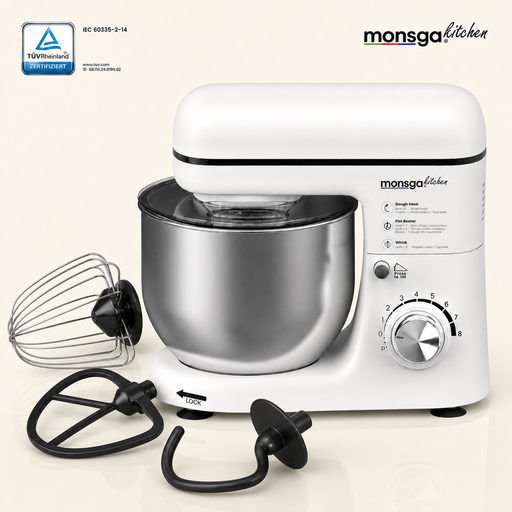 No image available
The product name lists a flat beater, which is worth considering if you’re looking for a mixer for short mixing times.
According to the product name, this model has a 5.0L stainless steel bowl, eight speeds, a flat beater, a whisk and a dough hook.
Follow your recipe and avoid kneading the dough for too long. The recipe we consulted mixes cold butter into crumbs and warns against over-kneading. If you’re using a stand mixer, check which standard beater comes with your model and stop as soon as the dough comes together as directed in the recipe.
Compare the appliance’s dimensions with the available space, and also check that you can position the bowl, add ingredients and use the controls. The listed appliance dimensions don’t necessarily tell you how much space you’ll need while using it.
It depends on the model and the part. Bosch says the MUMS2EW00 attachments are dishwasher-safe; for other models, follow their specific cleaning instructions and don’t assume the motor housing is dishwasher-safe.
No. According to the Dutch government, the Netherlands doesn’t have a fixed statutory warranty period; what you can reasonably expect from a product depends, among other things, on the product and the information you were given with it. Report any fault to the seller. The manufacturer’s warranty is additional.
Yes. The Netherlands Food and Consumer Product Safety Authority states that CE marking is compulsory for electrical products. According to the NVWA, a separate inspection isn’t required for this product group, so CE marking isn’t proof that the product has been independently tested.