
Weekend baker who wants light, airy scones
You want to work in cold butter and savoury ingredients without mixing the dough for too long. The PLUS recipe emphasises that scone dough should be mixed quickly and not over-kneaded.


For a weekend batch of savoury scones, a stand mixer is most worthwhile if you also use it regularly for other baking. Otherwise, a quick mix by hand may be all you need. If you do use a mixer, choose a low speed and an attachment suited to your recipe: KitchenAid recommends a dough hook or flat beater on a low speed for its savoury scone recipe, while PLUS warns that over-kneading can make scones tough. If kitchen space is limited, a compact model may be a better fit. Extra features are most useful when you’ll use them for other baking tasks too.
You want to work in cold butter and savoury ingredients without mixing the dough for too long. The PLUS recipe emphasises that scone dough should be mixed quickly and not over-kneaded.
You want to be able to set the mixer up and put it away without giving up the mixing function you need. Compare its dimensions with both your storage space and the spot where you’ll use it.
You want to use the same machine for things like batters and other doughs too, so check which attachments come with the specific model.
Choose this if: you have limited worktop or storage space and use the mixer regularly.
Bear in mind: a compact design doesn’t mean a mixer will make better scone dough. Check the bowl and included attachments too.
Choose this if: you regularly mix batters or make other doughs as well as scones.
Bear in mind: extra features aren’t necessarily useful for one weekend recipe, and a capacity quoted for yeast dough doesn’t tell you how much scone dough the bowl can hold.
Choose this if: you only bake scones occasionally or do plenty of chopping and slicing too.
Bear in mind: mixing by hand takes effort, while a food processor is most useful if you’ll use it for other kitchen tasks too. You don’t need a stand mixer for occasional scone baking.
| What to consider | What to look for | Who should give this extra thought? |
|---|---|---|
| Short mixing time and dough texture | Check that you can start on a low speed and see which suitable attachment comes with the model. Follow your recipe and stop mixing as soon as the dough comes together. | If I want light, airy scones, I want to mix the butter and ingredients gently and stop at the right time. Around 33% of consumers prioritise a short mixing time and dough texture. |
| Space and positioning | Compare the stated dimensions with your storage space and the room needed to use the bowl and attachment. | In a small kitchen, I want to be able to put the mixer away and still get it out easily when I need it. Around 27% of consumers give space and positioning top priority. |
| Other baking tasks | Check exactly which whisk, beater or dough hook comes with this model, and compare the bowl with the quantities in your usual recipes. | If I also make batters or other doughs, I want attachments suited to those tasks. Around 20% of consumers prioritise versatility. |
| Purchase and maintenance | Think about how often you’ll use the mixer, check the cleaning instructions for the specific model, and see which attachments are included. | If I only make scones occasionally, I want to know whether I’ll use the machine often enough to justify the space it takes up. Around 20% of consumers mainly consider how often they’ll use it and how much maintenance it needs. |
A stated capacity for yeast dough doesn’t tell you how much scone dough the same machine can handle. Scones need only a short mix, so compare the bowl with the quantity in your own recipe.
Check which type of dough the stated capacity refers to, and don’t assume it applies to scones.
A Dutch recipe for savoury scones describes rubbing cold butter in with your fingertips, then mixing quickly. A machine you rarely use will still take up space.
First decide whether you’ll also use the mixer regularly for whipping, batters or other doughs.
A mixer you rarely use will still take up space when stored away.
Check that the title, model code and description all refer to the same appliance. Conflicting information can make it unclear what you’re actually ordering.
Compare the full model code with the product description and check which appliance and parts are included in the offer.
The Kenwood Go KZM35.000GY is worth considering if you’re looking for a compact stand mixer that you can put away when you’re not using it.
The Bosch MUM58720 is an alternative if you want to use your mixer for other mixing and kneading tasks as well as making scones.
The KitchenAid Artisan 5KSM175PS is worth considering if the choice of included mixing attachments is important to you.
These stand mixers are options to compare for mixing savoury scone dough and other baking. The product specifications below are limited to information given in the relevant product listing. According to the Netherlands Food and Consumer Product Safety Authority, CE marking is compulsory for electrical products placed on the market in the Netherlands. Check the marking on the specific item.
 No image available
An option to compare if you’re looking for a stand mixer with multiple speed settings for mixing baking dough.
The product name lists a 5.5-litre bowl and 11 speeds.
 No image available
A stand mixer to compare if you want to make other baked goods as well as scones.
The product name lists a power rating of 1000 W. Check the bowl size and attachments included with the model on offer.
 No image available
An option to compare if you want a stand mixer with multiple speeds and a tilt-head design for different baking tasks.
The product name lists a 6-litre bowl and six speeds. The instructions advise against running the mixer for more than six minutes at a time without a break.
 No image available
A stand mixer to compare if you’re considering a Kenwood Go model for your baking.
Check the dimensions, bowl size and attachments included with the specific model you’re ordering.
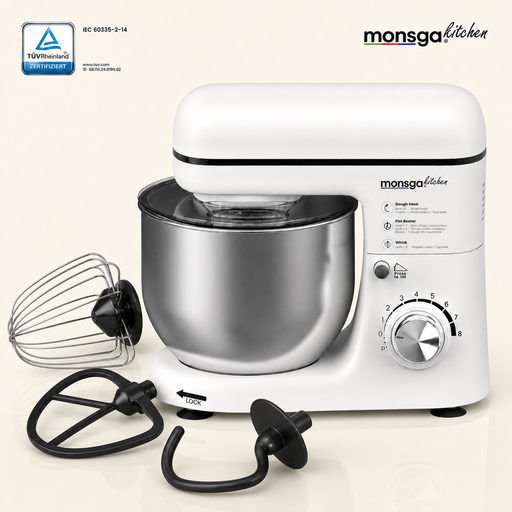 No image available
An option to compare if you’re looking for one mixer for scones and other baking.
The product name lists a 5-litre stainless steel bowl and eight speeds.
No. Mix the dough briefly and stop as soon as it comes together. The PLUS savoury scone recipe warns that over-kneading can make scones tough. In its recipe, KitchenAid uses a dough hook or flat beater on a low speed.
Follow the cleaning instructions for your model and attachment. KitchenAid instructs you to unplug the mixer before cleaning and wipe the machine itself with a soft, damp cloth.
Not automatically. In the Netherlands, you have a statutory guarantee. According to the Dutch Government, the seller must provide a solution if a product is faulty. Check what any extended warranty offers beyond your statutory protection.
According to the Netherlands Food and Consumer Product Safety Authority, CE marking is compulsory for electrical products placed on the market in the Netherlands. Check the marking on the specific item; a brand name alone doesn’t tell you whether that item carries the marking.
For a qualifying distance purchase from a business, the Dutch Government says you generally have 14 days to change your mind. According to its guidance, purchases from private sellers aren’t covered by the distance-selling rules.