What should you look for when buying?
First, choose a suitable beater and a low-speed setting. Then work out how many recipe batches you need and how much space you have in your kitchen.
| What to consider |
What should you look for? |
Who is this most important for? |
| Mixing control and dough texture |
Check whether the version has a suitable beater or dough hook and a low-speed setting; follow the instructions for the exact model. |
If I want my scones to stay light, I need to be able to mix briefly and stop as soon as the dough comes together. Around 36% of consumers give mixing control the highest priority. |
| Batch sizes and bowl capacity |
Work out the ingredients for each recipe batch and consult the manual; don’t use maximum quantities for cake or yeast dough as a guide for scones. |
For a get-together, I want to know whether my recipe will fit in one go or whether I’ll need to make several batches. Around 29% of consumers prioritise the batch size they need. |
| Worktop space and storage |
Measure the storage space and the clearance needed for the mixer head; compare these with the dimensions of the exact version. |
If my kitchen is short on space, I want to be able to put the mixer away easily after use. Around 21% of consumers consider available kitchen space the most important factor. |
| Cleaning and aftercare |
Check the cleaning instructions for each attachment and find out what any optional extended warranty covers. |
If I’m making several batches, I want to know how to clean the bowl and parts I’ve used, and who to contact if something goes wrong. Around 14% of consumers prioritise maintenance and aftercare. |
Stand mixers at Joybuy
These Joybuy stand mixers are worth comparing for their mixing attachments, bowl size and the space you have available.
 No image available
AUCMA Stand Mixer 5L, 10 speeds, black
The beater and adjustable speeds are useful if you want to mix the ingredients briefly.
5-litre bowl; 10 speeds with pulse function; tilt-head. The product name specifies a 400 W motor.
View at Joybuy
 No image available
AUCMA Stand Mixer 6L, 6 speeds, black
The beater and speed settings offer a starting point for brief mixing; check the instructions for the speed and use you’ve chosen.
6-litre bowl; six speeds; tilt-head. The product name specifies a 450 W motor. The product description recommends a break after a maximum of 6 minutes of continuous use.
View at Joybuy
 No image available
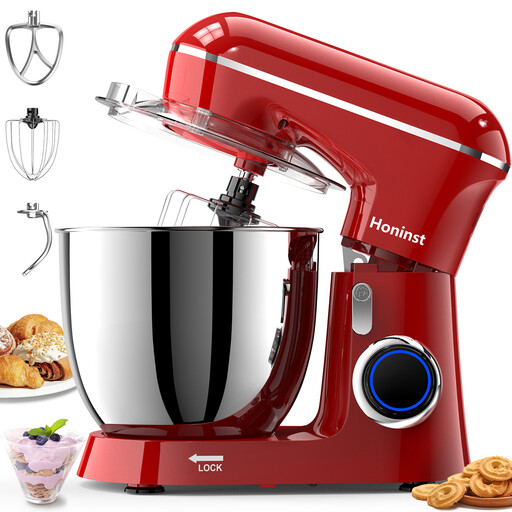
Honinst Stand Mixer 6.5QT, 10 speeds
The beater and speed control are worth comparing if you want to mix briefly.
6.5 QT bowl; 10 speeds; tilt-head; splash guard. The product name also lists a dough hook and whisk.
View at Joybuy
 No image available
Kenwood Chef XL KVL4110, silver
The K-beater is worth considering if you’re looking for an attachment for the short mixing step in a scone recipe.
6.7-litre bowl; the product information also lists a dough hook and the machine’s dimensions. Bowl capacity doesn’t determine how much scone dough you can mix.
View at Joybuy
 No image available
Kenwood Go KZM35, grey
The K-beater and six speeds with pulse function are useful features if you want to mix briefly and adjust the settings.
4-litre bowl; dimensions 33.5 × 18 × 30 cm. Compare the size with your recipe batches and measure the space available.
View at Joybuy
Frequently asked questions
Should I use the dough hook because scones are made from dough?
Not necessarily. A KitchenAid Netherlands recipe for savoury scones allows for a dough hook or flat beater and mixes briefly at a low speed. Follow your chosen recipe and the instructions for your mixer.
Can I convert the stated capacity for cake or yeast dough into a number of scones?
No. Those maximum quantities apply to the types of dough specified and don’t indicate a limit for scones. Work out the ingredients for each batch of your recipe and consult the manual for the exact model; make several batches if needed.
What should I consider when positioning and cleaning the mixer?
Measure not only the space for the machine, but also the clearance needed to raise the head and remove the bowl. Check the cleaning instructions for each included attachment; instructions for the bowl don’t automatically apply to the whisk or beater.
Do I still have rights in the Netherlands after the manufacturer’s warranty expires?
Your statutory guarantee is separate from the manufacturer’s warranty. According to the Government of the Netherlands, there is no fixed statutory warranty period in the Netherlands; what you could reasonably expect from the product and the cause of the problem both matter. If a product is faulty, contact the seller.
Do I have a cooling-off period if I buy a stand mixer online from a business?
According to the Government of the Netherlands, in many cases you have 14 days to change your mind when buying remotely from a business. Check the terms of the specific purchase; buying online from a private individual is different.
Is CE marking required for an electric stand mixer in the Netherlands?
CE marking is required for electrical appliances covered by the relevant rules. The Netherlands Food and Consumer Product Safety Authority describes the applicable low-voltage rules for rated AC voltages of 50–1000 V and DC voltages of 75–1500 V. Check the CE marking and electrical specifications of the specific appliance; CE marking doesn’t indicate how well it mixes scone dough.


