
If you bake scones occasionally
You want to mix a batch carefully for your guests and be able to put the machine away easily afterwards. KitchenAid Netherlands’ scone recipe says to mix the dough briefly, just until it comes together.


Choose a stand mixer that lets you mix the dough gently and stop as soon as it comes together; scones don’t need a long spell of machine kneading. Then match the bowl to your batch size and kitchen space, and only prioritise extra capacity if you’ll use the machine for other baking too. Before buying, check the exact model and the relevant safety and food-contact requirements.
You want to mix a batch carefully for your guests and be able to put the machine away easily afterwards. KitchenAid Netherlands’ scone recipe says to mix the dough briefly, just until it comes together.
You’re comparing the dimensions and the space needed for the bowl and attachments, while keeping in mind the importance of using a suitable mixing attachment. The dimensions Bosch gives for a model can help you compare, but they don’t tell you anything about its mixing performance.
You may also want to use the machine for other batters or doughs. So compare the bowl and the attachments supplied with the specific model.
First, check whether you can control the mixing speed easily. Then compare the batch size, the space available and the attachments you actually need.
| What to consider | What to look for | Who should prioritise this? |
|---|---|---|
| Avoid overmixing | Check that the mixer has a low speed and a suitable mixing attachment; keep an eye on the dough as it mixes. | If you’re making scones for guests, you’ll want to stop as soon as the dough comes together. Around 37% of consumers say gentle, controlled mixing is their top priority. |
| Batch size | Compare your recipe and the number of guests with the bowl capacity; maximum quantities for other doughs don’t indicate scone capacity. | If you’re baking for a group, you’ll want your planned batch to fit in the bowl. Around 27% of consumers say batch size for guests is their top priority. |
| Worktop and storage space | Compare the stated dimensions with the space you have, and allow for the bowl and any separate attachments too. | If space is limited, you’ll want to know where the machine and its parts can go after use. Around 18% of consumers prioritise kitchen space. |
| Other baking tasks | Check which mixing and kneading attachments come with the model, and make sure any separate accessories are compatible. | If you make other batters or doughs as well as scones, you’ll want to know which attachments you can actually use. Around 18% of consumers put versatility first. |
The stated quantity for bread dough doesn’t tell you how much scone dough you can make in a particular mixer.
Compare the amount in your recipe with the bowl capacity, and check the manual for the exact model.
An accessory may be designed for certain models, so it won’t necessarily fit another product range.
Before buying, check the full model number and the attachment’s compatibility information.
According to the Dutch government, your statutory right to a product that works properly may still apply after a commercial warranty has expired.
Check what additional cover a paid warranty offers, and contact the retailer if there’s a problem.
Bosch’s Dutch MUM ranges include both more compact and more spacious models; this doesn’t apply to every Bosch machine.
The Dutch 5KSM125EER is an Artisan model supplied with a bowl and mixing and kneading attachments.
The Dutch kMix KMX750ABK is worth comparing if you want a set that includes a K-beater and dough hook.
These stand mixers have a range of speed settings and attachments to consider when making your choice. Specifications alone don’t prove how a machine will mix your scone dough. Before buying, check the exact model for the required CE marking and the relevant rules for materials that come into contact with food.
 No image available
The six speeds and pulse function give you options for brief mixing. Keep an eye on the dough and follow your recipe’s instructions.
The title lists a 4.5 l stainless steel bowl and a 1300 W motor. The description mentions a dough hook, whisk and beater.
 No image available
The ten speeds and pulse function give you options for controlling the mixing; they don’t guarantee that the dough will come together at the right time without your input.
The product title lists a 5 l bowl, a 400 W motor, a dough hook, a whisk and a beater.
 No image available
The six speeds and pulse function offer different settings; follow your scone recipe and stop as soon as the dough comes together.
The product title lists a 6 l bowl, a 450 W motor, a dough hook, a whisk and a beater. The description advises against using the mixer continuously for more than six minutes without a break.
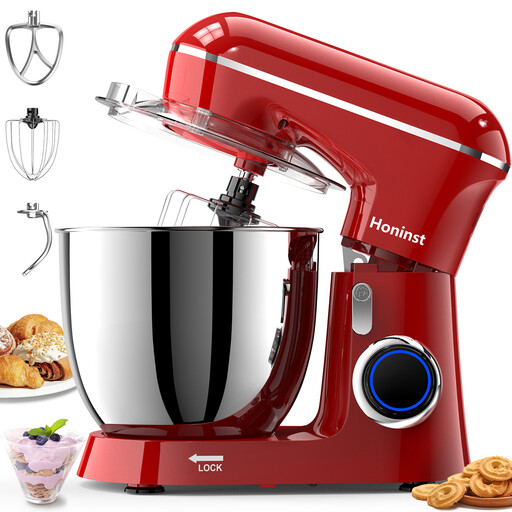 No image available
The ten speeds give you options for controlled mixing; you’ll need to check for yourself when the dough comes together.
The product title mentions a dough hook, whisk and beater. For heavy bread dough, the description specifies a maximum of ten minutes’ continuous use.
 No image available
The six speeds and pulse function are options to consider if you want to control the mixing speed. Check for yourself when the scone dough comes together.
The description lists a 4 l bowl, dimensions of 33.5 × 18 × 30 cm, a K-beater, whisk and dough hook. The maximum dough quantity is 1.4 kg; this isn’t a stated scone capacity.
No. KitchenAid Netherlands’ scone recipe says to mix on a low speed until the dough comes together, then finish working it on the worktop. If you’re following another recipe, use its own instructions.
Switch off the machine and unplug it before adjusting an attachment. Kenwood advises checking the height and clearance from the bowl; follow your model’s instructions to make adjustments.
According to the Dutch government, the retailer must provide a solution if there’s a problem. Your statutory right to a product that works properly may still apply after a manufacturer’s warranty or an extended warranty has expired; check what extra rights a paid warranty offers.
Yes. The Netherlands Food and Consumer Product Safety Authority lists CE marking as compulsory for electrical products and includes kitchen equipment among electrical appliances. The presence of a marking alone doesn’t establish that an individual model meets all applicable requirements.
Yes. EU rules on food-contact materials apply to materials and articles intended to come into contact with food, or where this can be expected during normal or foreseeable use. Check the relevant information for the model you choose.