
Baking a celebration cake in large batches
If you’re making several layers or cakes, compare the weight of your recipe with the stated maximum quantity of cake batter. Bowl capacity in litres alone won’t tell you how much batter you can mix at once.


Choose a stand mixer with a mixing beater or suitable whisk and adjustable speed, then match its capacity to the weight of your recipe. Compare the stated maximum quantity of cake batter with the bowl capacity in litres: these measurements are not interchangeable, and a larger bowl or higher wattage alone does not guarantee better mixing results. The Consumentenbond treats mixing results and specifications as separate considerations.
If you’re making several layers or cakes, compare the weight of your recipe with the stated maximum quantity of cake batter. Bowl capacity in litres alone won’t tell you how much batter you can mix at once.
For red velvet cake batter, a suitable mixing beater or whisk and adjustable speed are important. If you also want to whip cream or make icing, check whether a whisk is included with the exact model variant.
Measure the space where you’ll use and store the mixer, and allow room to remove the bowl. Kenwood lists the Go KZM35.000RD as 30 cm high.
Before choosing a model, compare the amount of batter in your recipe, the mixing attachment you need and the space available. Bosch and Kenwood list both bowl capacity and a maximum quantity of cake batter for specific models; these figures describe different things.
| What to consider | What should you look for? | Who should pay particular attention? |
|---|---|---|
| Controlled mixing | Check whether a mixing beater or suitable whisk is included and whether you can adjust the speed. | I add ingredients in stages and want an attachment suited to cake batter; around 36% of consumers prioritise control over mixing. |
| Party-sized batches | Work out the weight of the batter in your recipe and compare it with the maximum quantity of cake batter for the exact model variant. | I want to know whether I can mix all the layers I’ve planned in one go; around 29% of consumers prioritise the batch size they need. |
| Worktop and storage space | Measure the space available and allow room to operate the mixer and remove the bowl. | I want to be able to put the mixer away after baking, rather than have it permanently taking up worktop space; around 21% of consumers prioritise a suitable size. |
| Attachments and cleaning | Check which parts are included and read the cleaning instructions for each attachment. | I don’t want to find out after baking that an attachment I need is missing or difficult to clean; around 14% of consumers start by looking at accessories and care. |
Litres describe the bowl’s capacity; manufacturers may also state a separate maximum quantity of cake batter. One measurement is not a substitute for the other.
Weigh the full recipe and compare it with the maximum cake batter quantity for the exact model variant.
Higher wattage or more accessories do not, on their own, demonstrate better mixing results. The Consumentenbond assesses mixing results, ease of use and durability as separate factors.
Start with the type of batter you’ll be making, then check which attachment is included and how you can adjust the speed.
Model numbers and specifications can vary between versions, so a similar name alone isn’t enough to establish capacity or which attachments are included.
Before buying, check the full model number and the specifications that matter most for your recipe.
Bosch lists a maximum quantity of cake batter for the MUM58L20. This can be useful if you want to compare a recipe by weight.
The Go KZM35.000RD and kMix KMX750ABK have different stated bowl capacities and maximum quantities of cake batter. Compare the exact model variant with your recipe and the space you have available.
The Artisan 5KSM125EMH is worth considering if you’d like to use a whisk as well as make cake batter.
The Kitchen Chef Plus 6.2L may be worth comparing if bowl capacity and the basic attachments included are your main priorities.
The SMF04BLEU is worth comparing if you’re looking for a bowl with a handle and several included attachments.
These stand mixers are suitable for cake batter and, depending on the model variant, whipping too. Compare the attachments and speed settings listed with the needs of your recipe.
 No image available
The listed flat beater and whisk may be suitable for cake batter and other mixing tasks.
The product description lists a flat beater, whisk and 8 speeds.
 No image available
The mixing beater and adjustable speeds are useful if you want to mix in ingredients in stages.
The product information lists a 5 L bowl, 10 speeds and a pulse function. The stated dimensions are 35.4 × 22.5 × 29.6 cm.
 No image available
The listed beater and whisk are useful if you want to whip ingredients as well as mix them.
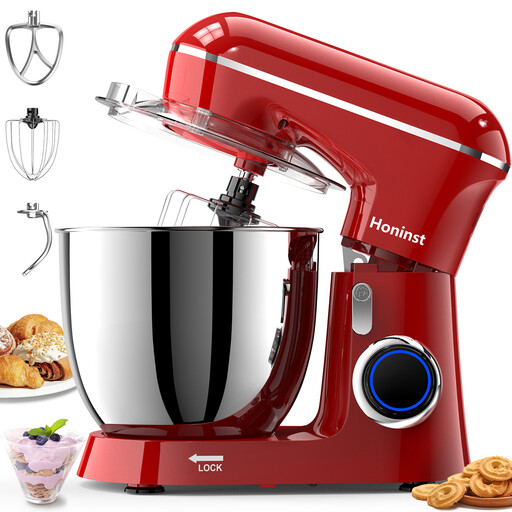
The product information lists a 6.5 QT bowl and 10 speeds.
 No image available
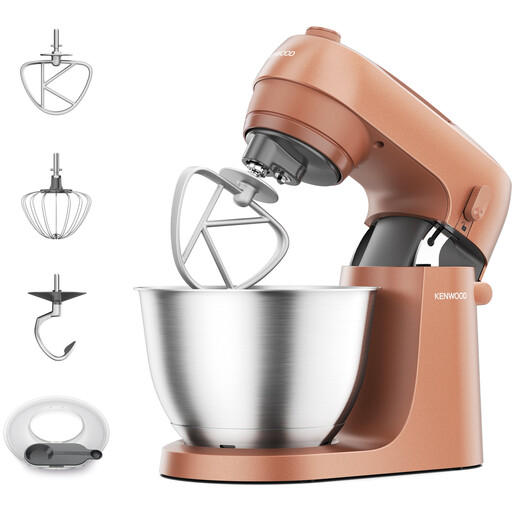
The K-beater is listed for batter; the whisk is useful if you also want to whip cream.
The product description lists a bowl capacity of 6.70 litres, a K-beater, whisk and dough hook. The stated dimensions are 34.50 cm high, 38.50 cm wide and 28 cm long.
 No image available
This model may suit you if you’re looking for a more compact stand mixer for batter and would also like to whip cream.
The product information lists a 4 L bowl, 6 speeds, a pulse function, K-beater and whisk. The stated height is 30 cm.
Choose a mixing beater or whisk that your machine’s manual recommends for cake batter. KitchenAid says its flat beater is suitable for cake batter; the Consumentenbond describes a dough hook as mainly intended for kneading bread dough. The King Arthur Baking recipe adds the flour and buttermilk in batches.
It’s best not to: the Voedingscentrum warns that raw eggs and flour can contain harmful bacteria, and says young children are particularly vulnerable. Wash your hands before and after handling raw batter.
Online purchases from a business generally come with a 14-day cooling-off period. You’re also entitled to a product that meets legal standards; according to the Dutch government, there is no fixed period for the statutory guarantee in the Netherlands, and the seller is your point of contact if a product is faulty. Check the relevant exceptions and terms; any manufacturer’s guarantee is in addition to this.
Electrical kitchen appliances sold in the Netherlands must comply with the relevant European safety rules. According to the Dutch Ondernemersplein, the manufacturer must apply a CE mark after carrying out a conformity assessment and draw up an EU Declaration of Conformity. A statement on a product page alone does not confirm that an individual appliance meets these requirements.