What should you look for when buying?
Start with the dough weight of your own recipe, then check that the mixer and its attachments suit your shared storage space and cleaning routine.
| What to consider |
What should you check? |
Who is this important for? |
| Dough capacity |
Add up the ingredients in your usual recipe and compare the total dough weight with the limit and instructions for the exact model. Also check whether a dough hook is included. |
If I mainly want to know whether my usual recipe will fit in one batch, I look at the stated dough limit. Around 29% of consumers prioritise whether a mixer can handle the amount of pizza dough they make. |
| Storage space |
Measure the available space and compare it with the appliance dimensions; leave room for the bowl and attachments, too. |
If I need to put the mixer away after every baking session, I want to know whether it will fit in my cupboard. Worktop and cupboard space are the main concern for around 23% of consumers. |
| Batch size |
Compare the total weight of your recipe and the number of portions with the manufacturer’s stated capacity. Plan to make smaller batches if a recipe exceeds the model’s limit. |
For a pizza night with friends, I want to make enough dough for several people without exceeding the stated limit. Around 18% of consumers prioritise batches for several people. |
| Cleaning |
Check the cleaning instructions for each bowl and attachment, and whether it is dishwasher-safe; clean food-contact parts between uses. |
If housemates use the mixer for different recipes, I want to be able to clean the food-contact parts according to the right instructions. This is a top priority for around 18% of consumers. |
| Purchase and aftercare |
Check what’s included in the box, whether any extra attachments fit the exact model, and which seller to contact if there’s a problem. |
I want to know whether the included dough hook is enough and who to contact if the mixer develops a fault. Around 12% of consumers focus mainly on the overall cost and how useful the appliance will be after purchase. |
Joybuy products for pizza dough
These stand mixers are options to compare for making pizza dough in a shared kitchen. Before buying, check the applicable requirements for electrical appliances, including CE marking, and the requirements for materials that come into contact with dough.
 No image available
AUCMA stand mixer, 5 litres, 10 speeds
An option to compare if you’re looking for an included dough hook and want to be able to put the mixer away after use.
The product description lists a 5-litre stainless steel bowl, a dough hook, 10 speeds and dimensions of 35,4 × 22,5 × 29,6 cm.
The title lists a 400 W motor; bowl capacity and motor power aren’t a substitute for a stated maximum dough weight.
View at Joybuy
 No image available
AUCMA stand mixer, 6 litres, 6 speeds
An option to compare if you want a tilt-head design and an included dough hook for use on a shared worktop.
The product description lists a 6-litre stainless steel bowl, a dough hook, 6 speeds, a splash guard and non-slip suction feet. The title lists a 450 W motor.
Check the maximum dough weight for your recipe; bowl capacity alone doesn’t tell you this.
View at Joybuy
 No image available
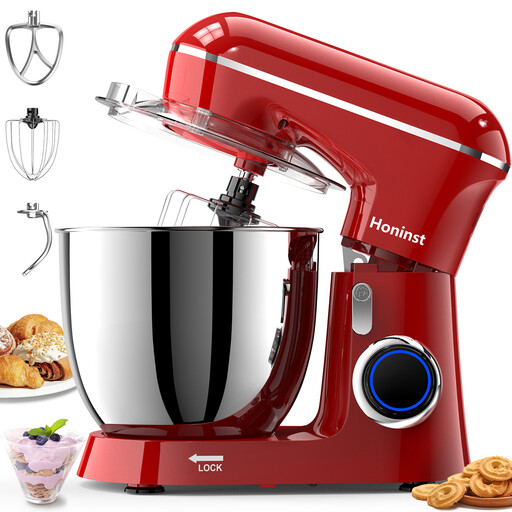
Honinst stand mixer, 6.5 QT, 10 speeds
An option to compare if you’re looking for a tilt-head design, splash guard and included dough hook.
The product description lists a 6.5 QT bowl, 10 speeds and non-slip feet.
For heavy yeast dough, the description specifies a maximum of 10 minutes’ continuous use, followed by at least 15 minutes to cool down; stick to this limit.
View at Joybuy
 No image available
Kenwood Go KZM35, grey
A compact option to compare if you want to put the mixer away after use and usually stay within its stated dough capacity.
The product description lists a 4-litre bowl, a dough hook, a maximum dough weight of 1,4 kg and dimensions of 33,5 × 18 × 30 cm.
A dough batch over 1,4 kg is outside the stated capacity of this version.
View at Joybuy
 No image available
Monsga SM100 stand mixer, 5 litres
An option to compare if dishwasher-safe accessories and an included dough hook are important to you.
The product description lists a recommended bowl capacity of 5 litres, 8 speeds, dishwasher-safe accessories and dimensions of 41 × 25 × 35 cm. The dough hook is described as Teflon-coated.
Check the maximum dough weight for your recipe; a recommended bowl capacity isn’t the same as a stated dough limit.
View at Joybuy
Frequently asked questions
Is a 5-litre bowl suitable for 5 kg of pizza dough?
No. Bowl capacity and dough weight are different specifications. Kenwood lists a 5-litre bowl and a dough capacity of 1,35 kg for the kMix KMX750ABK. Compare the total weight of your recipe with the instructions for the exact model.
What should I clean before someone else uses the mixer?
Unplug the mixer before cleaning and follow the instructions for the model and its attachments. For example, KitchenAid says that its standard wire whisk 5K452WW is not dishwasher-safe. Use clean equipment and clean food-contact parts between uses to help prevent cross-contamination.
Can I use the same speed and kneading time for every pizza dough?
No. Follow the instructions for your mixer and the recipe you’re making. For one published recipe using 500 g flour and 300 ml water, KitchenAid specifies speed 2 for kneading. That speed and timing aren’t a general setting for all mixers or recipes.
Do I still have rights in the Netherlands after the manufacturer’s guarantee has expired?
You may do: according to the Dutch government, the Netherlands has no fixed statutory guarantee period. What you can expect from a product depends on the product and the circumstances. If a product is faulty, contact the seller; a manufacturer’s guarantee doesn’t replace your statutory rights.
Which product requirements apply to a stand mixer in the Netherlands?
Electrical kitchen appliances must meet the applicable requirements for electrical products; the Netherlands Food and Consumer Product Safety Authority states that CE marking is mandatory for electrical products. Materials that come into contact with dough must meet the requirements for food-contact materials. CE marking isn’t proof of kneading performance.


