
Parent making pastry dough in batches
Wants to prepare several portions for the school bake sale and match the recipe size to a suitable capacity for pastry dough.


Start with the attachment and the instructions for your recipe: a whisk is not necessarily suitable for sweet pastry dough. Then compare the quantity of ingredients in each batch with a capacity specified for that type of dough, and measure the space where you plan to keep the machine. A larger bowl alone doesn’t tell you how much pastry dough you can make.
Wants to prepare several portions for the school bake sale and match the recipe size to a suitable capacity for pastry dough.
Needs a machine that can be put away after baking, so considers its external dimensions, not just the bowl capacity.
Wants to mix or whisk ingredients as well as make pastry dough, so takes the included attachments and how they can be used into account.
First choose the attachment for your recipe, then decide how much dough you want to make in each batch, and finally check that the machine suits your kitchen and cleaning routine.
| What to consider | What should you check? | Who is this important for? |
|---|---|---|
| Attachment and control over the dough | Check what is included with the exact version and what mixing instructions the manufacturer gives for your recipe. An included whisk is not the same as a mixing hook. | If I want to make crumbly pastry dough, I want to know which attachment and method are intended for the job. Around 36% of consumers prioritise having the right attachment and control over mixing. |
| Quantity per batch | Weigh the ingredients in your recipe and compare them with a manufacturer’s limit measured on the same basis. Kenwood specifies 0.5 kg of flour for pastry for the Go KZM35.000GY; Bosch states a maximum of 2.4 kg of dough for the MUMS2EW00, but does not specify this as a limit for sweet pastry dough. | If I’m preparing several tarts for a sale, I want to know whether my recipe will fit into one mixing session. Around 29% of consumers prioritise batch size. |
| Worktop and storage space | Measure the cupboard opening and the available space, and leave room to operate the machine. Kenwood lists dimensions of 33.5 × 18 × 30 cm for the Go KZM35.000GY; Bosch lists 266 × 266 × 277 mm for the MUMS2EW00. | If my kitchen has limited storage space, I want to know first whether the machine will fit. Around 21% of consumers make available space their main consideration. |
| Cleaning and maintenance | Check the cleaning instructions for each part and which attachments are included with the version you’re considering. Bosch says the MUMS2EW00 accessories are dishwasher-safe; check the terms for servicing and spare parts for the exact model. | If I want to tidy up quickly after several batches and avoid surprises with replacement parts, I check what’s included and the maintenance information. Around 14% of consumers prioritise cleaning, parts and servicing. |
Litres indicate the volume of the bowl, not the weight of a particular type of dough you can mix. Kenwood’s pastry figure is based on the weight of the flour; Bosch’s general dough quantity is not explicitly a limit for sweet pastry dough.
Compare your recipe with a manufacturer’s figure measured on the same basis. If there isn’t a suitable limit, plan to mix smaller batches.
Dividing a recipe across several batches takes extra mixing time.
KitchenAid lists a mixing hook as included with the Artisan 5KSM125EER and also describes a separate flat pastry beater for cold butter. These are different attachments.
Check the box contents and compatibility against the full model number before ordering an extra attachment.
A specialist attachment may need to be bought separately.
Rules on safe and hygienic food handling also apply when individuals sell food. The NVWA requires anyone who prepares and sells food several times a year to have an HACCP plan; consumers must be told about any allergens present.
Make a note of the ingredients and allergens in each tart, and decide in advance which fillings need to be kept chilled. If necessary, agree the arrangements for the event with the school.
Allergen information, hygiene and chilling also require preparation and may mean you need extra supplies.
The Go KZM35.000GY is worth considering if you want to compare a compact machine with a separately specified flour capacity for pastry.
The MUMS2EW00 is an option to compare if you’re looking for a bowl and a range of included baking and whisking attachments.
The Artisan 5KSM125EER is worth comparing if you also want to mix and whisk other ingredients.
The 220122 is another model to compare if a bowl with the usual mixing, whisking and dough attachments suits your plans.
These Joybuy products are stand mixers for mixing and baking. Compare the listed attachments and bowl details with your own recipe; bowl capacity alone doesn’t determine how much sweet pastry dough you can make in each batch.
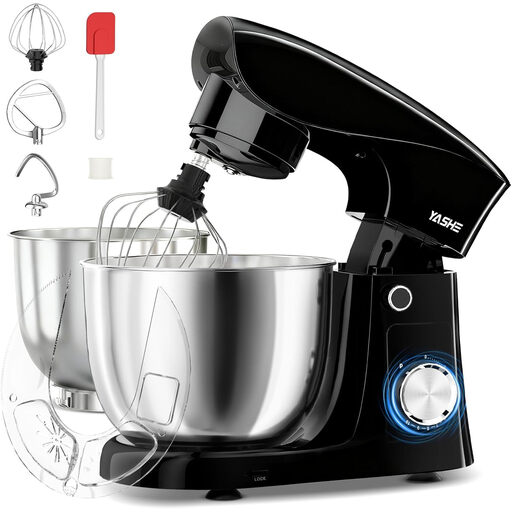 No image available
The two bowls and dough hook listed may be useful if you want to prepare different portions; check the maximum quantity for each bowl against your recipe.
The product name lists two bowls, a tilt-head design and a dough hook.
 No image available
The listed dough hook and mixing beater are worth comparing with the mixing method for your recipe; check the instruction manual too.
The product name lists a 5 l bowl, 10 speeds, 600 W, a dough hook, mixing beater, whisk and splash guard.
 No image available
The listed dough hook and mixing beater may help you compare the included attachments with your recipe; check the recommended use for your dough.
The product name lists a 5 l bowl, 10 speeds, a dough hook, whisk and beater.
 No image available
Its low height may be useful if you want to store the machine away; compare the dimensions with your cupboard and available worktop space.
Kenwood lists a 4 l bowl, a K-beater, dimensions of 33.5 × 18 × 30 cm and a pastry capacity of 0.5 kg of flour. This figure is not the weight of the finished dough.
 No image available
The product name lists a dough hook and flat beater; check the instruction manual for the right method for your pastry dough.
The product name lists a 5 l bowl, 8 speeds, a dough hook, flat beater and whisk.
Check your recipe and the machine’s instruction manual. KitchenAid describes the flat beater as suitable for things such as cookie dough and lists a separate flat pastry beater for cold butter. Don’t assume these attachments are interchangeable.
No. Litres indicate the volume of the bowl, not the weight of the dough. Kenwood lists a separate pastry capacity of 0.5 kg of flour for the Go KZM35.000GY; compare this figure with the ingredients in your recipe and take the total dough weight into account.
Weigh the ingredients in your recipe and compare them with a manufacturer’s figure that applies to the same type of dough and uses the same basis of measurement. Bosch lists a maximum of 2.4 kg of dough for the MUMS2EW00, but doesn’t specify this as a capacity for sweet pastry dough; plan to make several batches if needed.
Follow the cleaning instructions for each part of the exact model. Bosch says the MUMS2EW00 accessories are dishwasher-safe; this information doesn’t automatically apply to the motor unit or attachments of other machines.
Make sure consumers are told about any allergens present. For unpackaged products, the NVWA explains when this information can be provided in writing or verbally. The NVWA says anyone who prepares and sells food several times a year must have an HACCP plan. Keep perishable fillings at the right temperature: the NVWA recommends below 7 °C for these foods, and the Netherlands Nutrition Centre advises setting your fridge to 4 °C.